Is Russia’s changing nuclear doctrine a significant concern – or just another empty threat?
- Written by: Jon Richardson, Visiting Fellow, Centre for European Studies, Australian National University
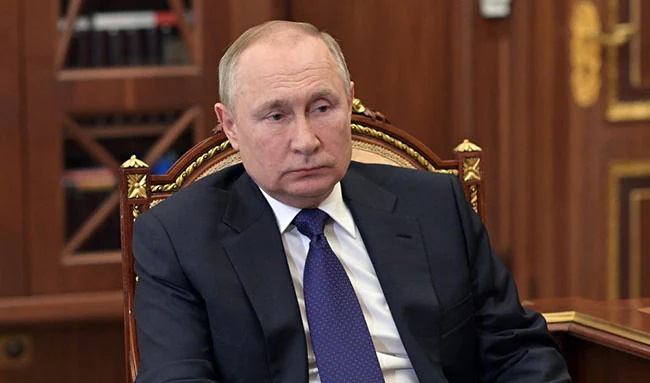
Russia’s announcement this week that it is revising its nuclear weapons doctrine has raised questions about what this means – and whether it marks a significant escalation in its war in Ukraine.
Deputy Foreign Minister Sergei Ryabkov[1] said in an interview the decision to change the nuclear doctrine was “connected with the escalation course of our Western adversaries”.
Russia’s existing nuclear doctrine[2] was set out in a decree by President Vladimir Putin in 2020. It states[3] that Russia may use nuclear weapons in the event of a nuclear attack by an enemy, or if a conventional attack “threatens the existence of the state”.
The document also opens the possibility of launching nuclear weapons if Russia receives warning of an imminent nuclear attack – not just after confirmation that Russian targets had been hit.
It also allows for their use in response to conventional attacks on vital facilities (for example, an early-warning radar system), which could make it difficult to detect and retaliate against a nuclear strike.
Russia’s modification of the doctrine in 2020 was apparently driven by military considerations, including advances in conventional missile systems.
By contrast, the latest signalling of changes to the doctrine would seem to fit more with a pattern of Russian sabre-rattling aimed at discouraging and limiting Western support for Ukraine.
Nuclear sabre-rattling
Nuclear threats are nothing new for the Putin government. One website has listed more than 50 instances[4] of senior Russians making direct or indirect nuclear threats since the full-scale invasion of Ukraine in February 2022.
When he announced his “special military operation” on day one of the invasion, for example, Putin placed Russian nuclear forces on “high combat alert”. He warned[5]:
whoever tries to impede us […] must know that the Russian response will be immediate and lead to consequences you have never seen in history.
Former President Dmitry Medvedev has also aired numerous threats, both vague and specific. Among the actions he has suggested could invite a nuclear response:
Last year, Foreign Minister Sergei Lavrov[6] issued a similar nuclear warning about the Western supply of F-16 fighter jets to Ukraine.
Some Putin associates[7] have even raised the prospect of a nuclear attack against the United Kingdom, or as a warning blow against Ukrainian cities[8], to demonstrate Russia’s seriousness against what it portrays as Western aggression.
These rhetorical blasts have also been accompanied by actions to signal Russia’s seriousness, including holding drills[9] involving its nuclear weapons or stationing[10] tactical nuclear weapons in Belarus.
Most of these Russian “red lines” have already been crossed, however, making Medvedev and the others look like the proverbial boy who cried wolf.
Ukraine’s recent incursion into Russia’s Kursk region, for example, crossed the line of undermining Russia’s territorial integrity, although any Ukrainian advance is hardly likely to “threaten the existence” of the Russian state.
And while Moscow howls publicly that the incursion is a “provocation” or “escalation”, it has itself invaded and occupied nearly one-fifth of Ukraine’s territory as recognised in a bilateral treaty[11], subjecting it to an occupation regime[12] that is hard to describe other than as fascist[13].
Russian bluster has made the West cautious
In his interview, Ryabkov did not elaborate on what changes to the nuclear doctrine might be under consideration. He later told Russian television[14] that NATO’s “disregard for our potential in this area and a belief […] that matters will not come to the worst requires a clearer and more precise statement of what can happen if they continue to ignore [our potential]”.
This echoes the calls of one Russian foreign policy hawk to lower the threshold[15] for using nuclear weapons to “sober up our opponents”.
An updated doctrine might also embrace the idea of “escalating-to-deescalate”, which has been advanced by some Russian military thinkers. The rationale here is that the first use of nuclear weapons could serve to “deescalate” a conventional conflict on terms favourable to Russia.
Russian sabre-rattling has certainly helped inject a high degree of caution into the West’s response, slowing its supply of much-needed arms to Ukraine and restricting Ukrainian forces from using them inside Russia or against certain Russian targets. As The Economist[16] points out, the reasons given by Washington for these restrictions keep shifting and remain unconvincing.
UK strategic expert Laurence Freedman notes[17] that, by taking on a quasi-supervisory role in how weapons are used, the Americans are “caught in a trap of their own making” and seem unsure how to get out of it.
While Russian nuclear threats cannot be completely ignored, it seems unlikely the mooted changes will signal Russian actions any more clearly. The track record of sabre-rattling bluster, muddied with regular disclaimers about having no intention to use nuclear weapons, comes across as a macabre “good cop, bad cop” routine.
The idea Russia would use nuclear weapons against NATO countries merely for supplying Ukraine with arms seems preposterous. More plausible is a strike on Ukraine with tactical nuclear weapons if Russia is pushed out of its occupied territory in Ukraine. But this would surely have disastrous consequences for Russia internationally for marginal military gains.
If Russia does succeed in taking more Ukrainian territory or securing its present occupation, it will give other countries the message that nuclear weapons are the only way to protect themselves against nuclear powers. More nuclear sabre-rattling only reinforces that message.
Ukraine itself handed the Soviet-era nuclear weapons it possessed to Russia in 1994 in exchange for guarantees of security[18] and inviolability of borders, which have obviously proved meaningless.
References
- ^ Sergei Ryabkov (www.reuters.com)
- ^ nuclear doctrine (archive.mid.ru)
- ^ states (www.theguardian.com)
- ^ more than 50 instances (www.independent.co.uk)
- ^ warned (www.en.kremlin.ru)
- ^ Sergei Lavrov (tass.com)
- ^ Putin associates (www.independent.co.uk)
- ^ against Ukrainian cities (www.newsweek.com)
- ^ holding drills (apnews.com)
- ^ stationing (foreignpolicy.com)
- ^ recognised in a bilateral treaty (en.wikipedia.org)
- ^ occupation regime (theconversation.com)
- ^ fascist (johnmenadue.com)
- ^ told Russian television (www.kommersant.ru)
- ^ lower the threshold (eng.globalaffairs.ru)
- ^ The Economist (www.economist.com)
- ^ notes (www.economist.com)
- ^ exchange for guarantees of security (en.wikipedia.org)
Authors: Jon Richardson, Visiting Fellow, Centre for European Studies, Australian National University