In sports-mad Australia, new research suggests physical education can be undervalued at school
- Written by: Casey Peter Mainsbridge, Senior Lecturer in Personal Devlopment, Health and Physical Education, University of New England
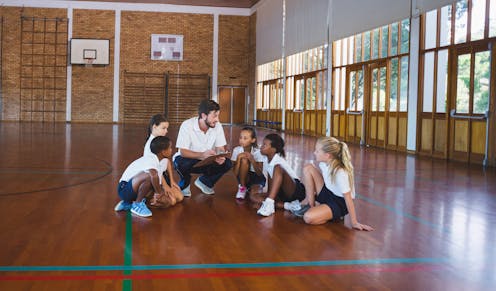
Sport is a significant part of Australian culture and for many represents national pride and social connection[1].
So, it would be fair to assume sport is viewed as central to Australian schools, with physical education (PE) ingrained into the curriculum.
However, increasingly[2], some school students are not provided with opportunities to learn through PE and engage with physical activity regularly.
This is concerning because PE and physical activity can provide benefits in terms of physical fitness, fundamental movement skills[3], mental health, social integration and overall wellbeing.
Because of this, we recently researched what is actually learnt by Australian school students in PE and how things could be improved.
Why is physical education important?
With students spending up to 200 days per year at school, regular PE can contribute to the development of skilled movement and feelings of success and confidence to pursue physical activity.
Broadly, students who enjoy PE are likely to feel positive[4] about being physically active.
Evidence suggests attitudes, beliefs and behaviours learned[5] during the school years, including those relating to physical activity, track into adulthood.
This highlights the importance of PE in shaping healthy habits.
The benefits of physical activity for children are wide-ranging.Some concerning trends
Despite the benefits of physical activity, studies show the levels of physical activity among children and adolescents globally have decreased over the past 25 years[6].
This trend exists in Australia, with decreases[7] in student fundamental movement skill levels and increases in screen time in the past ten years[8].
This trend is demonstrated by Australia receiving a grade of D-[9] on the Global Physical Activity Report card in 2014, 2018, and 2022 – suggesting the future health of Australian children and our status as a “sporting nation” is at risk.
To address this decline, PE teachers and the school community must be leaders in supporting the health and wellbeing of students by emphasising regular participation in physical activity, promoted by quality PE.
What is the current state of PE in Australia?
The Australian school curriculum[10] provides schools, teachers, parents and students with a clear understanding of what students should learn from the first year of school through to Year 10.
The curriculum applies no matter where a student lives or what school system they are in. It includes eight key learning areas, one of which is Health and Physical Education.
This part of the curriculum[11] aims to prepare students to take positive action to protect, enhance and advocate for their own and others’ health, wellbeing, safety and physical activity participation across their lifespan.
In Australia, PE is usually[12] taught by a specialist teacher in secondary schools, although this is not always the case in primary schools.
A lack of teaching expertise, together with other factors – a teacher’s negative experiences from their own schooling, perceived lack of time and interest, low confidence levels to teach the subject – can often lead to less curriculum time being given to PE compared to subjects such as maths, science and English.
Also, some school leaders and teachers[13] view PE as less academically rigorous and less important to the primary mission of education. This is often informed by their own experience of PE in schools, rather than its curricular potential.
Despite Health and Physical Education being an essential key learning area that is compulsory in Australian schools[14], there are sometimes significant challenges for PE teachers to achieve curriculum aims, such as subject marginalisation[15] due to its practical nature, lack of time, lack of resources and facilities, and staff outsourcing.
Our research and next steps
To try to get a better understanding of PE in this country, we recently conducted a systematic review[16] trying to understand what Australian school students learn in PE.
A systematic review is a structured and detailed analysis on a presented topic, with our review analysing 27 studies.
Broadly, we found an absence of research in Australia that explored this issue.
However, our research[17] did identify that teachers and schools should be encouraged and supported to engage in research to measure and evaluate their own teaching practices.
More teacher-engaged research and partnerships between schools and higher education institutions will help to truly understand what students are learning in PE.
There is also a need to recognise the challenges faced by PE teachers and to enable them to help students gain the broad physical and mental health benefits associated with PE.
What could this look like?
For teachers, regular professional development opportunities particularly for primary school teachers, greater consideration for PE curriculum time that is comparable to other subjects, and time to measure and track longitudinally the impact of PE on student learning.
There is also a need for PE to be at the forefront of a national conversation to respond to low levels of child and youth physical activity.
A strong link[18] exists between childrens’ health status and their learning capacity, so placing more value and resources towards PE, physical activity opportunities during the school day, and sport in schools must become an educational priority and prominent part of school culture.
Through PE, schools should be providing young people with opportunities to be physically active now and into their future.
References
- ^ national pride and social connection (theconversation.com)
- ^ increasingly (ro.ecu.edu.au)
- ^ fundamental movement skills (www.act.gov.au)
- ^ likely to feel positive (www.ncbi.nlm.nih.gov)
- ^ attitudes, beliefs and behaviours learned (www.clearinghouseforsport.gov.au)
- ^ have decreased over the past 25 years (www.ncbi.nlm.nih.gov)
- ^ decreases (www.scirp.org)
- ^ increases in screen time in the past ten years (growingupinaustralia.gov.au)
- ^ a grade of D- (www.sciencedirect.com)
- ^ Australian school curriculum (www.australiancurriculum.edu.au)
- ^ This part of the curriculum (www.australiancurriculum.edu.au)
- ^ PE is usually (researchoutput.csu.edu.au)
- ^ school leaders and teachers (journals.sagepub.com)
- ^ compulsory in Australian schools (www.sciencedirect.com)
- ^ subject marginalisation (journals.sagepub.com)
- ^ recently conducted a systematic review (www.tandfonline.com)
- ^ our research (www.tandfonline.com)
- ^ strong link (www.tandfonline.com)
Authors: Casey Peter Mainsbridge, Senior Lecturer in Personal Devlopment, Health and Physical Education, University of New England