do driving apps help people break road rules?
- Written by: Verity Truelove, Senior Research Fellow in Road Safety Research, University of the Sunshine Coast
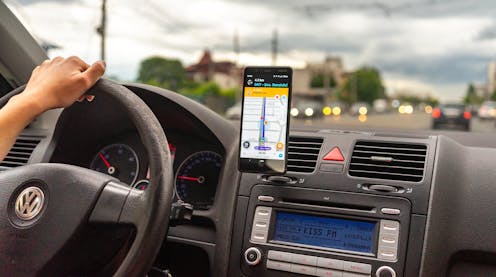
Apps such as Google Maps, Apple Maps and Waze can tell drivers when they are approaching speed cameras or random breath testing stations. Countries such as Germany, France and Switzerland have banned apps from displaying these enforcement locations.
But what effect are these apps having in Australia – are they helping drivers break road rules?
Our new paper[1], published in the journal Safety Science, examined this question.
We found this technology can, in some cases, contribute to people thinking they are invincible on the roads. However, we also found they can sometimes help people drive more safely.
Being made aware of enforcement can help road safety
We conducted focus groups and interviews with a total of 58 drivers from Queensland, to understand how the use of this technology influences perceptions of being caught for breaking road rules.
One driver told us:
If I know it’s coming up, I’ll put my phone down. If I was, say, texting or checking something, but then like once a good few 100 metres away, I sort of pick it up again, depending though.
Another said:
It sort of depends where I am driving, I guess. Like, if I am driving on a country road and there is a speed camera there I would probably slow down for the speed camera and then sort of speed up again once I am sort of past that; it sort of depends on the circumstances.
We also found that, for some people, being made aware of enforcement locations can help drivers better regulate their speed. This helped them comply with road rules more consistently.
Waze also shows the speed limit in the area, which further assisted some drivers to stick to the speed limit. One driver told us:
I’m a bit careful if I just look at the speedo and just double check that I’m on the right amount of speed.
Another said:
It just gives you a warning like, ‘OK, you need to check your speed.’ Just to double-check you’re going on the right speed perhaps or when it’s a camera coming up.

Concerning behaviours
Concerningly, we also found some drivers who use these apps are looking at and touching their screens more than they otherwise would. This can distract drivers and increase their risk of crashing[3].
One driver told us they post traffic updates on the app they use while driving, “which I know is wrong.”
Another said:
Just hit the button on the phone. Just two steps after I go past the camera.
Another driver told us:
It’s so helpful […] Especially if it’s, say, late night and I’m coming home from a party, and I don’t want to end up getting arrested.
One driver said:
I probably feel slightly more invincible, which is probably not a good thing.
When asked why these apps are used, one driver said:
I guess the drug and the drink-driving.
Apps can help and hinder road safety
We know breaking road rules significantly contributes to crashes and road fatalities[4], with deaths on Australian roads continuing to increase[5] over time.
On the one hand, when drivers are aware of enforcement measures like cameras and police, they are more likely to stop breaking the rules in those areas. That’s particularly true for behaviours such as speeding and using a phone while driving, we found.
Using apps that flag where cameras and police are located also means drivers would be more exposed to enforcement activities than they otherwise would be on a normal drive.
On the other hand, our results suggest some drivers are using these applications to break road rules more often in places where they think they won’t be caught.
These apps are also not always completely accurate.
For instance, even though Waze can display some police operation locations such as roadside breath testing, it can’t capture all on-road police activities. Further, camera locations are not always up to date or accurate.
 When drivers are aware of enforcement, they are more likely to stop breaking rules.
UnknownLatitude Images/Shutterstock[6]
When drivers are aware of enforcement, they are more likely to stop breaking rules.
UnknownLatitude Images/Shutterstock[6]
Weighing benefits against risks
While these apps do have some benefits, it’s important to weigh these against the risks.
It’s also important to recognise traffic enforcement isn’t just there to make you comply with road rules at a specific point; it is meant to remind you of the constant risk of being caught and to encourage consistent rule compliance.
The goal is to ensure that drivers are following the traffic rules across the entire network, not just in isolated spots.
With road fatalities at some of the highest rates we’ve seen in recent years[7], we need everyone to work together to stop more preventable deaths and injuries.
References
- ^ paper (www.sciencedirect.com)
- ^ Douglas Cliff/Shutterstock (www.shutterstock.com)
- ^ risk of crashing (www.sciencedirect.com)
- ^ crashes and road fatalities (www.who.int)
- ^ increase (www.bitre.gov.au)
- ^ UnknownLatitude Images/Shutterstock (www.shutterstock.com)
- ^ highest rates we’ve seen in recent years (www.bitre.gov.au)
Authors: Verity Truelove, Senior Research Fellow in Road Safety Research, University of the Sunshine Coast