The Indo-Pacific is an idea more than a region – and it’s pushing politics in a ‘pessimistic and paranoid’ direction
- Written by Nicholas Ross Smith, Senior Research Fellow, National Centre for Research on Europe, University of Canterbury
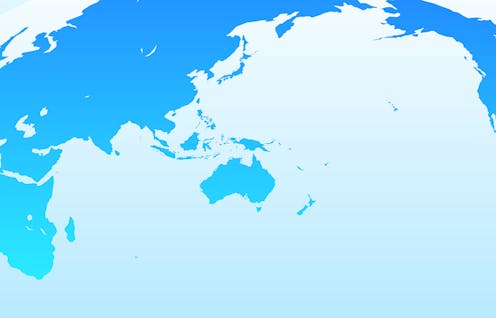
Over the past decade, the idea of an important geopolitical space called the “Indo-Pacific” has become integral to the grand strategising of countries[1] inside and outside this vast geographical area.
The term is not new, however. Australia – one of a few truly Indo-Pacific countries – used it during the 1970s to paint an optimistic vision of a future in which it was interlinked economically and politically with its neighbours in the Indian and Pacific oceans.
However, since Japan (under the leadership of Shinzo Abe) first used the term in 2007 as a way of conceptualising relations with India in the context of “broader Asia”, the Indo-Pacific has evolved significantly.
And with the advent of the AUKUS security pact in 2021, it is now common to refer to the Indo-Pacific as either a region or super-region. But this oversimplifies what is, in fact, a far more complex geopolitical reality.
What is a region?
A region is best thought of as a geographically enclosed complex. According to political scientist David Lake, regions are “so interrelated in terms of their security that actions by any one member, and significant security-related developments inside any member, have a major impact on others”.
The problem with thinking of the Indo-Pacific as a region or super-region is that at its widest definition – stretching from the east coast of Africa to the west coast of South America – it comprises more than half the geographic space of the surface of the Earth.
Simply put, the Indo-Pacific is too large to meaningfully conceive of as a region or even a super-region.
Furthermore, although many states have adopted an Indo-Pacific outlook in their strategising, they typically (save for greater powers) still think of their national security in a strict regional sense.
So, the Indo-Pacific as a geopolitical space looks vastly different in Washington DC than it does in Jakarta, Wellington, Tokyo or Manila (to choose but a few).
This is not to say the Indo-Pacific concept should be ignored. It represents an important development in international security. The fact is it has experienced the greatest geopolitical shift over the past decade or so – and this is likely to continue for the foreseeable future.
The China factor
If not a region or super-region, then, what is the Indo-Pacific?
It is perhaps better thought of in terms of what international relations experts Barry Buzan and Ole Waever call “macrosecuritisation[2]”: the identification of an “existential threat” to something deemed precious and worth protecting which demands an immediate and, if necessary, extraordinary collective response to protect it.
This was given a major boost in 2017 when the United States – still by far the most powerful global actor – formally adopted the Indo-Pacific concept at the centre of its strategic thinking.
In the process, it identified China as a clear strategic competitor. This decision had immediate real-world implications.
Firstly, it helped resuscitate the Quadrilateral Security Dialogue (Quad[3]) involving the US, Australia, India and Japan after nearly a decade of impasse.
Secondly, after Joe Biden ran for president on an “America must lead again” foreign policy platform, it led to the formation of AUKUS in 2021 and the launch of the Indo-Pacific Economic Framework for Prosperity[4] in 2022.
Geopolitical complexity
Importantly, not only the US is involved in this macrosecuritisation. Australia, India, Japan and, more recently, the United Kingdom and European Union (and particular member states, such as France) are all involved.
Together they are pushing an Indo-Pacific concept that is built on the identification of the rules-based international order as being under existential threat due to China’s rise and perceived assertiveness.
The framing of China as a “threat” rather than an “opportunity” – which dominated the previous “Asia-Pacific” construct – means a radically different perspective in the countries adopting Indo-Pacific outlooks.
This clearly matters greatly to regional geopolitics. But it still does not mean the Indo-Pacific has to be seen as a region or super-region.
Rather, the concept is distorting the geopolitics of different regions – especially East Asia, South-east Asia, South Asia and the South Pacific.
These remain genuine regions with their own unique security dynamics. But the Indo-Pacific idea is enveloping them and shifting the dynamics in a more pessimistic and paranoid direction.
A ‘New Cold War’
There is now a concerning habit of treating the Indo-Pacific as a coherent unitary geopolitical space rather than a constellation of different regions.
This lends credence to the simplistic analogy of the Indo-Pacific becoming the ground zero of a “New Cold War”. And it ignores the perspectives of the smaller countries that find themselves being sucked into this growing contest.
Seeing the Indo-Pacific for what it really is – not a natural geographical phenomenon but a construct – is an important step towards developing more coherent and nuanced policies that adequately capture the geopolitical complexity of the Indo-Pacific constellation.
But this runs contrary to the macrosecuritisation process already in place.
There are many reasons[5] why the current situation in the Indo-Pacific is nothing like the original Cold War. But the securitisation process is simplifying the geopolitics, at least in perception, into something reminiscent of it. The ramifications could be devastating.
References
- ^ grand strategising of countries (www.economist.com)
- ^ macrosecuritisation (www.proquest.com)
- ^ Quad (www.cfr.org)
- ^ Indo-Pacific Economic Framework for Prosperity (ustr.gov)
- ^ many reasons (www.scmp.com)
Authors: Nicholas Ross Smith, Senior Research Fellow, National Centre for Research on Europe, University of Canterbury