Yes, Trump can rename the Gulf of Mexico – just not for everyone. Here’s how it works
- Written by: Clive Schofield, Professor, Australian National Centre for Ocean Resources and Security (ANCORS), University of Wollongong
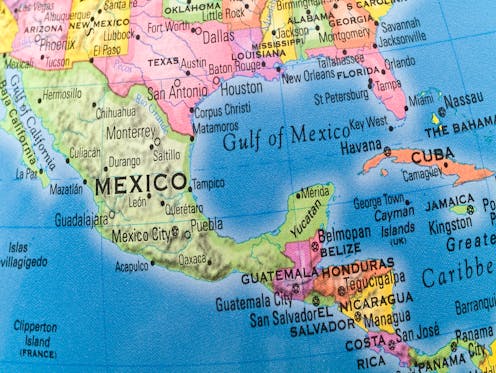
Among the blizzard of executive orders issued by Donald Trump on his first day back in the Oval Office was one titled Restoring Names that Honor American Greatness[1]. It unilaterally renamed “the area formerly known as the Gulf of Mexico” as the “Gulf of America”.
The order was justified by this maritime space having long been an “integral asset” to the United States, with its “bountiful geology” yielding around 14% of US crude oil production, “vibrant American fisheries”, and it being “a favourite destination of American tourism”.
The gulf was also characterised as “an indelible part of America” that would continue to play “a pivotal role in shaping America’s future and the global economy”.
But while it’s undoubtedly important to the US, this part of the Atlantic Ocean washes against other countries, too. So, can the president really rename it? Sure! At least as far as the US is concerned, anyway.
Naming rights
The relevant federal body is the Board on Geographic Names[2] (BGN), established in 1890 with the mission to maintain uniform geographic name usage.
Specifically, Trump’s executive order instructs the secretary of the interior to take “all appropriate actions” to change the name to the Gulf of America, ensure all federal references reflect the renaming, and update the Geographic Names Information System[3].
The BGN has usually been reluctant to change generally accepted geographic names. However, the executive order clearly signals that the composition of the board may change in order to ensure the proposed renaming happens.
But whatever the US decides to call the gulf, it doesn’t mean other countries will pay any heed. Indeed, Mexico’s President Claudia Sheinbaum Pardo promptly suggested the US might itself be renamed Mexican America[4].
She was referring to a 17th-century map showing that name for much of the area that now makes up the US, and asserted Mexico and the rest of the world would continue to use the name Gulf of Mexico[5].
Disputed histories
The International Hydrographic Organization[7] (IHO) publishes a volume called Limits of Oceans and Seas[8], covering the names of seas and oceans around the world, including the “Gulf of Mexico”.
But the study is explicit that these limits “have no political significance whatsoever” and are “solely for the convenience” of hydrographic offices preparing information for mariners.
It has not been published since 1953 – precisely because of a dispute over the geographic name of the body of water between Japan and Korea. Japan prefers to call it the Sea of Japan (as most know it) but South Korea has long campaigned[9] for it to be named the East Sea or East Sea/Sea of Japan.
A revised edition of the IHO volume was submitted to member states in 2002 but dealt with the issue by omitting coverage of the East Sea/Sea of Japan. It remains a working document only.
The issue is taken so seriously by South Korea that an ambassador-level position was created to deal with it, and a Society for the East Sea[10] was established 30 years ago.
That this deadlock has prevented a new edition of an IHO publication for more than 70 years shows not only the difficulty of changing generally well-recognised geographic names, but also the importance countries place on these matters.
Dangerous ground
Place names – known as toponyms – are sensitive because they show that any country changing a name has the right to do so, which implies sovereignty and possession. Names therefore carry historical and emotional significance and are readily politicised.
This is particularly true where past conflicts with unresolved legacies and current geopolitical rivalries are in play. For example, the Sea of Japan/East Sea dispute goes back to Japan’s 1905 annexation of Korea and subsequent 40-year colonial rule.
Similarly, the disputed sovereignty of the Falkland Islands/Las Malvinas, over which Britain and Argentina went to war in 1982, remains a perennial source of diplomatic dispute.
But the South China Sea case is hard to beat. All or parts of this body of water are simultaneously referred to as the South Sea (Nan Hai) by China, the West Philippines Sea by the Philippines, the North Natuna Sea by Indonesia, and (another) East Sea (Biển Đông) by Vietnam.
To further complicate things in that same area, what in English are generally known as the Spratly Islands are known in Chinese as the Nánshā Qúndǎo, the Kepulauan Spratly in Malay, and in Vietnamese as the Trường Sa.
All the individual islands, rocks and cays in this highly disputed zone also carry names, individually or collectively, in multiple languages. Even the names of entirely and permanently submerged features[11] have proved controversial. Early British Admiralty cartographers were arguably most accurate in naming the area simply “Dangerous Ground”.
Political gulfs
Globally, there have been moves to replace colonial references with original indigenous names, something very familiar to Australians and New Zealanders.
In the same executive order renaming the Gulf of Mexico, Trump also changed the name of the highest peak in North America (in Alaska) from Denali back to Mount McKinley (named after the 25th president, William McKinley, in 1917).
This simultaneously attacked the legacy of former president Barack Obama, who renamed the peak Denali in 2015, and spoke to Trump’s war on perceived “woke” politics.
That said, the change was tempered by the fact the national park area surrounding the mountain will retain the name Denali National Park and Preserve.
Ultimately, Trump can rebadge the Gulf of Mexico as the Gulf of America, but only from a strictly US perspective. It is unlikely to matter much to the rest of the world, save for those wishing to curry favour with the new administration.
Most of the world will likely continue to refer to the Gulf of Mexico. And the Gulf of America may yet be consigned to history in four years’ time.
References
- ^ Restoring Names that Honor American Greatness (www.whitehouse.gov)
- ^ Board on Geographic Names (www.usgs.gov)
- ^ Geographic Names Information System (www.usgs.gov)
- ^ Mexican America (www.usatoday.com)
- ^ continue to use the name Gulf of Mexico (www.nbcnewyork.com)
- ^ AAP (photos.aap.com.au)
- ^ International Hydrographic Organization (iho.int)
- ^ Limits of Oceans and Seas (iho.int)
- ^ long campaigned (english.hani.co.kr)
- ^ Society for the East Sea (www.eastsea1994.org)
- ^ submerged features (maritime-executive.com)
- ^ AAP (photos.aap.com.au)
Authors: Clive Schofield, Professor, Australian National Centre for Ocean Resources and Security (ANCORS), University of Wollongong