Australia spends $714 per person on roads every year – but just 90 cents goes to walking, wheeling and cycling
- Written by: Matthew Mclaughlin, Adjunct Research Fellow, The University of Western Australia
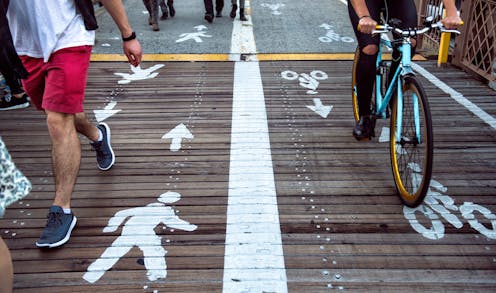
What could you buy for 90 cents? Not much – perhaps a banana.
Unfortunately, that’s how much the Australian government has invested[1] per person annually on walking, wheeling and cycling over the past 20 years.
How would Australians’ lives change if that figure rose?
Read more: What makes a city great for running and how can we promote 'runnability' in urban design?[2]
The state of play here and overseas
From 2008–2028, the federal government spent $384 million on the following active transport investments:
All up, about $714[3] per person is spent annually on roads; 90 cents out of this $714 is just pocket change.
Even if you don’t want to walk, wheel or ride, you should care because less driving helps everyone, including other drivers, who benefit from reduced traffic.
As a result of this over-investment in car road-building, Australia has the smallest number of[4] walking trips of 15 comparable countries across Western Europe and North America.
Cycling rates[5] are equally dismal.
Globally, the United Nations recommends[6] nations spend 20% of their transport budgets on walking and cycling infrastructure.
Countries like France[7], Scotland[8], the Netherlands, Denmark, Sweden and the largest cities in China invest between 10% and 20%.
These places were not always[9] known for walking and cycling – it took sustained redirecting of investment from roads to walking and cycling.
Meanwhile, many Australians are dependent[10] on cars because they have no other choice in terms of transport options.
Why spend more on walking and cycling?
Road use is inherently dangerous – in Australia last year, more than 1,300 people died on our roads[11], which is more than 25 people a week.
Owning a car can also be expensive, which is especially concerning for those struggling with the cost-of-living.
The typical Australian household spends 17%[12] of its income on transport – with car ownership making up 92.5% of that figure, compared to 7.5% on public transport.
Many Australians feel[13] forced[14] to own a car to get around, so investing in paths and public transport provides people the freedom to get around how they choose.
Congestion is getting worse[15] in most major cities and we can’t build[16] our way out of it with more or wider[17] roads.
About two-thirds[18] of car journeys in our cities could be walked, wheeled or cycled in 15 minutes or less, but these short car trips clog up our roads with traffic.
A major source[19] of all emissions in Australia are from driving.
If more people felt safe to walk, cycle or take public transport, it would reduce[20] this major emissions source.
There is a strong rationale and economic argument, too. The NSW government has estimated every kilometre walked benefits[21] the national economy by $6.30[22], while every kilometre cycled benefits the economy by $4.10[23].
This means that by simply walking 500 metres to the local shops and back, you’re saving the economy about $6, while riding five kilometres to work and back saves a whopping $41 for the economy.
But where could we get this funding from?
Redirecting funding from the current road budget makes the most sense, because getting more people walking, wheeling and cycling eases pressure on the transport system (think of school holiday traffic).
This is a popular proposition. One study found two-thirds of Australians supported the redirection of funding from roads to walking and cycling infrastructure[24]. Another found many Australians support building more walking and cycling paths[25] where they live.
This is not a partisan issue: all Australians in all communities would benefit, including drivers who would face less traffic and enjoy more parking availability.
Unfortunately, false solutions[26] to our unwalkable and un-cycleable communities continue to derail our focus on fixing the root cause of our problems. For example, telling people to ride to work, while not providing them a safe place to do so, doesn’t make sense.
What could $15 per person get us?
Investing $15 per Australian per year would create a better built environment to walk, wheel or ride and deliver significant economic, social and environmental benefits[27].
If this was matched with 50:50 funding from state and territory governments (which often happens with transport projects) over a ten-year period, this investment would deliver the four national projects already shortlisted on Infrastructure Australia’s infrastructure priority list[28] for our largest capital cities: Sydney[29], Melbourne[30], Perth[31], Brisbane[32].
It could also fund up to 15 regional cities to build comprehensive networks. Wagga Wagga[33] for example, is about to finish building a 56 kilometre network of walking and cycling paths. As a result, those using the network are 3.7 times[34] more likely to meet physical activity guidelines than those who don’t.
Such an investment could also fund supporting initiatives, such as electric bike subsidies which have proven extremely popular in both Queensland[35] and Tasmania[36].
What could $10 or $5 per person get us?
The Australian government could invest less than $15 per person – at $5 or $10 per year, the key projects outlined in Infrastructure Australia’s infrastructure priority list could still be targeted, but those would just take proportionally longer because there is less money.
Or, instead of investing in the four capital cities on the infrastructure priority list, it could invest in two.
A different approach could be to spend $5 or $10 to fund infrastructure for regional towns, but this wouldn’t help the problems in our capital cities.
When it comes to transport, the saying goes “we get what we build” – so if we build more roads, we get more people driving. If we build paths, we get more people walking and cycling short journeys and our roads are less congested.
We need bold solutions, and $15 should not be seen as an extravagance.
Acknowledgement: We would like to thank Sara Stace, President of Better Streets Australia, for her expertise in discussions regarding this article.
References
- ^ invested (docs.google.com)
- ^ What makes a city great for running and how can we promote 'runnability' in urban design? (theconversation.com)
- ^ $714 (federalfinancialrelations.gov.au)
- ^ smallest number of (www.mdpi.com)
- ^ rates (theconversation.com)
- ^ the United Nations recommends (news.un.org)
- ^ France (urban-mobility-observatory.transport.ec.europa.eu)
- ^ Scotland (www.transport.gov.scot)
- ^ not always (cyclingacademics.blogspot.com)
- ^ dependent (pursuit.unimelb.edu.au)
- ^ 1,300 people died on our roads (datahub.roadsafety.gov.au)
- ^ 17% (www.aaa.asn.au)
- ^ feel (pubmed.ncbi.nlm.nih.gov)
- ^ forced (research.monash.edu)
- ^ worse (www.infrastructureaustralia.gov.au)
- ^ build (youtu.be)
- ^ more or wider (link.springer.com)
- ^ two-thirds (www.infrastructureaustralia.gov.au)
- ^ source (www.climatecouncil.org.au)
- ^ it would reduce (www.aitpm.com.au)
- ^ benefits (www.health.nsw.gov.au)
- ^ $6.30 (www.transport.nsw.gov.au)
- ^ $4.10 (www.transport.nsw.gov.au)
- ^ from roads to walking and cycling infrastructure (irp.cdn-website.com)
- ^ building more walking and cycling paths (australiainstitute.org.au)
- ^ false solutions (darajapress.com)
- ^ benefits (sydney.org.au)
- ^ priority list (www.infrastructureaustralia.gov.au)
- ^ Sydney (www.infrastructureaustralia.gov.au)
- ^ Melbourne (www.infrastructureaustralia.gov.au)
- ^ Perth (www.infrastructureaustralia.gov.au)
- ^ Brisbane (www.infrastructureaustralia.gov.au)
- ^ Wagga Wagga (wagga.nsw.gov.au)
- ^ 3.7 times (www.transport.nsw.gov.au)
- ^ Queensland (www.qld.gov.au)
- ^ Tasmania (bicyclenetwork.com.au)
Authors: Matthew Mclaughlin, Adjunct Research Fellow, The University of Western Australia