Māori communities lead innovative ways of financing housing on ancestral lands
- Written by: Jack Barrett, Lecturer in Business, Auckland University of Technology
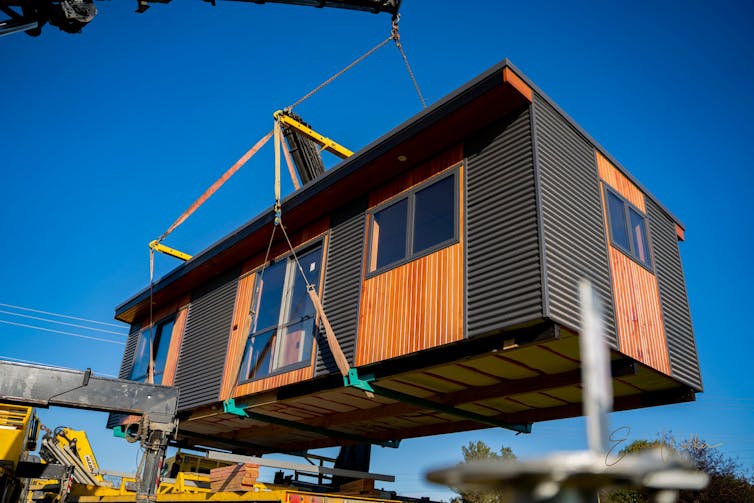
New Zealand’s housing crisis disproportionately affects Māori in rural areas where healthy homes are in short supply and collective land ownership presents a challenge to banks.
Governments have been grappling with this issue. The previous Labour-led government committed more than NZ$730 million to Māori-led housing solutions[1], and an announcement[2] this week by the current coalition government saw a $200 million investment into affordable rentals.
But Whare Ora[3], a community-run housing initiative in Te Tairāwhiti (East Coast), shows that innovative approaches to home ownership can be found within communities.
Since 2020, Whare Ora has developed a social enterprise model, focused on producing healthy, affordable and transportable whare (houses) for local communities. Run by the charitable company Hikurangi Enterprises, Whare Ora has now supplied more than 80 homes for local whānau.
This project is directly addressing regional housing deprivation[4] and the finance barriers[5] for building on Māori land under multiple ownership.
This holds particular potential for Indigenous housing.
Financial barriers
Despite Whare Ora producing high-quality houses at affordable prices, access to finance remains a significant barrier for whānau placing homes on ancestral lands.
This is mainly due to the perceived risk of lending against Māori freehold land, which is inalienable and often collectively owned. This creates issues for mainstream retail lenders that require land to be alienable to a single owner to secure a mortgage.
In exceptional circumstances, such as Ngāti Whātua Ōrakei’s recent agreement with BNZ[6], this can be mitigated if a trust can provide a guarantee over lending. This usually requires a large asset base or financial holdings.
However, the majority of Māori who want to build homes on ancestral lands are individual or collective whānau who don’t have access to such resources. The perceived risk excludes many who could service a loan but are unable to because the financial services don’t exist or aren’t designed for collectively-owned land.
For a region such as Te Tairāwhiti where about 25% of land is under Māori governance[7], this creates a lost opportunity for whānau to utilise ancestral lands for housing.
This is a systemic issue, documented by the National Housing Commission in 1983 and the Auditor General’s reports in 2011[8] and 2014[9].
Community partnerships
Seeking a solution to this finance barrier, Hikurangi Enterprises collaborated with Community Finance[11], a community-to-community lender, to investigate possible ways to administer lending for housing on collectively-owned land.
Supported by philanthropic organisations, this collaboration has given way to Kaenga Hou[12], a new trust set up to provide a range of progressive home-ownership options in Te Tairāwhiti.
Significantly, one option facilitates lending on ancestral land through a license-to-occupy agreement, based on an ethical finance model funded by impact investors.
Impact investors provide finance capital at below-market interest rates, while producing a social or environmental benefit (in this case addressing regional housing issues and strengthening Māori wellbeing through connections to ancestral lands).
This allows for more compassionate and innovative forms of investment, where complex issues can be worked through rather than written off as too risky or not profitable enough.
An ethical finance model
In designing a model to attract impact investment, Kaenga Hou and Community Finance sought innovative ways to mitigate investor risk while placing whānau at the centre of decisions, protecting them from exploitative lending and ensuring fair outcomes.
This was achieved through a creative rent-to-buy programme using whānau rental payments to reduce risk and build resilience into the model.
In short, whānau make rental payments to the trust. A portion of these payments repays the trust’s interest payments to investors funding the model. Another part builds a savings account, allowing the whānau to buy the home outright over time.
A final portion will be directed toward a support mechanism for all whānau in the programme. Known as the aroha fund, this aspires to support others if they face unexpected financial difficulty.
Innovation lies in the subtle details that reduce risk for both whānau and the investors. For example, the aroha fund increases the chance of programme completion, setting whānau up to succeed, while ensuring financial and social returns for the ethical investor.
Similarly, in the unlikely event whānau have to exit the programme, a proportion of the money accrued through the savings account can be returned and they would have paid an affordable rent while in the programme.
In this worst-case scenario, the programme aims to leave whānau in a better-off position than when they entered, uplifting whānau and safeguarding the reputation of investors. Collectively, these aspects ensure that positive whānau outcomes are just as important as creating a financial return.
Lessons for Te Tiriti-led futures
At its heart, housing on ancestral lands is a Te Tiriti issue. The Waitangi Tribunal recently concluded[13] the Crown has a duty to provide housing because of the guarantee of tino rangatiratanga[14] over kāinga (homes and settlements).
The government currently provides a loan scheme for housing on whenua Māori, but since its inception in 2010 it has been constantly scrutinised for low uptake[15] and accessibility[16], with similar pitfalls to retail lending.
This highlights the importance of taking lessons from community-led innovations and their approaches. In this case, more compassionate investment and a whānau-centred finance model created new possibilities for managing risk associated with lending to ancestral Māori lands.
Genuine partnerships, seeking to protect whānau while participating in finance systems, were key. This provides a road map for how Aotearoa might face such pressing issues, now and into the future.
References
- ^ Māori-led housing solutions (www.hud.govt.nz)
- ^ announcement (www.beehive.govt.nz)
- ^ Whare Ora (www.hikurangi.enterprises)
- ^ regional housing deprivation (www.fmhs.auckland.ac.nz)
- ^ finance barriers (www.rnz.co.nz)
- ^ Ngāti Whātua Ōrakei’s recent agreement with BNZ (www.rnz.co.nz)
- ^ about 25% of land is under Māori governance (oag.parliament.nz)
- ^ 2011 (oag.parliament.nz)
- ^ 2014 (oag.parliament.nz)
- ^ CC BY-SA (creativecommons.org)
- ^ Community Finance (communityfinance.co.nz)
- ^ Kaenga Hou (www.kaengahou.co.nz)
- ^ recently concluded (forms.justice.govt.nz)
- ^ tino rangatiratanga (maoridictionary.co.nz)
- ^ low uptake (oag.parliament.nz)
- ^ accessibility (www.mt.org.nz)
Authors: Jack Barrett, Lecturer in Business, Auckland University of Technology