Should you be allowed to sue a judge? The High Court says no
- Written by: Stephen Parker, Honorary Professorial Fellow, Melbourne CSHE, The University of Melbourne
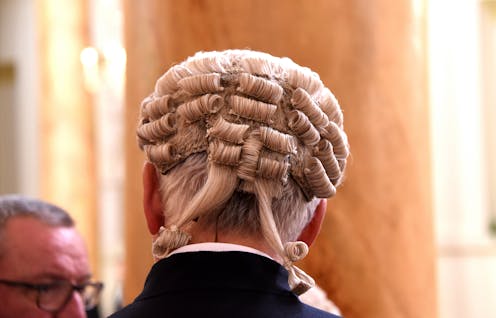
Judges in Australian courtrooms have a lot of power. They can decide on someone’s guilt and the punishment for it, including lengthy prison time.
But what if they get it badly wrong? Should you be able to sue a judge for damages?
For several centuries the answer has been no[1] in a “superior” court, such as a state Supreme Court, but possibly yes in an “inferior” court, such as a magistrates, district or county court, where most cases are actually heard.
The High Court of Australia has now ruled[2] that judges are immune from being sued for damages in every court and for all purposes. It is absolute, even if you have been falsely imprisoned.
But how did this decision come to be, and what does it mean for fair judicial processes?
The High Court case
The story behind the ruling began with a legal property dispute between a couple called the Stradfords.
Judge Salvatore Vasta in the Federal Circuit Court ordered that Mr Stradford should make “full and frank disclosure” of various financial documents. Mrs Stradford complained repeatedly that the disclosure was not complete.
Judge Vasta adjourned proceedings briefly to allow them to discuss settlement. To give Mr Stradford something to think about, he said he hoped Mr Stradford had brought his toothbrush with him.
Later that day, Judge Vasta sentenced Mr Stradford to 12 months’ imprisonment for contempt of court in disobeying the disclosure order. Judge Vasta mistakenly assumed a previous judge had already decided Mr Stradford was in contempt.
Mr Stradford appealed the contempt conviction in the Full Court of the Family Court. It allowed the appeal[3], concluding “the processes employed [by Judge Vasta] were so devoid of procedural fairness […] and the reasons for judgment so lacking in engagement with the issues of fact and law to be applied” that it would be an “affront to justice” to permit the contempt declaration and the imprisonment order to stand.
Armed with this finding, Mr Stradford sued Judge Vasta for damages for false imprisonment and won. Judge Vasta then appealed to the High Court, arguing that he was immune from being sued. In its ruling last week, the High Court agreed with him.
Why can’t judges be sued?
Immunity from being sued helps protect judicial independence, said the High Court.
If, at the back of their mind, a judge thinks they might be sued for damages should they make a wrong decision, they might be swayed by that, rather than objectively and impartially applying the law to the facts.
Immunity also helps to achieve finality in court proceedings and “quell disputes”. Finality is a consideration in all legal systems, and is the reason why some claims are time-barred if not brought within a specified period. You don’t want the same cases dragging on forever.
The High Court noted that a disappointed litigant can appeal against a decision, but once all appeal avenues have been exhausted, that is that.

If a judge has committed a crime, such as accepting a bribe, then the criminal law can be applied.
But in the more likely case where the unsuccessful party argues there has been a mistake, or even that the judge was motivated by bias or malice, the only recourse is to appeal. They can’t sue the judge.
The High Court noted also that a judge can be removed by parliament for misbehaviour or incapacity.
But there are counter-arguments to which the court didn’t give much attention.
For those who feel the outcome was wrong, appealing against a decision is very expensive. It’s simply not open to most people, due to the near-disappearance of legal aid in civil cases[5].
And the removal of judges by parliaments is extremely rare, while not helping the litigant anyway.
Is this good public policy?
In other walks of professional life, indemnity insurance exists. If judges could be sued, but were insured, they would normally not pay compensation personally. And if they could not find insurance, perhaps something needs investigating.
A compromise position would be possible. Any legal action against a judge could have to exceed a certain threshold of severity to proceed.
For example, a plaintiff might have to obtain prior permission, and for that they might have to prove malice on the part of the judge or an error so extreme that the judge had been reckless, not merely negligent.
But courts are different, it seems. Litigants do not make a contract with courts and are not consumers of a court’s services. They are engaging in a public process, where bigger issues are in play.
The public policy arguments so resoundingly endorsed by the High Court aren’t based on data about what the public thinks, or would necessarily think if all the arguments were presented to them.
None of this has improved Mr (or Mrs) Stradford’s financial position. No one is going to compensate them.
Courts are, in a very real sense, a law unto themselves.
References
- ^ answer has been no (lawincontext.com.au)
- ^ now ruled (eresources.hcourt.gov.au)
- ^ allowed the appeal (classic.austlii.edu.au)
- ^ Shutterstock (www.shutterstock.com)
- ^ legal aid in civil cases (lawcouncil.au)
Authors: Stephen Parker, Honorary Professorial Fellow, Melbourne CSHE, The University of Melbourne
Read more https://theconversation.com/should-you-be-allowed-to-sue-a-judge-the-high-court-says-no-249939