Australia urgently needs to get serious about long-term climate policy – but there’s no sign of that in the election campaign
- Written by: Frank Jotzo, Professor, Crawford School of Public Policy and Head of Energy, Institute for Climate Energy and Disaster Solutions, Australian National University
The federal election should be an earnest contest over the fundamentals of Australia’s climate and energy policies.
Strong global action on climate change is clearly in Australia’s long-term national interest. But it has fallen prey to US President Donald Trump’s disruption[1] of the world order, which has drained global attention from other crucial issues, including climate change.
The Trump administration’s anti-climate actions[2] might energise some to counteract it, but its overall affect will be chilling.
Election reality
A comprehensive platform to strengthen[3] and broaden Australian climate policy towards net zero is needed more than ever.
But the political reality playing out in the election campaign is very different, with the overriding focus on the cost of living, and the usual emphasis on electoral tactics rather than long-term strategies.
Even a policy like Labor’s subsidised home batteries[4] is being framed as a hip-pocket measure, rather than as a small contribution to energy infrastructure.
Likewise, the Coalition’s pledge to halve fuel excise[5] is aimed squarely at easing price pressures at the pump. In fact, the policy would slightly delay progress towards low emissions transport.
The vexed question of how to ensure sufficient gas supplies for south eastern Australia is also cloaked in energy affordability. We are already seeing industry[6] push back against the Coalition’s policy to require gas companies to withhold a share of production for the domestic market.
Off target
Regardless of who wins the election, Australia’s 43% emissions reduction target[7] by 2030 will be difficult to achieve unless there is a change of pace.
The government’s projections[8] assume sharp cuts during 2027–30. But national emissions have flatlined at around 28% below 2005 levels for four years.

Under the Paris Agreement, a 2035 target commitment is required this year. The Climate Change Authority will give its advice to the new government after the election. It has previously floated a reduction range[10] of 65–75%
This would be compatible with the global goal of keeping warming below 2°C[11]. Yet it might look highly ambitious under current political and international circumstances.
Renewables reloaded
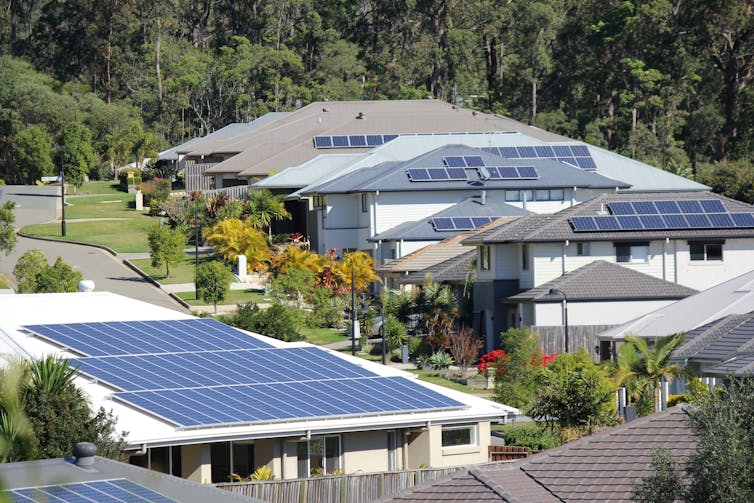
The shift from coal to clean energy sources in the power sector is well underway. In 2024, renewables accounted for 39%[12] of the national energy market, three times the share a decade ago.
But progress has slowed at the same time as older coal plants[13] have become unreliable and costly to run.
It is clear that the future of an affordable, secure power supply in Australia is mostly wind and solar, supported by energy storage and some gas.
But progress needs to be much faster. Many renewable projects, transmission lines and also Snowy 2 energy storage, are behind schedule. This is due to supply chain constraints, regulatory clogging and community opposition.
Blueprint for action
Deep emission reductions can still be achieved over the next ten years, but only if we pull out all the stops. That would mean:
- going much faster on electricity transition
- strengthening incentives and regulation to cut industrial and resource sector emissions
- getting serious about a transition to clean transport
- meaningful action towards low-emissions agriculture including changes to land use.
A re-elected Labor government would likely do more on renewable power, while also strengthening action on industrial and resource emissions through the Safeguard Mechanism[14].
But more will be needed to prepare for the 2030s. If the Teals hold the balance of power in a hung parliament, they would push Labor to be more ambitious.
By contrast, a Dutton government might dial back[15] the existing ambition and adopt a lower 2035 target than labor.
Nuclear means more coal
The initial focus of the Coalition’s energy policy going into the campaign has been to build nuclear[16] power stations.
Nuclear power would be far more expensive than the alternatives, costing[17] hundreds of billions of dollars for only a small share of future power supply. It would need enormous subsidies, probably through government ownership[18].
Deployment would inevitably be a very long time off. The near term affect would be to delay the transition to more renewable energy.

The Coalition’s modelling[20] assumes ageing coal-fired power plants would keep running beyond their announced closure dates. That would mean burning more coal and keeping Australia’s national carbon emissions[21] higher for longer.
The future of resource exports is green
Australia’s intrinsic interest in limiting climate change remains urgent. Our opportunity as a green commodity producer and exporter remains solid.
Green industry policy has been on the rise under the Albanese government, through support for green hydrogen[22] and green iron[23]. But we will not be able to subsidise our way to greatness in clean export industries.
What is needed is international green commodity markets for Australian supplies of green ammonia, iron and other products. This is best achieved through carbon pricing in commodity importing countries, coupled with border carbon adjustments which give exporters of cleanly produced products an edge in those markets.
A strong Australian 2035 emissions target would help send a signal to investors and overseas markets that we are serious about the transition.
A COP in Australia
Australia has a strong chance of hosting the 2026 UN climate conference[24]. Labor wants it, but the Coalition doesn’t[25].
COP31 would be a big chance for Australia to demonstrate positive leadership. It would also create pressure to do more for developing countries, given the conference would be hosted jointly with Pacific island states.
Disappointment is likely, as rich countries will probably fail to meet expectations. In any case, Australia will be pushed by our Pacific neighbours[26] to do more on climate change.
We could do with the encouragement.
This is the fourth article in our special series, Australia’s Policy Challenges. You can read the other articles here[27]
References
- ^ disruption (www.chathamhouse.org)
- ^ anti-climate actions (climate.law.columbia.edu)
- ^ strengthen (www.iea.org)
- ^ home batteries (theconversation.com)
- ^ excise (www.abc.net.au)
- ^ industry (www.reuters.com)
- ^ target (www.aofm.gov.au)
- ^ projections (www.dcceew.gov.au)
- ^ Kathie Nichols/Shutterstock (www.shutterstock.com)
- ^ reduction range (www.climatechangeauthority.gov.au)
- ^ below 2°C (unfccc.int)
- ^ 39% (openelectricity.org.au)
- ^ coal plants (grattan.edu.au)
- ^ Safeguard Mechanism (cer.gov.au)
- ^ dial back (www.abc.net.au)
- ^ nuclear (peterdutton.com.au)
- ^ costing (theconversation.com)
- ^ ownership (theconversation.com)
- ^ Steven Markham (photos.aap.com.au)
- ^ modelling (www.frontier-economics.com.au)
- ^ emissions (www.climatechangeauthority.gov.au)
- ^ hydrogen (www.afr.com)
- ^ iron (www.pm.gov.au)
- ^ 2026 UN climate conference (wwf.org.au)
- ^ doesn’t (theconversation.com)
- ^ pushed by our Pacific neighbours (www.abc.net.au)
- ^ here (theconversation.com)
Authors: Frank Jotzo, Professor, Crawford School of Public Policy and Head of Energy, Institute for Climate Energy and Disaster Solutions, Australian National University