Lest we forget? Aside from Anzac Day, NZ has been slow to remember its military veterans
- Written by: Alexander Gillespie, Professor of Law, University of Waikato
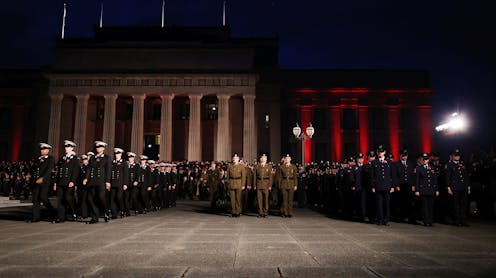
Following some very public protests, including Victoria Cross recipient Willie Apiata handing back his medal[1], the government’s announcement of an expanded official definition[2] of the term “veteran” brings some good news for former military personnel ahead of this year’s ANZAC Day.
The change will add roughly 100,000 service people and remove an anomaly that favoured those who served overseas, unless they served in New Zealand before 1974 when the Accident Compensation Corporation was founded. The new definition will not automatically change existing entitlements, but the government has expressed commitment to improving veterans’ support.
The government will also establish a new national day of tribute for veterans. This falls somewhat short of a recommendation from the 2018 independent review[3] of the Veterans’ Support Act which stated the government should accept it has a “moral duty of care to veterans”. But if adopted, this would create a missing ethical compass all democracies should have to acknowledge responsibilities to those who risked everything in service of their country.
The same report also recommended better financial support for veterans[4], but so far the government has been reluctant to review the adequacy of veterans’ pensions.
None of this is particularly surprising, given New Zealand’s history of sending people to fight and then rejecting their claims for recognition and compensation when the war is over.
Some of this may also come to light in the Waitangi Tribunal’s current Military Veterans Kaupapa Inquiry[5], with potentially strong evidence of discrimination against Māori service personnel in particular.
Sacrifice and compensation
When New Zealand gave out its first military pensions[6] in 1866, only the victors of the New Zealand Wars received them. For Māori allies, equity was missing. Pro-government Māori troops were eligible, but at a lower rate than Pākehā veterans.
It was only in 1903 that specialist facilities such as the Ranfurly war veterans’ home in Auckland were created.
The initial treatments for those who suffered “shell shock”, especially in the first world war, were atrocious. Their placement in mental institutions only ended following public outcry.
Some veterans of the New Zealand Wars were compensated by being granted confiscated Māori land. It wasn’t until 1915 that a new system was formalised[7].
This provided farm settlement schemes and vocational training for first world war veterans. The balloted farmland was largely exclusionary as Māori veterans were assumed to have tribal land already available to them.
The rehabilitation of disabled service personnel dates back to the 1930s, before being formally legislated in 1941[8]. But the focus faded over the following decades, with the specific status of veterans blurring as they were lumped in with more generic welfare goals.
It took until 1964 for the government to pay war pensions to those who served in Jayforce, the 12,000-strong New Zealand troops stationed in Japan as part of the postwar occupation from 1946 to 1948.
From atomic tests to Agent Orange
A decade later, more than 500 New Zealand navy personnel took part in Operation Grapple, the British hydrogen bomb tests near Kiribati in 1957–58. Despite evidence of a variety of health problems – including cancer, premature death and deformities in children – it was not until 1990 that the government extended coverage of benefits[11] to veterans who had contracted some specific listed conditions.
It took another eight years before the government broadened the evidence requirements and accepted service in Operation Grapple as an eligibility starting point for additional emergency pensions.
Last year, the United States declared a National Atomic Veterans’ Day[12] and made potentially significant compensation available. But neither New Zealand[13] nor Britain[14] even apologised for putting those personnel in harm’s way so recklessly.
During the war in Vietnam, some of the 3,400 New Zealanders who served between 1963 and 1975 were exposed to “Agent Orange”, the notorious defoliant used by the US military.
Some of them and their children experienced related health problems and higher death rates. The government did not accept there was a problem[15] until 2006 and apologised in 2008[16].
Assistance and compensation was based on evidence of specific listed conditions. And although the list has expanded over time, the legal and medical burden of proving a link between exposure and an illness falls on the veteran[17].
This is the opposite of what should happen. If there is uncertainty about the medical condition of a veteran, such as a non-listed condition, it should be for the Crown to prove an illness or injury is not related to military service. This burden should not fall on the victim.
Lest we forget
Today, support for veterans remains limited. There is still a reluctance to systematically understand, study and respond to the long-term consequences of military service.
For many, service develops skills such as resilience, confidence and flexibility which are sought after in civilian life. For some, their experiences lead to lingering trauma and even self-harm or suicide.
While Britain[18] and Australia[19] can track the incidence of veteran self-harm, New Zealand lacks robust data. Beyond some early research[20], the prevalence of suicide in the veteran population is unknown.
Despite recommendations from the 2018 report that this data gap should be plugged, it means that when three self-inflicted deaths of veterans[21] occurred within three weeks earlier this year, this couldn’t be viewed within any overall pattern. This makes appropriate support and interventions harder to design.
This all points to the same problem. While we intone “lest we forget” on April 25, a day later most of us are looking the other way.
References
- ^ handing back his medal (www.rnz.co.nz)
- ^ expanded official definition (www.rnz.co.nz)
- ^ 2018 independent review (www.veteransaffairs.mil.nz)
- ^ recommended better financial support for veterans (www.veteransaffairs.mil.nz)
- ^ Military Veterans Kaupapa Inquiry (www.waitangitribunal.govt.nz)
- ^ gave out its first military pensions (www.nzlii.org)
- ^ new system was formalised (www.nzlii.org)
- ^ formally legislated in 1941 (www.nzlii.org)
- ^ Wikimedia Commons (commons.wikimedia.org)
- ^ CC BY-SA (creativecommons.org)
- ^ extended coverage of benefits (www.veteransaffairs.mil.nz)
- ^ National Atomic Veterans’ Day (www.federalregister.gov)
- ^ New Zealand (www.rnz.co.nz)
- ^ Britain (www.bbc.com)
- ^ did not accept there was a problem (www.veteransaffairs.mil.nz)
- ^ apologised in 2008 (www.beehive.govt.nz)
- ^ falls on the veteran (www.rnz.co.nz)
- ^ Britain (militaryhealth.bmj.com)
- ^ Australia (defenceveteransuicide.royalcommission.gov.au)
- ^ early research (www.nzdf.mil.nz)
- ^ three self-inflicted deaths of veterans (www.nzherald.co.nz)
Authors: Alexander Gillespie, Professor of Law, University of Waikato