A law change will expand who we remember on Anzac Day – the New Zealand Wars should be included too
- Written by: Alexander Gillespie, Professor of Law, University of Waikato
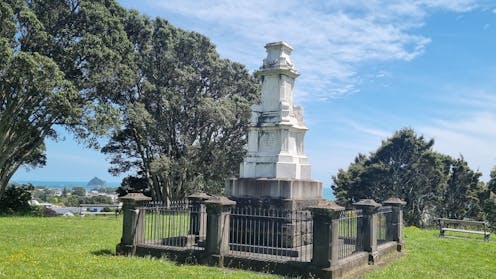
Anzac Day has come and gone again. But – lest we forget – war and its consequences are not confined to single days in the calendar. Nor do we only remember those who fought at Gallipoli more than a century ago.
This gradual expansion of the scope and meaning of April 25 is now about to grow further, with the Anzac Day Amendment Bill[1] currently before parliament. Its goal is to make the commemoration “broader and more inclusive than it currently is”.
Remembrance will soon include “other conflicts and persons who have served New Zealand in time of war or in warlike conflicts in the past and in the future that are not currently covered”.
New Zealand personnel who served in United Nations missions, and who fought or died in training, will be recognised, as will civilians who served in war or warlike conflicts. Without doubt, it is an excellent initiative.
The question is, does it go far enough? The obvious omission, if the new law is intended to be “broader” and include past wars, is the conflict that helped shape (and still shapes) the country we are today: the New Zealand Wars[2].
Of course, including this pivotal period from 1843 to 1872 plays into the politics of today, given the land confiscations and other injustices the New Zealand Wars also represent. The question is whether their inclusion can avoid becoming a culture war in the process.
How Anzac Day has grown
The case for explicitly including the New Zealand Wars is strong. It is thought about 500 British and colonial troops, 250 of their Māori allies (sometimes known as kūpapa[3]), and 2,000 Māori fighting against the Crown died in these conflicts.
It was also during these wars that Australian and New Zealand military cooperation[4] (the earliest form of Anzacs, in a sense) actually began. Around 2,500 Australian men enlisted for irregular New Zealand militia units, many encouraged by the offer of land grants in return for serving.
Furthermore, Anzac Day has gradually grown over time to include wars and military conflicts beyond the tragedy in Turkey, first observed in 1916 when the government gazetted a half-day holiday (later made into a full public holiday in 1921) .
The government again changed the law governing Anzac Day in 1949[5] to include World War II and the 11,500 New Zealand citizens who died in it. Significantly, it also added the South African/Boer War (which killed 59 New Zealanders), setting a precedent for bringing pre-first world war events into the frame.
In 1966, Anzac Day’s scope grew again[6] to recognise those “who at any time have given their lives for New Zealand and the British Empire or Commonwealth of Nations”. This allowed commemorations to cover the Cold War period, during which New Zealanders were killed in the Malayan Emergency[7] (15), Korea (38) and Vietnam (37).
Remembering without prejudice
The counterargument to including the New Zealand Wars in an expanded Anzac Day might be that we already have a dedicated day of observance: Te Pūtake o te Riri on October 28, the date the Declaration of Independence of the United Tribes of New Zealand[9] (precursor to the Treaty of Waitangi) was signed in 1835.
First observed in 2018, the commemorations take place in different locations each year. And perhaps one day, young New Zealanders will talk about the events at Rangiriri, Gate Pā, Matawhero and Ngātapa in the same way they now talk about Gallipoli, Passchendaele, Crete and Monte Cassino.
But the problem is that a two-tier system seems to have been created. Te Pūtake o te Riri was not made an official holiday and has struggled for wider recognition[10]. While there is some public funding[11] available, it is not on the scale of Anzac Day.
Te Pūtake o te Riri can and will continue to evolve, and it’s focus on the causes and injustices of these conflicts should not be diminished.
But an expanded and more inclusive Anzac Day, which recognises those who fought and died, would add another layer of meaning to a date long enshrined in the national calendar, similar to the way National Memorial Day[12] in the United States encompasses their Civil War.
We are now at a point in history when the injustices of the early colonial government have at least been acknowledged through the Treaty settlement process. It would make sense for the New Zealand Wars to be folded into the Anzac Day Amendment Bill.
The words “lest we forget” should also apply to those who fell in the nation’s third most costly military conflict. That way we can remember all of the fallen, without prejudice.
Public submissions[13] on the Anzac Day Amendment Bill close on Thursday May 22.
References
- ^ Anzac Day Amendment Bill (www.legislation.govt.nz)
- ^ the New Zealand Wars (teara.govt.nz)
- ^ kūpapa (teara.govt.nz)
- ^ Australian and New Zealand military cooperation (guides.slv.vic.gov.au)
- ^ changed the law governing Anzac Day in 1949 (www.nzlii.org)
- ^ scope grew again (www.nzlii.org)
- ^ Malayan Emergency (nzhistory.govt.nz)
- ^ Getty Images (www.gettyimages.co.nz)
- ^ Declaration of Independence of the United Tribes of New Zealand (nzhistory.govt.nz)
- ^ struggled for wider recognition (theconversation.com)
- ^ public funding (www.tpk.govt.nz)
- ^ National Memorial Day (www.cem.va.gov)
- ^ Public submissions (www.parliament.nz)
Authors: Alexander Gillespie, Professor of Law, University of Waikato