Why it’s time to delay tackling in junior sports until the age of 12
- Written by: Joel Garrett, Lecturer in Exercise Science and Physiology, Griffith University
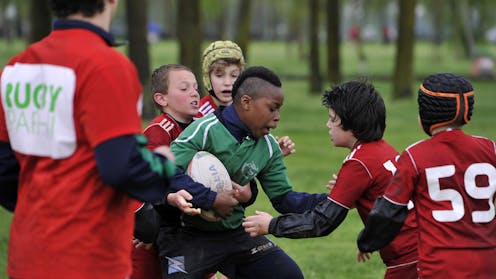
Many children across Australia have begun to play their favourite contact sports like rugby league, rugby union and Australian rules football.
Many will be just starting out during their early years of primary school.
Yet there are growing concerns these young athletes may be at heightened risk of sports-related concussions due to their more vulnerable developing brains.
Our new opinion article, published in Sports Medicine[1], presents the case for delaying all full-contact tackling until the age of 12[2], based on the current body of evidence and ongoing debate in the field.
Some see this as a necessary step to safeguard children’s brains. Others worry it might leave kids unprepared for more physical challenges as they grow[3].
But children are not mini adults.
Why age 12?
Children have thinner cranial bones[4], proportionally larger heads and weaker neck muscles than adults, making them more vulnerable[5] to rotational and linear forces during head impacts.
Read more: A stronger neck can help young athletes reduce their risk of concussion[6]
Their neural pathways are still maturing, so repeated head knocks – referred to as “sub-concussive” impacts[7], which don’t produce obvious concussion symptoms – may pose greater risks[8] for long-term brain development.
Around the ages of eight to 12 is a sweet spot[9] for children’s cognitive and motor development, as they make significant gains in physical fitness, motor coordination, body awareness and cognitive functions such as reaction time and decision-making.
An eight-year-old, for instance, may struggle with the rapid judgements required to align their shoulder and brace their neck properly when tackling a moving player.
However, by 12, many can execute these decisions with greater consistency[10].
Aligning physical growth with cognitive readiness can allow young athletes to enter contact situations with a firmer grasp of safe techniques and the confidence to use them during games.
Why this might be needed
A common misconception[11] is delaying full-body contact means not teaching it at all.
Children should be gradually taught skills like body positioning, safe falling and correct shoulder placement before they are faced with high-intensity collisions[12].
This means children get time to master core skills of the sport, such as catching, passing, kicking and tactics, free from the added demands of body-to-body contact.
This dual focus on skill-based contact training and fundamental sport skills promotes a more holistic athlete development aligned with childhood development.
Unsurprisingly, studies show non-contact versions of sports have fewer head impacts than those in full-contact leagues[13].
Weight-based categories, such as those used[14] in some junior rugby competitions, aim to lower injury risks[15] by preventing physical mismatches. However, they don’t fully address poor technique or cognitive readiness.
Many leagues across the world are modifying contact rules to reduce youth injuries, with ice hockey the best example.
Some ice hockey competitions in North America raised the introduction of body checking (when players crash into each other[16] with their hips or shoulders) to 13–14 years of age[17], resulting in significantly lower injury rates[18] among younger players.
Studies also found[19] delaying body checking did not increase concussion risk in later years, supporting the idea that “later is safer”.
The argument against
Delaying full-body contact (such as tackling) in youth sport remains controversial[20].
Some argue[21] early contact fosters character and builds resilience and physical readiness despite the risk to a developing brain.
But while early findings suggest delaying contact can reduce injuries, we still don’t have enough long-term studies to prove the full impact over time.
Delaying tackling also poses a challenge, as modifying a sport’s contact rules is complex, and cultural resistance or limited coaching resources in community leagues can hinder change.
Still, many believe that with appropriate formats, coach education and a phased introduction, it is possible to balance skill development with athlete safety.
A way forward
A potential way forward involves structured, progressive skill development[22], and gradually teaching young players how to give and receive contact, initially in controlled, low-intensity settings. The emphasis should be focused on safe falling, bracing, neck strengthening[23] and correct head placement.
Some experts also recommend[24] a broader approach that makes safety part of everything in sport, including everything from how coaches teach to the rules of the game to the overall culture.
By ensuring consistency across coaches, referees and administrators, this model helps reduce the risk of concussions[25].
With a structured progression and strong safety culture, more children will be physically and cognitively prepared to participate in full-contact sports confidently, safely and with greater long-term enjoyment and retention.
Growing evidence[26] supports introducing contact in a developmentally appropriate way to improve safety.
Earlier collisions may raise the risk of concussions without offering much benefit in the long run.
A delayed approach, with progressive skill instruction, may be safer and allow children to develop core skills first.
It’s a way to protect young brains and ensure every child can play confidently and safely once they transition to full-contact tackling, promoting long-term participation safely.
References
- ^ Sports Medicine (link.springer.com)
- ^ until the age of 12 (doi.org)
- ^ as they grow (www.bbc.com)
- ^ thinner cranial bones (doi.org)
- ^ making them more vulnerable (doi.org)
- ^ A stronger neck can help young athletes reduce their risk of concussion (theconversation.com)
- ^ sub-concussive” impacts (www.medicalnewstoday.com)
- ^ greater risks (doi.org)
- ^ a sweet spot (pubmed.ncbi.nlm.nih.gov)
- ^ with greater consistency (doi.org)
- ^ common misconception (doi.org)
- ^ high-intensity collisions (doi.org)
- ^ full-contact leagues (doi.org)
- ^ those used (www.aucklandrugby.co.nz)
- ^ aim to lower injury risks (doi.org)
- ^ crash into each other (www.purehockey.com)
- ^ to 13–14 years of age (www.iha.org.au)
- ^ significantly lower injury rates (doi.org)
- ^ also found (doi.org)
- ^ remains controversial (www.smh.com.au)
- ^ Some argue (www.bbc.com)
- ^ progressive skill development (doi.org)
- ^ neck strengthening (theconversation.com)
- ^ experts also recommend (doi.org)
- ^ reduce the risk of concussions (doi.org)
- ^ Growing evidence (doi.org)
Authors: Joel Garrett, Lecturer in Exercise Science and Physiology, Griffith University