a cautionary tale from the Dutch Golden Age
- Written by: Garritt C. Van Dyk, Senior Lecturer in History, University of Waikato
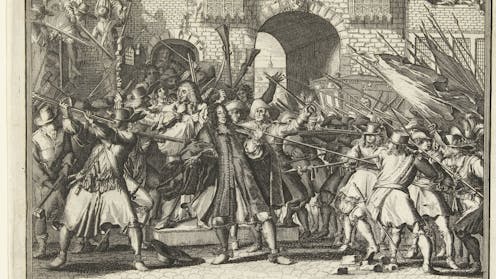
The Dutch Golden Age, beginning in 1588, is known for the art of Rembrandt, the invention of the microscope, and the spice trade of the Dutch East India Company. It ended a little under a century later in a frenzy of body parts and mob justice.
In 1672, enraged by a fake news campaign, rioters killed the recently ousted head of state[1] Johan de Witt and his brother Cornelis. The mob hung them upside down[2], removed their organs, ate parts of the corpses, and sold fingers and tongues as souvenirs[3].
Even in a period characterised by torture and assassination, this grisly act stands out as extreme. But it also stands as a warning from history about what can happen when disinformation is allowed to run rampant.
The attack on Johan and Cornelis de Witt was fuelled by a relentless flood of malicious propaganda[4] and forgeries claiming the brothers were corrupt, immoral elitists who had conspired with enemies of the Dutch Republic.
The anonymous authors of the smear campaigns blamed Johan for war with England and “all the bloodshed, killing and injuring, the crippled and mutilated people, including widows and orphans” that allegedly kept him in power.
According to one pamphlet, the violence was legitimate[5] because the ends justified the means: “Beating to death is not a sin in case it is practised against a tyrant.” The sentiment echoes a quote frequently attributed to Napoleon, recently shared by US President Donald Trump[6] on social media: “He who saves his country does not violate any law.”
‘Fight like hell’
These days, of course, we’ve become accustomed to the dangers fake news (and deepfakes) pose in the promotion of political violence[7], hate speech, extremism and extrajudicial killings.
In March, for example, historical footage of war crimes[8] in Syria was manipulated by generative AI to appear as current events. Combined with disinformation in chat rooms and on social media, it incited panic and violence.
The effects were magnified in a country with no reliable independent media, where informal news is often the only source of information.
But even in a superpower with an established media culture, similar things happen. Before the January 6 insurrection at the US Capitol in 2021, Trump called on thousands of supporters[9] at a “Save America” rally to “fight like hell” or they were “not going to have a country anymore”.
This was shortly before Congress verified the presidential election result, which Trump alleged was invalid because of voter fraud. Addressing the same crowd, Trump advisor Rudolph Giuliani called for[10] “trial by combat”.
What happened might not have been as extreme as the events in the Netherlands 350 years earlier, but a violent mob fired up on disinformation still shook the foundations of US democracy.
The ‘disaster year’
The deeper forces at work in the US were and still are complex – just as they were in the 17th-century Dutch Republic. What brought it down was a volatile mix of power struggles, geopolitical rivalries and oligarchy.
William of Orange had been excluded from the office of stadtholder, the hereditary head of state, by a secret treaty with England under Oliver Cromwell to end the First Anglo-Dutch War[12].
When the English monarchy was restored, however, the treaty became invalid and the Orangists attempted to reinstate William. Johan De Witt represented the States Party, made up of wealthy oligarchs, whereas William was seen as a man of the people.
The republic had built an impressive navy and merchant fleet but neglected its army. A land invasion by France and allies was supported by the English navy. To prevent the invasion from advancing, land was flooded by opening gates and canals.
The combination of floods and an occupying army threw the economy into chaos. The Orangists wouldn’t cooperate with the States Party, and the republic was on the brink of collapse. The Dutch referred to 1672 as the Rampjaar, the “disaster year”.
Historical rhymes
Satirists, pamphleteers and activists seized on the crises as an opportunity to ramp up their campaign against the de Witt brothers. Political opposition turned into personal attacks, false accusations and calls for violence.
Johan was assaulted and stabbed in an attempted assassination in June 1672, resigning from his role as head of state two months later. Cornelis was then arrested for treason. When Johan went to visit him in prison, the guards and soldiers disappeared, and a conveniently positioned mob dragged the brothers into the street.
The rest, as they say, is history. William III was strongly suspected of orchestrating the brothers’ gruesome murder, but this was never confirmed.
Is there is a moral to the story? Perhaps it is simply that, in a time of crisis, a campaign of disinformation can transform political opposition and rebellion into assassination – and worse.
Pamphlets – the social media of their day – manipulated public perception and amplified popular anxiety into murderous rage. A golden age of prosperity under a republic headed by oligarchs ended with ritualised political violence and the return of a monarch who promised to keep the people safe.
They say history doesn’t repeat, but it does rhyme. As ever, the need to separate fact from fiction remains an urgent task.
References
- ^ killed the recently ousted head of state (escholarship.org)
- ^ hung them upside down (rijksmuseumamsterdam.blogspot.com)
- ^ sold fingers and tongues as souvenirs (www.gevangenpoort.nl)
- ^ malicious propaganda (kam.illinois.edu)
- ^ the violence was legitimate (brill.com)
- ^ shared by US President Donald Trump (www.nytimes.com)
- ^ promotion of political violence (www.ipsos.com)
- ^ historical footage of war crimes (www.dw.com)
- ^ called on thousands of supporters (www.nytimes.com)
- ^ Rudolph Giuliani called for (www.rev.com)
- ^ Getty Images (www.gettyimages.co.nz)
- ^ First Anglo-Dutch War (www.heritage-history.com)
Authors: Garritt C. Van Dyk, Senior Lecturer in History, University of Waikato