Decades on from the Royal Commission, why are Indigenous people still dying in custody?
- Written by: Thalia Anthony, Professor of Law, University of Technology Sydney
Aboriginal and Torres Strait Islander readers are advised that this article contains the name of an Indigenous person who has died.
The recent deaths in custody of two Indigenous men in the Northern Territory have provoked a deeply confronting question – will it ever end?
About 597 First Nations[1] people have died in custody sine the 1991 Royal Commission[2] into Aboriginal Deaths in Custody.
This year alone, 12 Indigenous people[3] have died – 31% of total custodial deaths.
The raw numbers are a tragic indictment of government failure to implement in full the Commission’s 339 recommendations.
We are potentially further away from resolving this crisis than we were 34 years ago.
Recent deaths
Kumanjayi White was a vulnerable young[4] Warlpiri man with a disability under a guardianship order. He stopped breathing while being restrained by police in an Alice Springs supermarket on May 27. His family is calling for all CCTV and body camera footage to be released.
Days later a 68-year-old Aboriginal Elder[5] from Wadeye was taken to the Palmerston Watchhouse after being detained for apparent intoxication at Darwin airport. He was later transferred to a hospital where he died.
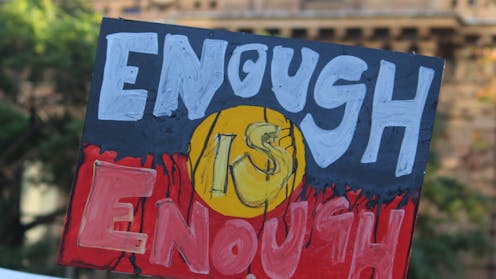
Alice Springs protest over the death of Kumanjayi White.Both were under the care and protection of the state when they died. The royal commission revealed “so many” deaths had occurred in similar circumstances and urged change. It found there was:
little appreciation of, and less dedication to, the duty of care owed by custodial authorities and their officers to persons in care.
Seemingly, care and protection were the last things Kumanjayi White and the Wadeye Elder were afforded by NT police.
Preventable deaths
The royal commission investigated 99 Aboriginal deaths in custody between 1980 and 1989. If all of its recommendations had been fully implemented, lives may have been saved.
For instance, recommendation 127 called for “protocols for the care and management” of Aboriginal people in custody, especially those suffering from physical or mental illness. This may have informed a more appropriate and therapeutic response to White and prevented his death.
Recommendation 80 provided for “non-custodial facilities for the care and treatment of intoxicated persons”. Such facilities may have staved off the trauma the Elder faced when he was detained, and the adverse impact it had on his health.
More broadly, a lack of independent oversight has compromised accountability. Recommendations 29-31 would have given the coroner, and an assisting lawyer, “the power to direct police” in their investigations:
It must never again be the case that a death in custody, of Aboriginal or non-Aboriginal persons, will not lead to rigorous and accountable investigations.
Yet, the Northern Territory police has rejected pleas by White’s family for an independent investigation.
Another audit?
Northern Territory Labor MP Marion Scrymgour is calling on the Albanese government to order a full audit[7] of the royal commission recommendations.
She says Indigenous people are being completely ostracised and victimised:
People are dying. The federal government, I think, needs to show leadership.

It is unlikely another audit will cure the failures by the government to act on the recommendations.
Instead, a new standing body should be established to ensure they are all fully implemented. It should be led by First Nations people and involve families whose loved ones have died in custody in recognition of their lived expertise.
In 2023, independent Senator Lidia Thorpe moved a motion[9] for the Aboriginal and Torres Strait Islander social justice commissioner to assume responsibility for the implementation of the recommendations. While the government expressed support for this motion, there has been no progress.
Another mechanism for change would be for governments to report back on recommendations made by coroners[10] in relation to deaths in custody. Almost 600 inquests have issued a large repository of recommendations, many of which have been shelved.
Leadership lacking?
Prime Minister Anthony Albanese recently conceded[11] no government has “done well enough” to reduce Aboriginal deaths in custody. But he has rejected calls for an intervention in the Northern Territory justice system:
I need to be convinced that people in Canberra know better than people in the Northern Territory about how to deal with these issues.

Albanese is ignoring the essence of what is driving deaths in custody.
Reflecting on the 25-year anniversary of the royal commission in 2016, criminology professor Chris Cunneen wrote that Australia had become much less compassionate[13] and more ready to blame individuals for their alleged failings:
Nowhere is this more clear than in our desire for punishment. A harsh criminal justice system – in particular, more prisons and people behind bars – has apparently become a hallmark of good government.
There are too many First Nations deaths in custody because there are too many First Nations people in custody in the first place.
At the time of the royal commission, 14% of the prison[14] population was First Nations. Today, it’s 36%[15], even though Indigenous people make up just 3.8% of Australia’s overall population[16].
Governments across the country have expanded law and order practices, police forces and prisons in the name of community safety.
This includes a recent $1.5 billion public order plan[17] to expand policing in the Northern Territory. Such agendas impose a distinct lack of safety on First Nations people, who bear the brunt of such policies. It also instils a message that social issues can only be addressed by punitive and coercive responses.
The royal commission showed us there is another way: self-determination and stamping out opportunities for racist and violent policing. First Nations families have campaigned for these issues for decades.
How many more Indigenous deaths in custody does there have to be before we listen?
References
- ^ 597 First Nations (www.aic.gov.au)
- ^ Royal Commission (www.naa.gov.au)
- ^ 12 Indigenous people (www.aic.gov.au)
- ^ vulnerable young (www.theguardian.com)
- ^ Aboriginal Elder (www.sbs.com.au)
- ^ Bianca De Marchi/AAP (photos.aap.com.au)
- ^ full audit (www.abc.net.au)
- ^ Mick Tsikas/AAP (photos.aap.com.au)
- ^ moved a motion (www.lidiathorpe.com)
- ^ made by coroners (onlinelibrary.wiley.com)
- ^ recently conceded (www.pm.gov.au)
- ^ Mick Tsikas/AAP (photos.aap.com.au)
- ^ much less compassionate (theconversation.com)
- ^ 14% of the prison (www7.austlii.edu.au)
- ^ it’s 36% (www.abs.gov.au)
- ^ overall population (www.abs.gov.au)
- ^ public order plan (budget.nt.gov.au)
Authors: Thalia Anthony, Professor of Law, University of Technology Sydney