After a hopeful start, Labor’s affordable housing fund is proving problematic
- Written by: Katrina Raynor, Director of the Centre for Equitable Housing, Per Capita and Research Associate, The University of Melbourne
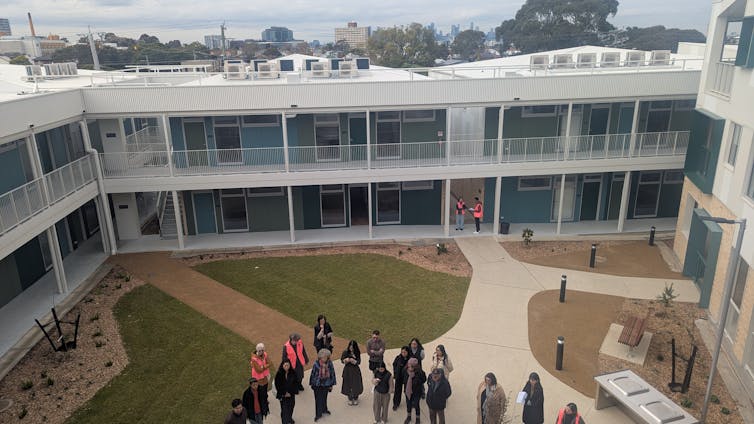
When the Albanese government announced the A$10 billion Housing Australia Future Fund[1] in 2023, the news reverberated through the housing sector.
A new funding facility to help build 30,000 social and affordable rental homes in five years. Given we only increased Australia’s social housing stock by 24,000 dwellings in the decade to 2024, this represents a significant uptick.
The future fund is part of the National Housing Accord’s overall commitment to build 1.2 million new homes[2] by the end of the decade. This target is now in serious doubt following advice from Treasury[3].
Nonetheless, people were genuinely excited and hopeful about the focus on meeting the housing needs of lower income people.
But stakeholders were also sceptical – and they had every right to be.
How it works
The future fund is a dedicated investment vehicle[4] which helps finance new housing builds using the returns on the original $10 billion endowment.
It does this by distributing loans and grants via competitive funding rounds open to not-for-profits, the private sector and other levels of government.
When announcing the scheme, then Housing Minister Julie Collins said it would help address acute housing needs for people who are especially vulnerable:
[…] this will provide housing support to remote Indigenous communities, women and children experiencing domestic and family violence, older women at risk of homelessness, and veterans experiencing or at risk of homelessness.
Two funding rounds have so far been announced – 9,284 social dwellings and 9,366 affordable homes.
State and territory governments are involved in the process by providing access to land, expediting planning approvals and sometimes acting as developers.
Reasons for hope
The future fund is what the housing sector has been begging for for decades[6]. It is a consistent, somewhat protected, pot of funding with a mandate to build social and affordable housing at scale.
It is one of several hopeful changes underway in the housing space. The housing portfolio is now ensconced in cabinet after being elevated in the first Albanese ministry.

The relocation of housing and homelessness into Treasury is another positive development. Previously, policy areas were fragmented[8] across a variety of departments.
This is particularly welcome given we are yet to see the promised National Housing and Homeless Plan[9] despite consultations beginning in 2023.
Room for improvement
While the future fund is a welcome infusion of money, my discussions with stakeholders have provided mixed feedback.
As with any new program, there have been teething issues. Red tape has slowed contracts[10], while the May election paused all negotiations.
Housing funding in Australia remains lumpy[11] – characterised by sudden changes in the scale and priorities of funding – and policy is highly politicised.
Survival of the cheapest
Loans and grants are distributed through competitive, oversubscribed funding rounds.
Coupled with a need for quick political wins, bigger players with lower cost projects are far more likely to receive funding to guarantee a larger quantum of housing.
While this may appear to reflect greater value for money, it means the scheme is incentivised to fund affordable housing aimed at moderate income households rather than social housing aimed at more vulnerable people. New homes are not targeted where need is greatest.
Given affordable housing will be delivered at 75% of market rent, there are many people who will still not be able to afford it. While we undoubtedly need both, the need is far greater for social housing.
As the chart above shows, almost all funding in round one went to Tier One Community Housing Providers, who are the biggest developers with the most in-house capacity.
While privileging larger organisations is not necessarily a bad thing, it does mean smaller players with more location or cohort-specific strengths are continuing to miss out.
For example, only one Aboriginal Community Housing Provider was successful in the first round, sparking calls for an Aboriginal-specific funding round[13].
Program inefficency
Submitting bids is time consuming and uncertain, especially for funding rounds designed to stimulate new partnerships between stakeholders who haven’t worked together before.

Further, establishing partnerships and contracts with government is labour intensive and complex.
One industry insider recently joked the main things being funded by the scheme are new backyard pools for Sydney-based lawyers.
Beyond this, the future fund provides availability payments[15] – which recur quarterly during the operating phase of projects – rather than upfront capital grants.
According to research[16], this is one of the most inefficient ways to fund social housing. Capital grants paid at the start to support construction are far more cost effective.
Lack of operational funds
Another key barrier is the focus on “bricks and mortar” to the exclusion of ongoing service costs.
Funding to cover tenancy support, building maintenance and operations, and other wrap-around services is essential, especially for social housing aimed at individuals with higher needs.
This is not covered by the fund and is yet to be substantively picked up by state governments either.
Clearly, there are aspects of the housing future fund that need improvement. But this is not a call to abolish the scheme.
The last thing the sector needs is another policy pivot or funding cut. In fact, doubling the fund to $20 billion would be warranted.
The 30,000 new homes fall well short of the estimated 640,000 Australian households whose housing needs are currently unmet[17].
The Housing Australia Future Fund is just one element – but an important one – in the suite of measures we should be using to address acute housing needs.
References
- ^ Housing Australia Future Fund (alp.org.au)
- ^ 1.2 million new homes (treasury.gov.au)
- ^ advice from Treasury (www.theguardian.com)
- ^ dedicated investment vehicle (www.finance.gov.au)
- ^ Chart by author, Data from Housing Australia (www.housingaustralia.gov.au)
- ^ begging for for decades (msd.unimelb.edu.au)
- ^ CC BY (creativecommons.org)
- ^ were fragmented (www.ahuri.edu.au)
- ^ National Housing and Homeless Plan (www.dss.gov.au)
- ^ slowed contracts (www.afr.com)
- ^ remains lumpy (theconversation.com)
- ^ Chart by author, Data from Housing Australia (www.housingaustralia.gov.au)
- ^ Aboriginal-specific funding round (vahhf.org.au)
- ^ Bianca De Marchi/AAP (photos.aap.com.au)
- ^ availability payments (www.housingaustralia.gov.au)
- ^ to research (www.ahuri.edu.au)
- ^ currently unmet (cityfutures.ada.unsw.edu.au)
Authors: Katrina Raynor, Director of the Centre for Equitable Housing, Per Capita and Research Associate, The University of Melbourne