As female independent MPs descend on parliament, they’re fulfilling the dreams of women across history
- Written by: Elizabeth Chappell, Post Doctoral Research, University of New England
Australia’s 48th parliament has a record[1] 112 women members. Ten of those women are independents.
As they take their seats in the chamber, they’ll be realising the aspirations of some of Australia’s first suffragists who, more than a century ago, staunchly supported independent representation, but failed to gain traction at the ballot box.
Our earliest female political aspirants, Catherine Spence in Adelaide, Rose Scott in Sydney and Vida Goldstein in Melbourne, eschewed party politics, believing significant social issues should transcend political boundaries.
Recent close contests in the electorates of Bradfield and the eponymous Goldstein echoed the challenges of female independent candidates across time.
Australia’ first female candidate
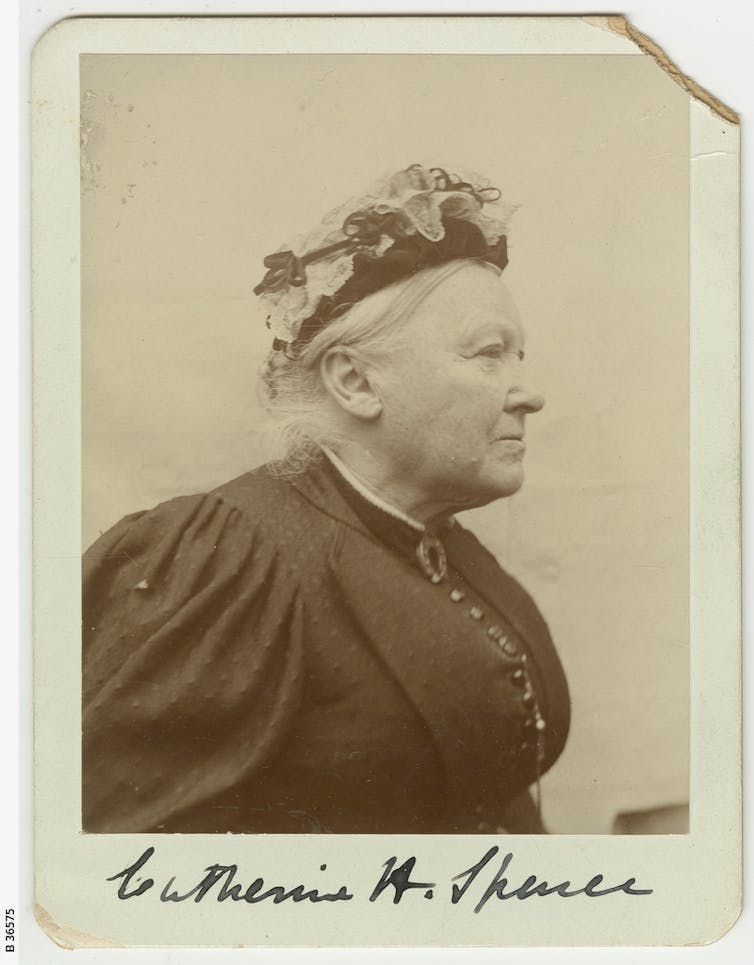
Spence[2] had been declined preselection for the nascent Labor Party in 1896. This was when women in South Australia, including Aboriginal women, became the first in Australia to have the right not only to vote, but also to stand for parliament.
Spence believed issues of social justice and electoral reform should override party allegiance.

The following year, Spence nominated for the federal convention to draft a Constitution for the new Australian parliament. Her strongest commitment was to proportional voting based on the Hare system of the single transferable vote, which was ultimately introduced to the Australian Senate[4] in 1948. Spence believed this was the fairest electoral system to give voice to minority concerns.
She was the only woman to nominate. Although not elected, she won her place in history as Australia’s first female political candidate.
Acknowledging her defeat, Spence reflected:
I stood or fell on a question which both parties thought it expedient to ignore […] I look on my position in the poll as very satisfactory.
Similarly, Goldstein[5], the first woman to stand for Australia’s federal parliament in 1903, viewed her loss as “virtually a victory”. She explained to her supporters[6]:
I stood as a protest against press domination and the creation of the vicious system of machine politics. I had the prejudice of ages to fight, and yet I secured more than half of the votes of the candidate heading the polls.
‘Women do not vote as women’
Scott[7] was a political powerbroker of her day.
Although she did not stand for office, she brought together politicians across the divide with people of influence from the judiciary, publishing and the arts at her Friday evening salons.
Despite her privileged background and private income, Scott’s political leanings were towards socialism.
For more than 20 years she corresponded regularly with both Spence and Goldstein. Their extant letters reveal shared concerns for equal pay and education for women and child welfare.
Significant NSW legislation was reputedly drafted on Scott’s rosewood dining table. She remained staunchly opposed to party politics, scrawling her endorsement across a copy of The Inebriates Act 1900 “non-party and non-sectarian”.
Scott joined Goldstein on the hustings and furnished letters of support in Goldstein’s campaign pamphlets.
Spence, however, recalling the bitter lesson of her own candidature, wrote:
I am not at all sure that Vida Goldstein is wise in standing for the Senate. Women do not vote as women for women.
Successive, but unsuccessful attempts
Like Spence, Goldstein was hampered by misinformation, with questions asked about her eligibility to stand for parliament. Both lacked the financial support available to their opponents backed by party organisations.
Goldstein was attacked in the conservative press for her views on home and marriage. Comments on her dress and appearance trivialised reporting of her political message. Labor newspapers proclaimed that support for Goldstein would split the vote and result in a defeat of Labor’s candidates.

Spence escaped similar attention because she was short, stout and in her seventies when she campaigned.
Goldstein nominated for the Senate again in 1910, campaigning for equal pay and federal reform of marriage and divorce laws.
Although she polled higher than in 1903, her campaign was hampered by lack of funds and negative press coverage.
Party politics had become more polarised. Many women were now actively joining the Labor Party or supporting the conservative Australian Women’s National League.
Between 1910 and her final tilt for the Senate in 1917, Goldstein stood twice for the seat of Kooyong, currently held for a second term by independent MP Monique Ryan.
Goldstein stood as a progressive independent for Kooyong in 1912. Labor did not field a candidate. She polled around half the votes of her male opponent. She stood again in 1915, remaining frank and uncompromising on her independent status[9]:
as a non-party candidate I had difficulties to face that confronted no other candidate. The non-party candidate does not get the support of the party press. And the other special prejudice I have to fight is that of sex.
While their work towards women’s suffrage is acknowledged, the broader social and political contributions of our early feminists are often overlooked. When the right to vote still seemed unobtainable, they were lobbying for fairer divorce, child welfare, prevention of domestic violence and equal pay. Political representation seemed a step too far.
“None of these women could have imagined a Julia Gillard. It would have made their heads spin to think that a woman could be prime minister,” says historian Clare Wright[10].
An Australian parliament with majority of cabinet positions held by women[11], with women leading both the opposition in the House of Representatives and the government in the Senate, would leave them stunned, but triumphant.
References
- ^ a record (theconversation.com)
- ^ Spence (adb.anu.edu.au)
- ^ State Library of South Australia (collections.slsa.sa.gov.au)
- ^ Australian Senate (peo.gov.au)
- ^ Goldstein (adb.anu.edu.au)
- ^ explained to her supporters (nla.gov.au)
- ^ Scott (adb.anu.edu.au)
- ^ Museums Vcitoria (collections.museumsvictoria.com.au)
- ^ independent status (nla.gov.au)
- ^ Clare Wright (www.parliament.nsw.gov.au)
- ^ by women (theconversation.com)
Authors: Elizabeth Chappell, Post Doctoral Research, University of New England