Why UK recognition of a Palestinian state should not be conditional on Israel’s actions
- Written by: Karen Scott, Professor in Law, University of Canterbury
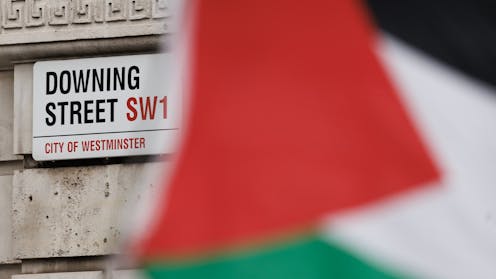
The announcement this week[1] by UK Prime Minister Keir Starmer on the recognition of a Palestininian state has been welcomed by many who want to see a ceasefire in Gaza and lasting peace in the region.
In contrast to other recent statements on the status of Palestine, however, the UK has said it will recognise Palestine as a state in September
unless the Israeli government takes substantive steps to end the appalling situation in Gaza and commits to a long term sustainable peace, including through allowing the UN to restart without delay the supply of humanitarian support to the people of Gaza to end starvation, agreeing to a ceasefire, and making clear there will be no annexations in the West Bank.
Until this week, the UK’s position had been that recognition would only follow a negotiated two-state solution[2] in Israel-Palestine. Other countries have now begun to shift from that position, too.
The latest UK statement was preceded by announcements from France on July 25[3] and Canada on July 31[4] that they too would recognise Palestine as a state in September.
But the UK position is different in one important way: it is conditional on Israel failing to comply with its international humanitarian obligations in Gaza and the West Bank.
In other words, recognition of Palestine as a state by the UK is being used as a stick to persuade Israel to agree to a ceasefire. Should Israel agree to those conditions, the UK will presumably not recognise Palestine as a state in September, but will revert to its original position on a two-state solution.
Conditional recognition subject to action by Israel – a third state – represents an unwelcome and arguably dangerous departure from international practice.
While recognition (or otherwise) of states is inherently political – as demonstrated by the unique status of Taiwan, for example – it is not and should not be made conditional on the action or inaction of third states.
How states are recognised
According to the Convention on the Rights and Duties of States[5], a state must have a permanent population, territory, an independent government, and the capacity to enter into relations with other states, as well as self-determination.
Palestine has arguably met all these criteria, with the possible exception of an independent government, given the level of Israeli intervention in the West Bank and the current situation in Gaza.
Although recognition by other states is arguably not a formal criterion of statehood, it is very difficult to function as a state without reasonably widespread recognition by other states.
Some 147 countries[6] – two-thirds of UN members – now recognise the State of Palestine, including Spain[7], Ireland[8] and Norway[9], which made announcements in 2024.
Those choosing not to formally recognise a Palestinian state are now in a small minority, including Australia and New Zealand. This is inevitably leading to calls in those countries to change position.
Australia is considering such a shift[10], subject to conditions similar to those set out by Canada – including the release of Israeli hostages, the demilitarisation of Hamas, and reform of the Palestinian Authority.
New Zealand is currently maintaining its longstanding position[11] of recognising Palestine within the context of a two-state solution. On July 30, Foreign Minister Winston Peters and 13 of his counterparts issued a joint statement – the “New York Call[12]” – demanding an immediate ceasefire in Gaza and reiterating “unwavering commitment to the vision of the two-State solution”.
The statement also asserted that “positive consideration” to recognise the state of Palestine is “an essential step towards the two-state solution”.
Better options are available
The UK’s position, however, introduces another dynamic. By using recognition of Palestine as a tool to punish Israel for its actual and alleged breaches of international law in Gaza, it is implicitly failing to respect Palestine’s right to self-determination.
If Palestine deserves statehood, it is on its own terms, not as a condition of Israel’s policies and actions.
But it is also setting a dangerous precedent. Countries could choose to recognise (or not recognise) states to pressure or punish them (or indeed other states) for breaches of international law. Such breaches may or may not be connected to the state actually seeking recognition.
This is important, because the post-colonial settlement of geographical boundaries remains deeply insecure in many regions. As well, low-lying island nations at risk of losing territory from sea-level rise may also find their status challenged, as territory has traditionally been a requirement of statehood.
The UK’s apparent conditional recognition of Palestine is only likely to increase this international instability around statehood.
While the UK’s announcement may be “clever politics[13]” from a domestic perspective, and avoids outright US opposition internationally, it has conflated two separate issues.
The better option would be for the UK to recognise Palestine as a state, joining a growing number of countries that plan to do so in advance of the UN General Assembly meeting in September. It could make this subject to conditions, including the release of hostages and exclusion of Hamas from Palestinian governance.
And it should continue to press Israel to agree to a ceasefire in addition to the other demands set out in its announcement, and hold Israel accountable for its gross breaches of international law in Gaza. It can back up those demands with appropriate diplomatic and trade sanctions.
New Zealand, too, has a range of options[14] available, and can help increase the pressure on Israel by using them.
References
- ^ announcement this week (www.gov.uk)
- ^ negotiated two-state solution (theconversation.com)
- ^ France on July 25 (www.theguardian.com)
- ^ Canada on July 31 (www.rnz.co.nz)
- ^ Convention on the Rights and Duties of States (www.ilsa.org)
- ^ 147 countries (www.euronews.com)
- ^ Spain (www.lamoncloa.gob.es)
- ^ Ireland (www.gov.ie)
- ^ Norway (www.regjeringen.no)
- ^ considering such a shift (theconversation.com)
- ^ maintaining its longstanding position (www.rnz.co.nz)
- ^ New York Call (www.canada.ca)
- ^ clever politics (theconversation.com)
- ^ range of options (theconversation.com)
Authors: Karen Scott, Professor in Law, University of Canterbury