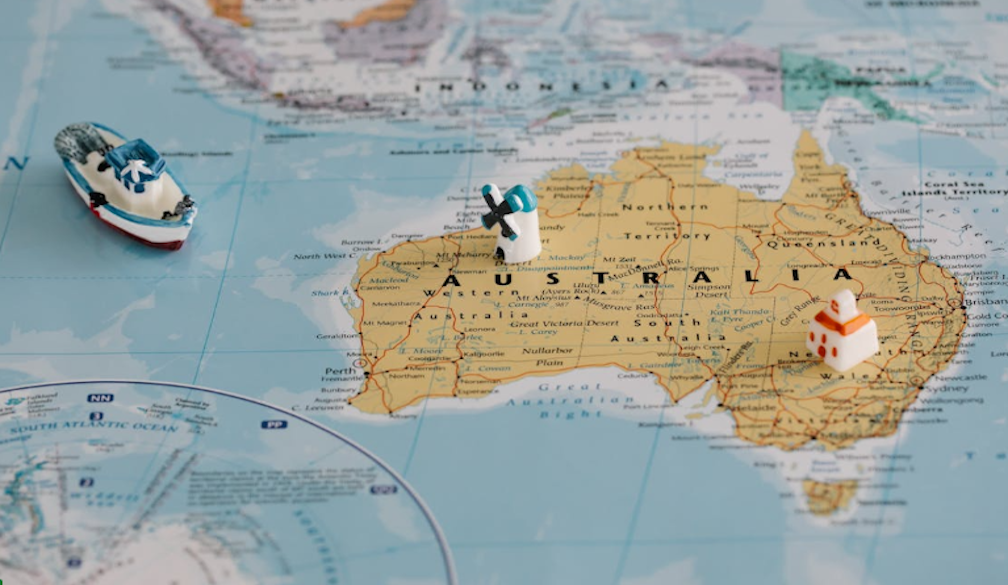
As the world order shifts, NZ should ‘spread its diplomatic wings’ and look at joining BRICS
- Written by: Chris Ogden, Associate Professor in Global Studies, University of Auckland, Waipapa Taumata Rau
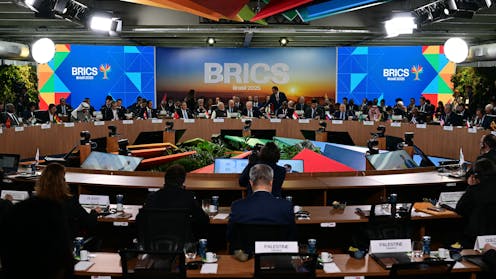
With the old global order in a heightened state of flux, driven by US President Donald Trump’s attacks on free trade, international organisations and human rights[1], small states like New Zealand are having to adjust their foreign policies and hedge their bets.
As long-term economic and diplomatic power shifts towards Asia and the wider Indo-Pacific[2], alternative multilateral groups are now growing in importance.
Foremost among these is the grouping known as BRICS[3], a maturing – and potentially dominant – centre of global economic power. Whether New Zealand would consider joining is still moot, but the forum already includes major nations vital to this country’s future.
Formed in September 2006 by Brazil, Russia, India and China (the original BRIC), it had its first annual summit in June 2009, with South Africa joining in December 2010 (thus becoming BRICS).
The core strategic logic of BRICS is based on consensus and solidarity, not coercion, and to gain member benefits via collective strength. As then Indian prime minister Manmohan Singh put it in 2009[4]:
We share the vision of inclusive growth and prosperity in the world [… and] we stand for a rule-based, stable and predictable global order.
Having substantial economies, populations, landmasses and ambitions underpinned this shared goal of a multipolar world – which now seems to be emerging by a different route due to Trump’s isolationist “America first” policies.
Strength in numbers
In 2012, motivated by mutual concerns over food and energy security, terrorism and climate change, BRICS members signed the Delhi Declaration[5], stating:
We envision a future marked by global peace, economic and social progress [… and] strengthened representation of emerging and developing countries in the institutions of global governance.
In 2013, BRICS launched the New Development Bank[6], designed to progressively reform the world’s financial architecture after the global financial crisis of 2008.
Seeking to fund sustainable development and infrastructure projects in developing states, the bank now rivals older Western-based institutions such as the World Bank and International Monetary Fund (IMF).
The rising significance of BRICS has been accelerated by its recent expansion. In 2024, Egypt, Ethiopia, Iran, Saudi Arabia and the United Arab Emirates all became members, as did Indonesia in 2025.
Argentina had also agreed to join in 2024[7] but then pulled out due to the election of its US-orientated populist president Javier Milei.
The expansion saw BRICS’ share of global GDP[8] rise to 39% in 2023. Member states now account for 48.5% of the planet’s population and 36% of total global territory.
BRICS also accounts for[9] around 72% of the world’s reserves of rare earth minerals, 43.6% of global oil production, 36% of natural gas production and 78.2% of coal production.
By such measures, BRICS is an economic and diplomatic powerhouse. In economic terms, it has been out-ranking the G7 countries (US, Germany, Japan, UK, France, Italy and Canada) since around 2019[10].
An alternative, not a choice
Diplomatically, BRICS members pledge[11] to better synchronise their national policies by meeting on the sidelines of the UN General Assembly, IMF, World Bank and G20 summits.
Joining such a body provides an attractive way for countries to enhance their trade and diplomatic bandwidth, as well as hedge against US-inspired instability.
Joining BRICS also comes with potential risks, of course. Any perception of traditional Western alliance systems being undercut could see aid and investment reduce[12]. So far, however, Trump’s threat to impose an extra 10% trade tariff[13] on any countries aligned with BRICS is yet to materialise.
But as economist Stephen Onyeiwu has written[14], with the exception of Russia and Iran,
Most of the countries and partners in BRICS are either allies of western countries or neutral on global issues. They are unlikely to support decisions or actions that are grossly inimical to western interests.
Given the current geopolitical situation, New Zealand may well baulk at closer ties with Russia and Iran. But being inside the forum would also allow diplomatic opportunities to press other member states over their actions or policies.
In fact, New Zealand – along with many US allies[15] – joined the Beijing-inspired Asia Infrastructure Investment Bank and signed a Free Trade Agreement with China[16] in 2008. It didn’t suffer any adverse consequences.
New BRICS members can be invited or make a formal request to apply[17], which is then considered at the next BRICS annual summit. Or they can apply to be a partner country[18], which is akin to “observer” status.
This allows them to take part in special summits and foreign minister meetings, as well as contribute to official documents and policy statements. But they can’t host meetings or select new members and partners.
Most importantly, joining BRICS would not mean New Zealand needs to leave other multilateral institutions.
Rather, it would be a pragmatic way for Wellington to spread its diplomatic wings[19] and prepare for a future in which Asia and the Indo-Pacific – already the world’s largest economic and military region – will only become more powerful.
References
- ^ attacks on free trade, international organisations and human rights (www.thepost.co.nz)
- ^ shifts towards Asia and the wider Indo-Pacific (theconversation.com)
- ^ BRICS (infobrics.org)
- ^ Manmohan Singh put it in 2009 (archivepmo.nic.in)
- ^ Delhi Declaration (www.mea.gov.in)
- ^ New Development Bank (www.ndb.int)
- ^ agreed to join in 2024 (www.bbc.com)
- ^ share of global GDP (brics.br)
- ^ also accounts for (brics.br)
- ^ since around 2019 (www.visualcapitalist.com)
- ^ BRICS members pledge (www.fmprc.gov.cn)
- ^ aid and investment reduce (theconversation.com)
- ^ threat to impose an extra 10% trade tariff (theconversation.com)
- ^ Stephen Onyeiwu has written (theconversation.com)
- ^ along with many US allies (theconversation.com)
- ^ Free Trade Agreement with China (www.mfat.govt.nz)
- ^ can be invited or make a formal request to apply (www.channelnewsasia.com)
- ^ apply to be a partner country (theconversation.com)
- ^ spread its diplomatic wings (www.thepost.co.nz)
Authors: Chris Ogden, Associate Professor in Global Studies, University of Auckland, Waipapa Taumata Rau