Papua New Guinea has played an important role in Australian history – it’s time we acknowledged that
- Written by: Geoff Keating, Lecturer, UnISQ College, University of Southern Queensland
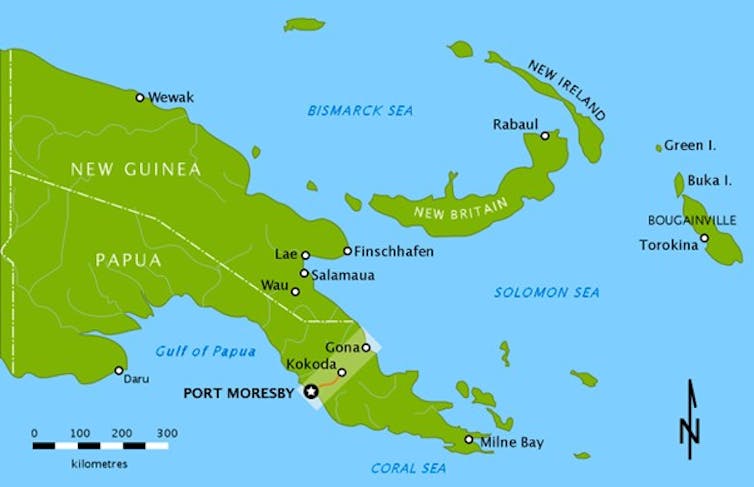
Fifty years ago this week, Papua New Guinea became independent from Australia. This anniversary gives both nations cause to reflect on our shared histories, as both colony and coloniser.
Once separate territories under Australian administration, Papua and New Guinea became Papua New Guinea in 1971. The land and its people have had a profound influence on Australian history and Australians’ lives.
PNG has also played an important role in some of our nation’s most significant military experiences, as well as in Federation in 1901.
An annexation and a federation
Australia’s federation was not just due to the great ideas of powerful men from New South Wales and Victoria, looking to create a great democratic and egalitarian experiment in the South Pacific, as we are so often led to believe.
The real catalyst for Federation was far less noble. Queensland, newly separated from NSW, had discovered the potential of further plantation expansion to the north, beyond the Torres Straits. With ample water, land and labour, politicians argued[1] a plantation economy would enrich Queensland.
The excess labour could also be exported back to the Australian mainland to meet the labour shortages on the frontier. This process, known as “blackbirding[2]” is a shameful moment of our history, not dissimilar to slavery.
In 1883, the governor of Queensland, Thomas McIlwraith[3], sent an official, Henry Majoribanks Chester[4], to claim Papua and New Guinea for Queensland. This came to fruition on April 4 1883.
The British government was horrified. Secretary for the colonies, Lord Derby, saw the actions of Queensland as a major overstep of their authority as a colony. British parliamentarians also saw the potential of colonial abuse.
Britain’s disavowal led to the gathering of an Intercolonial Convention[5] in Sydney during November and December of the same year. The main themes of the meeting were Federation and annexation. In short, the colonies were unhappy with their colonial masters in Britain. They wanted to have the power to act without British disapproval or interference.
Paranoia and invasion from the north
Without Queensland’s cavalier annexing of Papua, the process of Federation would have likely taken a very different path. Fuelling the push for Federation came the news[6] that in November 1884, German colonists had established a protectorate over the northern half of New Guinea.
This news caused paranoia within the colonies about a potential German invasion. This invasion would require the need for defence co-operation across Australia. Without Papua and New Guinea, it can be argued Federation might have been substantially slower.
Fear of an invasion from the North[7] is a recurring theme in Australian military history. Again, the importance of New Guinea has been sidelined to conflicts further afield. In the first world war, for example, we remember the actions in the Middle East and in Europe, but forget the Australian Army’s first deployment was not across the world, but instead across the Bismarck Sea.
Within a month of Australia’s declaration of war on Germany in 1914, 100 soldiers and 500 naval reservists undertook our first seaborn invasion of the war, at modern Kokopo, in what is now New Britain, PNG.
Further attacks at Bita Paka and Rabaul saw Australian troops take possession of the capital of German New Guinea, at the cost of seven dead and five wounded[8], one of those being the commander of the force, Lieutenant-Commander Charles Elwell[9].
New Guinea is not invisible from our military memory; after all, the Australia victory at Kokoda in the second world war (July-November 1942) is celebrated as a hugely significant moment in our national history and the creation of our national identity.
However, it was at Milne Bay on the far south-eastern tip of PNG, not Kokoda, where Australian troops inflicted the first defeat on land of the Japanese in the Pacific in August 1942.
The actions of Australian soldiers and airmen saw the decisive defeat of a Japanese effort to further isolate Australia and endanger supply lines to Port Moresby.
The battle resulted in the deaths of 167 Australians, with another 206 wounded.
Australia has had a long and complicated history with our northern neighbour before and after independence. Many find it hard to accept that, as Australians, we were a colonial master. Yet Papua New Guinea and its people have, time and time again, shown they have been integral to the Australian story.
Correction: This story has been amended to correct that Charles Elwell was a lieutenant-commander, not a lieutenant-general._
References
- ^ politicians argued (espace.library.uq.edu.au)
- ^ blackbirding (theconversation.com)
- ^ Thomas McIlwraith (adb.anu.edu.au)
- ^ Henry Majoribanks Chester (adb.anu.edu.au)
- ^ Intercolonial Convention (www.parliament.tas.gov.au)
- ^ came the news (trove.nla.gov.au)
- ^ Fear of an invasion from the North (researchcentre.army.gov.au)
- ^ cost of seven dead and five wounded (www.awm.gov.au)
- ^ Lieutenant-Commander Charles Elwell (www.anzac-biographies.com)
- ^ Australia's Defining Moments Digital Classroom (digital-classroom.nma.gov.au)
Authors: Geoff Keating, Lecturer, UnISQ College, University of Southern Queensland