From gladiators to mock naval battles, what were the major sports events in the ancient world?
- Written by: Konstantine Panegyres, Lecturer in Classics and Ancient History, The University of Western Australia
The ancient Athenian writer Isocrates[1] (436-338 BC) once commented[2]:
Many cities judge those who excel in the athletic contests to be worthy of greater rewards than those who, by painstaking thought and endeavour, discover some useful thing.
Why is it so many people are obsessed with big sporting events and the great athletes who perform in them?
With Grand Final season upon us for Australia’s two major codes – the Australian Football League and National Rugby League – it’s worth reflecting on the long history of major sporting events.
The main events on the ancient sporting calendar
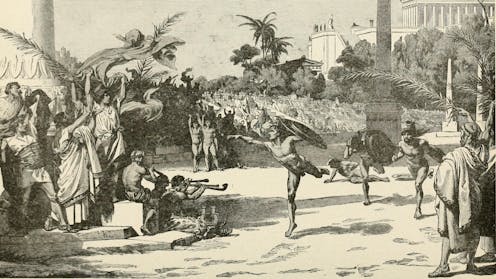
Everyone has heard of the ancient Olympics[3]. These games were held at the site of Olympia, in Elis.
The earliest recorded Olympic games occurred in 776 BC but the competition might have existed long before that time.
The ancient Olympic games lasted for more than 1,000 years, coming to an end in the reign of the emperor Theodosius the Younger (408-450 AD).
Not many people now know the Olympics was just one of a group of four main sporting events in the ancient world.
The other main competitions on the sporting calendar were the Pythian games[4] (established in 586 BC), the Isthmian games[5] (established in 582 BC) and the Nemean games[6] (established in 573 BC).
These were all primarily athletic contests, though they also included some musical competitions.
Victors at the Olympic games won an olive wreath to wear as a crown.
At the Pythian games the prize was a laurel wreath, at the Nemean games a wreath of celery leaves, at the Isthmian games a wreath of pine leaves. Wreaths were prized as a sign of great glory and excellence.
These four events were collectively called the “periodos[7]” (meaning “cycle”).
The Olympic and Pythian games were held every four years. The Nemean and Isthmian games were held every two years.
This arrangement meant in a cycle of four years[8], the first year would feature the Isthmian and Olympic games, the second year Nemean games, the third year Isthmian and Pythian games, and the fourth year Nemean games.
An athlete who won prizes at all four games in one cycle was called a “periodonikes[9]” (meaning “cycle winner”).
Being periodonikes was one of the highest accolades any athlete could achieve in the ancient world. A modern equivalent is the “Grand Slam” in tennis[10] – when a player wins all four major championships (Australian Open, French Open, Wimbledon, and US Open) in one year.
Some ancient athletes, like the long-distance runner Ergoteles of Himera (5th century BC), became periodonikes twice.
Ancient sports fans
Ancient people loved to attend all four of these major events.
The Greek orator Dio Chrysostom [11] said people who went to the games had simple motives.
They wanted, Dio tells us[12],
to watch the athletes and to fill themselves up with food and drink.
Fans sat in the seats, eating and drinking, cheering on the athletes and celebrating the victories.
The Greek writer Philostratus[13] (190-230 AD) described[14] the reaction of fans in the stands when an athlete won:
the spectators jump up from their seats and shout, some wave their hands, some their garments, some leap from the ground, and some grapple with their neighbours for joy … these really amazing deeds make it impossible for the spectators to contain themselves.
Other types of spectacles
Ancient Greeks and Romans did not hold competitions with prizes for games with balls or other types of sporting activities.
For the Greeks, athletics and races with horses were supreme.
The Romans enjoyed creating huge combat spectacles involving gladiators or ships.
For example, to entertain the people, the Roman emperor Claudius[15] (10 BC-54 AD) created a naval battle involving 19,000 combatants at Lake Fucinus. Criminals from Roman prisons were brought in to fight each other to the death for this grim spectacle.
According to[16] the historian Tacitus[17] (56-c.120 AD), people flocked from all Italy to see this event:
The shores, the hills, the mountain-crests, formed a kind of theatre, soon filled by an untold multitude, attracted from the neighbouring towns, and in part from the Rome itself.
Although it’s unlikely Australians will be able to watch massive fights-to-the-death at stadiums any time soon, the people’s love of big sporting spectacles seems unlikely ever to come to an end.
References
- ^ Isocrates (www.britannica.com)
- ^ commented (www.loebclassics.com)
- ^ ancient Olympics (theconversation.com)
- ^ Pythian games (ancientolympics.arts.kuleuven.be)
- ^ Isthmian games (ancientolympics.arts.kuleuven.be)
- ^ Nemean games (ancientolympics.arts.kuleuven.be)
- ^ periodos (ancientolympics.arts.kuleuven.be)
- ^ in a cycle of four years (ancientolympics.arts.kuleuven.be)
- ^ periodonikes (lsj.gr)
- ^ “Grand Slam” in tennis (en.wikipedia.org)
- ^ Dio Chrysostom (www.britannica.com)
- ^ tells us (www.loebclassics.com)
- ^ Philostratus (www.britannica.com)
- ^ described (www.loebclassics.com)
- ^ Claudius (www.britannica.com)
- ^ According to (www.loebclassics.com)
- ^ Tacitus (www.britannica.com)
Authors: Konstantine Panegyres, Lecturer in Classics and Ancient History, The University of Western Australia