As Australia welcomes its millionth refugee, its hardline border policies endure. We can lead by example again
- Written by Daniel Ghezelbash, Professor and Director, Kaldor Centre for International Refugee Law, UNSW Law & Justice, UNSW Sydney
Any day now, Australia will welcome its millionth refugee since the second world war.
This milestone, which the Refugee Council of Australia believes will happen[1] by the end of this year, is a moment to mark the transformative contributions that refugees and their families have made to our society and economy over seven decades.
But Australia’s millionth refugee also arrives at a moment when the system to protect them is under immense strain and struggling for popular support.
A vocal minority is expressing rage on the streets and social media about immigration, with many making no distinction between refugees (who face danger of persecution in their home county) and migrants (who choose to move to another country, usually for work, education or family reasons). Both are met with the same backlash, borne of grievance and fear.
The same phenomenon is being seen globally. In the US, President Donald Trump has blocked[2] many thousands of refugees already approved for US admission.
He also plans to restrict[3] the number of refugees next year to just 7,500 – a huge decrease from the ceiling of 125,000 during the Biden administration. Trump is also planning to fill those spots mainly with white South Africans.
This is a moment to take pride in our history of moral national action on refugees – and to lead by example again by demanding more humane policies for those continuing to seek refuge here.
The birth of refugee protections
The 1951 Refugee Convention[4] came out of the rubble of WWII. It defined who should be considered a refugee and established rights and protections owed to them.
During the war (and the lead-up to it), many countries were unwilling[5] to help those fleeing persecution. In 1939, for example, the United States shamefully denied landing[6] to the St Louis, a German liner carrying more than 900 Jewish refugees.
Yet, in the post-war years, the US took the global lead in refugee resettlement. Many governments saw their support of the Refugee Convention as a way of saying “never again”.
This treaty – and its companion 1967 Protocol[7] – have now been ratified by 149 countries. These are all voluntary participants in the international refugee protection system.
A history of inclusion and exclusion
From 1947–1954, Prime Minister Ben Chifley welcomed 170,000 displaced people[8] to Australia from the camps of Europe. This was roughly three times more refugees per capita than we admit today.
It was not a purely humanitarian impulse: Australia needed labour, and thousands of displaced people provided it. It was a win-win, ultimately transforming Australia into one of the wealthiest, most successful and most multicultural countries in the world.
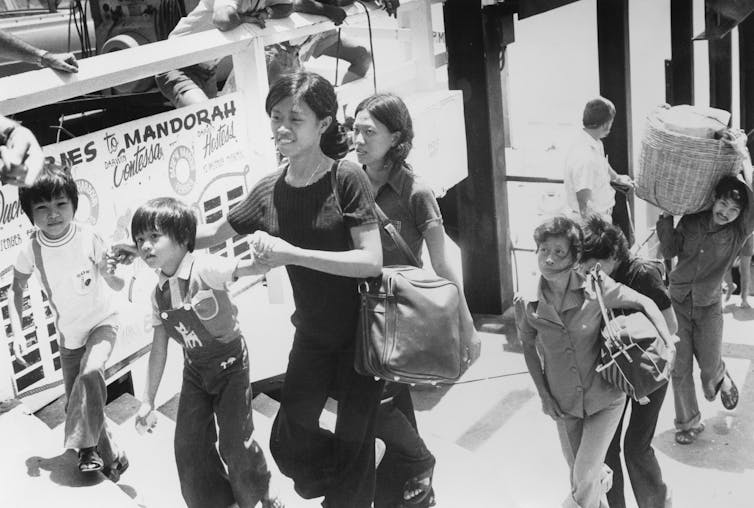
In the 1970s, when boats of Vietnamese asylum seekers began arriving in Australia’s north, Prime Minister Malcolm Fraser actively encouraged[9] ordinary Australians to understand they deserved protection, humane treatment and fair processes.
The future governor of South Australia, Hieu Van Le, arrived by boat in Darwin Harbour in 1977. As he later recounted[10]:
We saw a tinnie with two blokes with shorts and singlet […] and with the first beers of the day in their hands, [who] waved to us and steered their boat very close … and one of them raised his stubby as if proposing a toast. ‘G’day mate’, he shouted, ‘welcome to Australia’.
In the aftermath of the Tiananmen Square massacre in Beijing in 1989, Prime Minister Bob Hawke spontaneously announced that more than 40,000 Chinese students could remain in Australia if they were too afraid to return home. He later recalled[11]:
I had no consultation with anyone and when I walked off the dais [after making the announcement]. I was told, ‘You cannot do that, prime minister’. I said to them ‘I just did, it is done’.“
It wasn’t always an easy sell. Yet, these leaders understood that protecting refugees was more than a legal obligation – it was a reflection of our national character.
During the 1990s, political opportunists in Australia turned on refugees. In 1992, the Labor government responded to the arrival of boats carrying asylum seekers from Cambodia by introducing mandatory detention[12] – and the now-familiar dehumanising rhetoric began.
In the decades that followed, governments introduced a series of policies, including offshore processing, boat turn-backs and temporary protection visas, that stripped refugees of their work rights and educational opportunities, separated families and curtailed appeal rights.
Leading by example
There are no easy solutions to this issue. Refugee movements are complex by nature, and people in desperate need will resort to desperate measures.
Trying to deter people in need of protection leads not to sustainable solutions[13], but rather to expensive, chaotic and damaging measures with intergenerational consequences.
Policies that punish people for seeking safety betray basic values of fairness and decency, and violate Australia’s international legal obligations. They also ignore the immense benefits and potential that refugees bring to our society.
A truly successful refugee policy[14] not only manages national borders, it also protects people who are fleeing atrocities and human rights abuses.
This moment gives Australia an opportunity to learn from the lessons of the past and become a global leader in refugee protection again. The question is not whether we can rise to the occasion, but whether we choose to.
References
- ^ will happen (www.refugeecouncil.org.au)
- ^ blocked (www.pbs.org)
- ^ restrict (www.theguardian.com)
- ^ 1951 Refugee Convention (www.unhcr.org)
- ^ unwilling (encyclopedia.ushmm.org)
- ^ denied landing (encyclopedia.ushmm.org)
- ^ 1967 Protocol (www.ohchr.org)
- ^ 170,000 displaced people (parlinfo.aph.gov.au)
- ^ actively encouraged (pmtranscripts.pmc.gov.au)
- ^ later recounted (cpd.org.au)
- ^ recalled (www.smh.com.au)
- ^ mandatory detention (www.kaldorcentre.unsw.edu.au)
- ^ not to sustainable solutions (www.unsw.edu.au)
- ^ successful refugee policy (www.unsw.edu.au)
Authors: Daniel Ghezelbash, Professor and Director, Kaldor Centre for International Refugee Law, UNSW Law & Justice, UNSW Sydney