With a deadline looming, Lebanon is under pressure to disarm Hezbollah or risk another war
- Written by Amin Saikal, Emeritus Professor of Middle Eastern Studies, Australian National University; The University of Western Australia; Victoria University
Lebanon faces a grave predicament. Israel wants the Hezbollah militant group based in the country to be disarmed[1]. Hezbollah has refused to give up its arms as long as Israel threatens Lebanon. And the Lebanese government is not strong enough to subdue Hezbollah on its own.
This is a recipe for renewed internal conflict in Lebanon, as well as another round of war[2] between Israel and Hezbollah. The cost could be devastating for both Lebanese and regional stability.
Israel’s two-month war on Hezbollah
Israel and Hezbollah have been at loggerheads since the Lebanese group’s creation, with help from the Islamic Republic of Iran, in the early 1980s.
Successive Israeli leaders have sought to stifle Hezbollah’s growth as a formidable paramilitary force in Lebanese politics and threat to Israel’s national security. Israel invaded[3] Lebanon in 1982 and 2006 to try to destroy the group, without much success.
However, Israel’s war against Hamas in Gaza gave it another opportunity to take on Hezbollah when the group joined the conflict[4] in solidarity with Hamas.
After nearly a year of Hezbollah rocket attacks on northern Israel and Israeli retaliation, Prime Minister Benjamin Netanyahu opened a “new phase[5]” of the Gaza war in September 2024.
Using unprecedented means, such as remote detonation of the group’s pagers[6] and 2,000-pound (900kg) US-made “bunker buster[7]” bombs, the Israel Defence Forces (IDF) quickly pierced Hezbollah’s defences. It decapitated the group by killing its firebrand and strategic-minded leader, Hassan Nasrallah[8], and his successor, Hashem Safieddine[9].
Shaky ceasefire
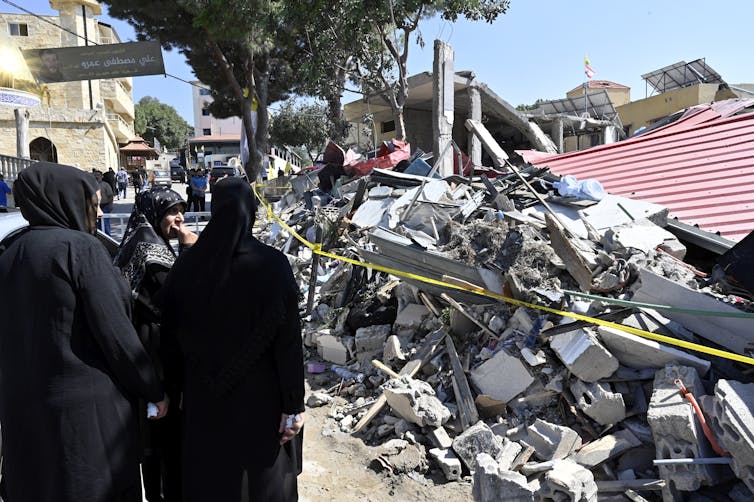
When a ceasefire took hold after nearly two months of fighting, 3,800 people in Lebanon were killed[10], many of them civilians. Israel lost more than 80 soldiers and 47 civilians. Some 1.2 million Lebanese people were displaced, along with around 46,000 Israelis.
Israel claimed to have eliminated many of the group’s hideouts and assets, including ammunition depots and infrastructure, especially in Beirut and southern Lebanon. The IDF also pushed most of Hezbollah’s forces back to the Litani River – 29 kilometres north of the Israeli border.
In February of this year, Israel withdrew its troops[11] from most of southern Lebanon, but maintained[12] control of five strategic points inside Lebanon after the deadline to withdraw its troops.
Then, in August, Israel said it would pull back[13] the rest of its forces only when the Lebanese army was able to take over positions currently manned by Hezbollah operatives and the group was totally disarmed.
Under the terms of the ceasefire, brokered[14] by the United States and France in November 2024, the Lebanese army is responsible for disarming Hezbollah. The Trump administration has set a December 31 deadline[15] to disarm the group.

But the reformist Lebanese Prime Minister Nawaf Salam’s task has become very difficult, with Israel regularly bombing[16] what it calls Hezbollah targets to ensure the group does not regain its pre-war strength.
Israeli strikes have killed[17] at least 127 Lebanese civilians and wounded dozens since the start of the ceasefire.
Hezbollah has vowed not to disarm[18]. Its new chief, Sheikh Naim Qassem, has warned[19] the Lebanese government against giving in to Israeli and American demands.
He also said if Israel broadens its attacks into another war, Hezbollah’s missiles “would fall” on Israel.
Will war return?
Hezbollah has been weakened as Tehran’s most important pillar of influence in the Middle East. But it still remains well-manned and equipped. It also remains popular[20] among the Shias who form the largest segment of Lebanon’s religiously and politically divided population.
Salam, a Sunni Muslim, has his work cut out for him.

On the one hand, he presides over a “consociational[21]” system of governance, in which different religious and sectarian groups share power in proportion to the size of their communities under the presidency of General Joseph Aoun[22] (a Christian). This does not augur well for long-term national unity.
On the other hand, Salam needs to deal with a shattered economy and finances – and, more importantly, the Israeli demand that Hezbollah be disarmed.
If Salam deploys the Lebanese armed forces, numbering around 60,000 active personnel, to force Hezbollah to disarm, this could trigger a devastating civil war, similar to the one that gripped[23] Lebanon from 1975 to 1990. If he doesn’t, he risks Israel’s wrath and another round of war.
There is no easy way out of this explosive situation. But the key to a viable resolution lies largely with the Trump administration. It needs to restrain Israel from continuing to breach the ceasefire to give time to Salam’s government to find a non-confrontational way to defuse the situation.
Lebanon has endured many tragic episodes in its turbulent history and can survive its current predicament, as well. As the renowned Lebanese-American writer, poet and artist Khalil Gibran (1881–1931) has said[24]:
We are a nation strong in its weakness, majestic in its concealment, speaking while silent and giving while begging, we are the burden of a thicket, while our enemy looks at us from a high place then descends and seizes us with his claws and bites our bodies with his beak, enjoying our taste, but he cannot swallow us and will not be able to swallow us.
References
- ^ disarmed (www.abc.net.au)
- ^ round of war (www.nytimes.com)
- ^ invaded (theconversation.com)
- ^ joined the conflict (www.aljazeera.com)
- ^ new phase (www.aljazeera.com)
- ^ remote detonation of the group’s pagers (theconversation.com)
- ^ bunker buster (www.aljazeera.com)
- ^ Hassan Nasrallah (www.aljazeera.com)
- ^ Hashem Safieddine (www.theguardian.com)
- ^ 3,800 people in Lebanon were killed (apnews.com)
- ^ withdrew its troops (www.bbc.com)
- ^ maintained (www.france24.com)
- ^ would pull back (www.reuters.com)
- ^ brokered (www.politico.com)
- ^ December 31 deadline (www.brookings.edu)
- ^ bombing (www.abc.net.au)
- ^ killed (www.abc.net.au)
- ^ vowed not to disarm (www.france24.com)
- ^ warned (www.reuters.com)
- ^ popular (nepf.org.au)
- ^ consociational (www.tandfonline.com)
- ^ General Joseph Aoun (www.aljazeera.com)
- ^ gripped (www.britannica.com)
- ^ has said (wlcu.world)
Authors: Amin Saikal, Emeritus Professor of Middle Eastern Studies, Australian National University; The University of Western Australia; Victoria University