Trump and Netanyahu want regime change, but Iran’s regime was built for survival. A long war is now likely
- Written by Amin Saikal, Emeritus Professor of Middle Eastern Studies, Australian National University; The University of Western Australia; Victoria University
The joint US–Israel strikes on Iran, which killed the Iranian supreme leader, Ayatollah Ali Khamenei[1], and Tehran’s retaliatory strikes on Israel and neighbouring Arab countries have again plunged the Middle East into war.
US President Donald Trump and Israeli Prime Minister Benjamin Netanyahu said their aim is to bring about a favourable regime change in Iran. The implications of this for Iran, the region and beyond should not be underestimated.
Although Khamenei’s killing is a significant blow to the Islamic regime, it is not insurmountable. Many Iranian leaders have been killed in the past, including Qassem Soleimani[2], Tehran’s regional security architect, who was assassinated by the US in January 2020.
But they have been replaced relatively smoothly[3], and the Islamic regime has endured.
Khamenei’s departure is unlikely to mean the end of the Islamic regime in the short run. He anticipated this eventuality, and reportedly last week arranged a line of succession[4] for his leadership and that of senior military, security and political leaders if they were “martyred”.
However, Khamenei was both a political and spiritual leader[5]. He has commanded followers not only among devout Shias in Iran, but also many Muslims across the wider region. His assassination will spur some of them to seek revenge, potentially sparking a wave of extremist violent actions in the region and beyond.
A regime built for survival
Under a constitutional provision of the Islamic Republic, the Assembly of Experts – the body responsible for appointing and dismissing a supreme leader – will now meet and appoint an interim or long-term leader, either from among their own ranks or outside.
There are three likely candidates[6] to be his successor:
- Gholam-Hossein Mohseni-Eje’i, the head of the judiciary
- Ali Asghar Hejazi, Khamenei’s chief-of-staff
- Hassan Khomeini, the grandson of the founder of the Islamic Republic, Ayatollah Rohullah Khomeini.
The regime has every incentive to do what it must to ensure its survival. There are many regime enforcers and defenders, led by the Islamic Revolutionary Guard Corps (IRGC) and its subordinate paramilitary Basij group, across the country to suppress any domestic uprisings and fight for the endurance of the regime.
Their fortunes are intimately tied to the regime. So are a range of administrators and bureaucrats in the Iranian government, as well as regime sympathisers among ordinary Iranians. They are motivated by a blend of Shi’ism and fierce nationalism to remain loyal to the regime.
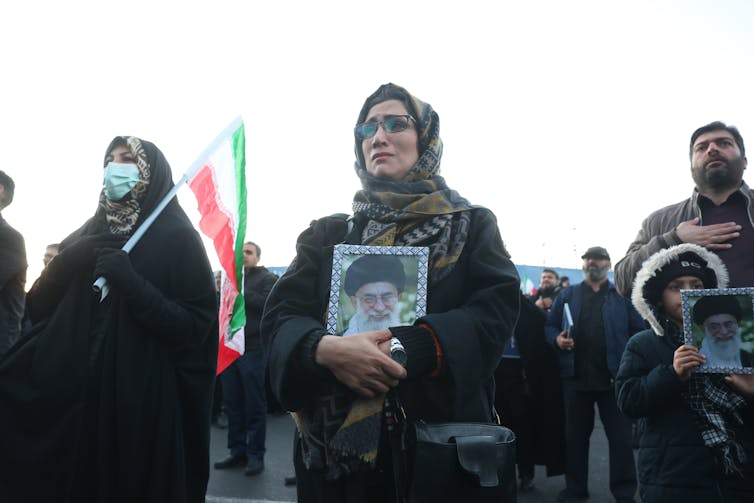
Trump and Netanyahu have called on the Iranian people[7] – some 60% of whom are below the age of 30[8] – to topple the regime once the US-Israeli operations have crippled it.
Many are deeply aggrieved by the regime’s theocratic impositions and dire economic situation and took to the streets in protests in late 2025 and early 2026. The regime cracked down harshly[9] then, killing thousands.
Could a public uprising happen now? So far, the coercive and administrative state apparatus seems to be solidly backing the regime. Without serious cracks appearing among these figures – particularly the IRGC – the regime can be expected to survive this crisis.
Global economic pain
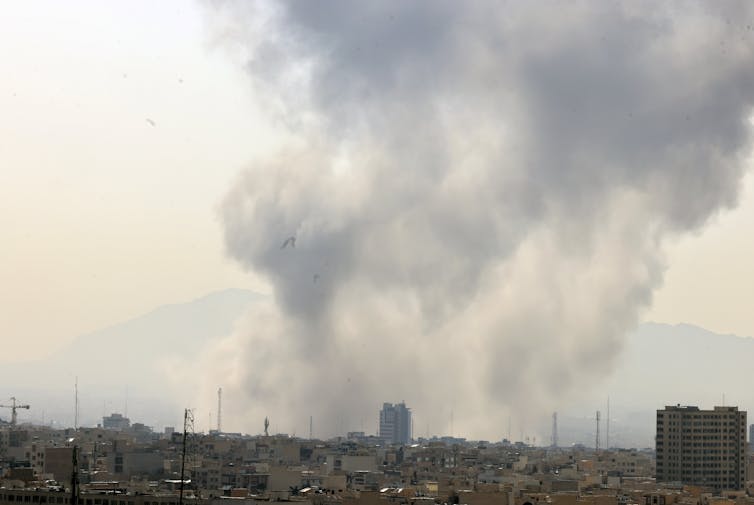
The regime has also been able to respond very quickly to outside aggression. It has already hit back[10] at Israel and US military bases across the Persian Gulf, using short-range and long-range advanced ballistic missiles and drones.
While many of the projectiles have been repelled, some have hit their targets, causing serious damage[11].
The IRGC has also set out to choke[12] the Strait of Hormuz – the narrow strategic waterway that connects the Persian Gulf to the Gulf of Oman and Indian Ocean. Some 20% of the world’s oil and 25% of its liquefied gas flows through the strait every day[13].
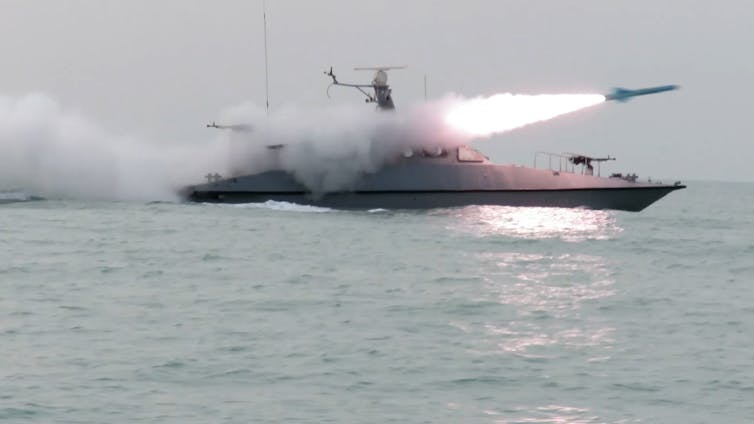
The United States has vowed to keep the strait open, but the IRGC is potentially well-placed to block traffic from going through. There could be serious implications for the global energy supply and broader economy.
Both sides in this conflict have trespassed all of the previous red lines. They are now in open warfare, which is engulfing the entire region.
A prolonged war looks likely
If there was any pretence on the part of Washington and Jerusalem that their attacks would not lead to a regional war, they were wrong. This is already happening.
Many countries that have close cooperation agreements with Iran, including China and Russia, have condemned the US-Israeli actions. The United Nations secretary-general António Guterres has also urgently called[14] for de-escalation and a return to diplomatic negotiations, as have many others.
But the chances for this look very slim. The US and Iran were in the middle of a second round of talks over Tehran’s nuclear program when the attacks happened. The Omani foreign minister, who mediated between the two sides, publicly said[15] just days ago that “peace was within reach”.
But this was not enough to convince Trump and Netanyahu to let the negotiations continue. They sensed now was the best time to strike the Islamic Republic to destroy not just its nuclear program but also its military capability after Israel degraded some of Tehran’s regional affiliates, such as Hamas and Hezbollah, and expanded its footprint in Lebanon and Syria over the last two and a half years.
While it is difficult to be definitive about where the war is likely to lead, the scene is set for a long conflict. It may not last days, but rather weeks. The US and Israel do not want anything short of regime change, and the regime is determined to survive.
With this war, the Trump leadership is also signalling to its adversaries – China, in particular – that the US remains the preeminent global power, while Netanyahu is seeking to cement Israel’s position as the dominant regional actor.
Pity the Iranian people, the region and the world that have to endure the consequences of another war of choice in the Middle East for geopolitical gains in an already deeply troubled world.
References
- ^ killed the Iranian supreme leader, Ayatollah Ali Khamenei (theconversation.com)
- ^ Qassem Soleimani (theconversation.com)
- ^ replaced relatively smoothly (www.amazon.com.au)
- ^ arranged a line of succession (www.nytimes.com)
- ^ political and spiritual leader (www.amazon.com.au)
- ^ three likely candidates (www.nytimes.com)
- ^ called on the Iranian people (www.nytimes.com)
- ^ are below the age of 30 (mei.edu)
- ^ cracked down harshly (theconversation.com)
- ^ hit back (www.aljazeera.com)
- ^ causing serious damage (www.aljazeera.com)
- ^ also set out to choke (www.jpost.com)
- ^ flows through the strait every day (www.abc.net.au)
- ^ urgently called (www.aljazeera.com)
- ^ publicly said (www.commondreams.org)
Authors: Amin Saikal, Emeritus Professor of Middle Eastern Studies, Australian National University; The University of Western Australia; Victoria University