How Taiwan is viewing the Iran war – and what it reveals about US credibility
- Written by: Bonnie Yushih Liao, Assistant Professor of Diplomacy & International Relations, Tamkang University
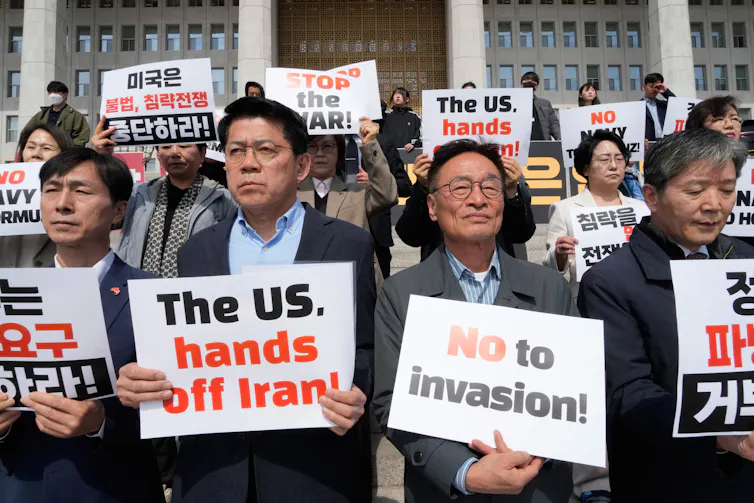
The United States and Israeli strikes on Iran have become increasingly concerning for the world due to the risks of further escalation and the impact on energy markets.
In Taiwan, however, the focus has shifted in a different direction.
Rather than treating the war as geographically distant, Taiwanese political leaders and analysts are viewing it as a real-time indicator[1] of how the United States operates under strategic pressure.
The key question is less about whether the United States would act if a conflict with China were to break out in the Indo-Pacific region, and more about how it would manage competing pressures if multiple crises unfolded at once.
A test of limits, not intentions
There is growing recognition in Taiwan that US resources are not unlimited.
The Middle East war has caused energy prices to fluctuate and stoked fears of rising inflation in the United States, demonstrating the domestic costs of military operations.
US President Donald Trump’s approval ratings[2] have also taken a hit, with some in his own party now questioning his rationale[3] for going to war.
Some reports have indicated[4] US supplies of interceptor missiles are running low. The US military has, for example, had to move some THAAD missile interceptors[5] from South Korea to the Middle East. The US has also struggled to defend[6] against Iran’s use of asymmetrical fighting tactics.
This has direct implications for the deterrence Washington has long maintained in the Indo-Pacific. This deterrence depends not only on US war-fighting capability, but on the expectation this capability will remain intact under strain.
Conflicts elsewhere may not weaken the US resolve to intervene if China were to invade or pressure Taiwan in some fashion. But they can drain American resources and influence where these items are prioritised.
Shifting thresholds for the use of force
The US has also framed its strikes on Iran as a “preventive” action[7] aimed at mitigating a future threat rather than responding to an imminent attack. This raises broader questions about the changing threshold for the use of force in the Indo-Pacific.
For Taiwan, this is not an abstract notion. If the threshold for military action is lowered from imminent threat to potential risk, the strategic environment becomes less predictable in the Indo-Pacific.
This broadens the range of circumstances under which force by the United States may be justified.
The speed with which the Trump administration has acted in Iran has also increased uncertainty for regional partners like Japan and South Korea in assessing when and how the United States would act against China.
The US’ NATO partners weren’t told about the Iran strikes before they happened. This could make Japan and South Korea similarly worried about a lack of communication on potential US actions over Taiwan.
Wars rarely follow anticipated pathways
The Iran war has also raised broader questions about how the United States adapts as crises evolve.
Much of the discussion[8] around Taiwan has traditionally centred on the possibility of a large-scale Chinese invasion[9]. However, recent developments suggest escalation may be less linear than this.
Rather than following a single, predictable pathway, conflicts can develop through a sequence of smaller decisions, the ambiguity over signals sent by an adversary, or rapidly changing political conditions.
This has contributed to a shift in strategic discussion in Taiwan. Recent defence policy debates[10] and security forums have increasingly examined scenarios in which China pressured Taiwan with grey-zone tactics, blockades and incremental escalatory moves, rather than focusing solely on full-scale invasion.
As a result, attention is shifting to how such pressure might build over time – through cyber operations, maritime restrictions or limited military actions – and possibly spiral out of control.
The current crisis in the Strait of Hormuz has been watched closely in Taiwan as an example of how disruption of a strategic chokepoint can quickly impact the world. This raises questions about whether similar dynamics could emerge in the Taiwan Strait, and how prepared external actors – including the US – would be to respond.
The US has also been unable to prevent the Iran war from spilling over into the Persian Gulf states. This raises questions about whether a war over Taiwan could be contained or produce wider regional effects.
The risk of misinterpretation
For Taiwan, the most immediate challenge comes from how China interprets US actions in Iran. If Beijing concludes that diminishing military resources or domestic pressures would limit the US’ ability to wage a sustained conflict in the Indo-Pacific, it may reassess the risks of applying coercive pressure on Taiwan.
This does not imply immediate conflict is likely over Taiwan. However, it increases the likelihood that China would try to pressure or coerce Taiwan just below the threshold of full-scale war.
History suggests[11] that escalation is often shaped by how situations are interpreted by adversaries, rather than by clear shifts in power. When states believe conditions are more favourable than they actually are, the risk of misjudgement increases.
For Taiwan, the challenge is therefore not only to assess developments in the Middle East, but to ensure that its own position is not misunderstood. This involves:
- maintaining credible defensive capabilities
- reinforcing internal cohesion against possible threats
- signalling clearly that any attempt at coercion would face robust resistance.
Deterrence depends not only on what a country can do, but what others believe it will do — and whether those beliefs discourage risk-taking.
References
- ^ real-time indicator (www.reuters.com)
- ^ approval ratings (www.bbc.com)
- ^ questioning his rationale (www.nytimes.com)
- ^ indicated (www.middleeasteye.net)
- ^ THAAD missile interceptors (www.afr.com)
- ^ struggled to defend (theconversation.com)
- ^ “preventive” action (theconversation.com)
- ^ discussion (media.defense.gov)
- ^ large-scale Chinese invasion (www.brookings.edu)
- ^ defence policy debates (indsr.org.tw)
- ^ suggests (www.usni.org)
Authors: Bonnie Yushih Liao, Assistant Professor of Diplomacy & International Relations, Tamkang University