Iran has a powerful new tool in the Strait of Hormuz that it can leverage long after the war
- Written by: Ali Mamouri, Research Fellow, Middle East Studies, Deakin University
The Trump administration claims its blockade of the Strait of Hormuz[1] is working, with nine ships complying with orders to turn around.
One of those was a Chinese-owned tanker called the Rich Starry[2] that turned around in the Gulf of Oman on Wednesday to head back through the strait.
Iran, meanwhile, maintains it still has control over the strait and it will determine which ships transit through the crucial waterway. It also said[3] if its ports are threatened, “no port in the Persian Gulf and the Sea of Oman will remain safe”.
No matter how the blockade plays out, Iran will be in a far better position in the long term when it comes to maintaining control over the strait – not the US.
Iran’s powerful new tool
For decades, Iran had threatened to use the Strait of Hormuz as leverage against its adversaries. It avoided doing so, however, until the current war against the United States and Israel, which it sees as existential.
Ironically, while the US and Israel aimed to weaken Iran’s nuclear and missile capabilities, the conflict has given Tehran a powerful new tool – control of the strait.
Tehran is now likely to make this control a core part of its long-term strategic thinking. In fact, Iran’s negotiators in the recent peace talks with the US had added Iranian sovereignty over the strait[4] to their list of demands.
This leverage serves at least three key purposes.
First, it provides significant revenue potential from the tolls and transit fees it is already charging ships going through the strait.
By imposing minimal transit-related costs — estimated at around US$1 per barrel or up to US$2 million (A$2.8 million) per tanker — Iran could reportedly generate[5] some US$600 million (A$836 million) per month from oil and another US$800 million (A$1.1 billion) per month from gas shipments.
Economists say[6] at least 80% of the tolls would be paid by the Persian Gulf states – or as much as US$14 billion (A$20 billion) a year on oil alone.
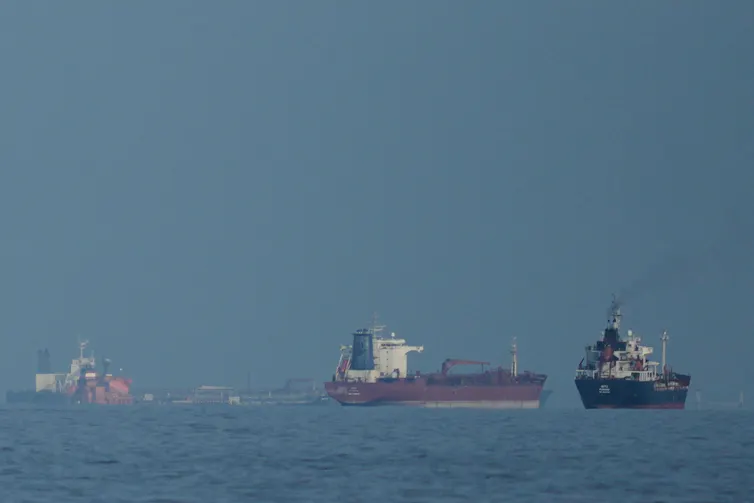
Second, the strait functions as a security guarantee[7]. By demonstrating its ability to disrupt a critical global energy artery, Iran has raised the cost of any future military action against it. This creates deterrence through economic risk rather than purely military means.
Third, it gives Iran geopolitical leverage, particularly with countries in the Global South. Control over the strait allows Iran to bargain with energy-dependent states, encouraging them to circumvent US sanctions on the regime and deepen economic engagement in exchange for concessions accessing the strait.
The US is now trying to neutralise Iran’s leverage over the strait. Yet, this “siege of a siege” faces clear structural limitations.
For one, Iran’s control over the strait is much easier to maintain than a US blockade in international waters. Even with allied support (which has yet to materialise), the US would struggle to restrict access to the strait for an extended period. Such an effort would be highly costly for the US military and would have significant consequences for the global economy.
In this sense, Hormuz risks becoming America’s Suez moment[8] — a strategic chokepoint that reveals the limits of power rather than its reach.
How will China react?
But could China, which buys more than 80% of Iran’s oil[9], play a role in pressuring Iran to relax its control over the strait?
It has not done yet, and is unlikely to do. So far, China is blaming the US and rejecting its blockade.
In fact, China’s Foreign Ministry spokesperson Guo Jiakun used forceful language[10] this week, calling the blockade “dangerous and irresponsible”.
Although one Chinese tanker has been turned around, others have transited[11] through the new “tollbooth” system in recent days. This is an indication of China’s need and willingness to abide by Iran’s new rules – at least for the moment.
While China is exposed to the US blockade – about 40% of its oil imports[12] come through the waterway – it has prepared for this moment.
It has diversified[13] its oil imports to avoid being too reliant on any one supplier. And China is believed to have enough petroleum reserves to replace imports via the strait for up to seven months.
Still, it remains to be seen if China would support a toll system in the long term. Despite Beijing’s silence so far, some experts believe[14] it would oppose this. China has repeatedly stressed the need to return to “normal passage” through the strait as soon as possible.
China’s expanding role in the region
China also stands to benefit from the political shifts that could come after the war.
The war has pushed the Gulf states toward a shared realisation[15] that alignment with the US and partnership with Israel do not necessarily guarantee their security.
As a result, they may seek to diversify their relationships. This is reflected in the crown prince of Abu Dhabi’s visit[16] to Beijing this week.
Trade between the Gulf states and China has grown significantly, with total exchanges reaching approximately US$257 billion (A$358 billion) in 2024[17], narrowly surpassing the Gulf’s combined trade with major Western economies.
China is also expanding its diplomatic footprint in the region, helping to mediate the agreement[18] between Saudi Arabia and Iran in 2023 to normalise relations and playing an indirect role[19] in the recent Pakistan talks between Iran and the US to end the war. It clearly sees a bigger role in the region in the future.
Looking ahead, Iran may seek to leverage this moment to pursue a more regionally based security framework with the Gulf states, potentially with China acting as a guarantor or facilitator. Such a development would mark a significant departure from the longstanding US role as the primary security provider in the region.
References
- ^ blockade of the Strait of Hormuz (www.nytimes.com)
- ^ Chinese-owned tanker called the Rich Starry (www.indiatoday.in)
- ^ said (x.com)
- ^ added Iranian sovereignty over the strait (edition.cnn.com)
- ^ could reportedly generate (edition.cnn.com)
- ^ say (www.wsj.com)
- ^ security guarantee (am.jpmorgan.com)
- ^ America’s Suez moment (www.middleeasteye.net)
- ^ 80% of Iran’s oil (www.reuters.com)
- ^ used forceful language (www.nbcnews.com)
- ^ transited (www.msn.com)
- ^ 40% of its oil imports (www.nytimes.com)
- ^ diversified (www.reuters.com)
- ^ believe (www.wsj.com)
- ^ toward a shared realisation (theconversation.com)
- ^ visit (www.mediaoffice.abudhabi)
- ^ US$257 billion (A$358 billion) in 2024 (www.asiahouse.org)
- ^ mediate the agreement (www.al-monitor.com)
- ^ indirect role (www.abc.net.au)
Authors: Ali Mamouri, Research Fellow, Middle East Studies, Deakin University