What Victoria's abattoir rules mean for the supply and price of meat
- Written by: Flavio Romero Macau, Senior Lecturer in Supply Chain Management and Global Logistics, Edith Cowan University
With Victoria’s declaration of a state of disaster and imposition of Stage 4 restrictions, many Melburnians have returned to panic buying. Supermarket shelves across the city have been stripped of canned goods, fresh vegetables and meat.
The meat buying, at least, makes some sense.
After aged care homes, meat-processing facilities have been a major contributor to Victoria’s COVID-19 outbreak. Hundreds of coronavirus cases have been linked to about a dozen sites[1], with the biggest outbreaks at those in Melbourne’s outer western and northern surburbs.
There were expectations following the state government’s lockdown announcement on Sunday that these facilities might be closed completely, along with the other business restrictions announced on Monday.
Read more: Melbourne non-essential retailers closed, as Morrison unveils pandemic leave[2]
That didn’t happen. But the state’s 70-plus meat-processing facilities[3] will be required to reduce their production capacity by one-third.
They must also implement, in the words of premier Daniel Andrews[4], “some of the most stringent safety protocols that have been ever put in place in any industrial setting”, including workers dressing “as if they were a health worker – gloves and gowns, masks and shields.”
This is going to affect the supply of meat to Victorian supermarkets, and prices. But thankfully not for long.
Why meat processors?
Processing meat is the opposite of an assembly line. It’s a disassembly line, the equivalent of auto workers pulling apart cars – removing the wheels, doors, seats, engine and so on – to sell the parts. Now imagine each car is slightly different, and must be taken apart in a slightly different way, at fast pace.
Automating such work is difficult. It is complex and intensive manual labour. Lots of people work close together, in a hard environment, for long hours, in cold and dry spaces. These factors make it easy for COVID-19 to spread.
The Victorian government’s directive that meat-processing facilities reduce output by one-third is to ensure workplace changes such as gaps between shifts, more physical distancing, and more attention to measures such as wearing personal protective equipment and not sharing cutting equipment.
So production will go at a slower pace. Output will be lower, and the per-unit cost of packaging meat products for consumers will be higher.
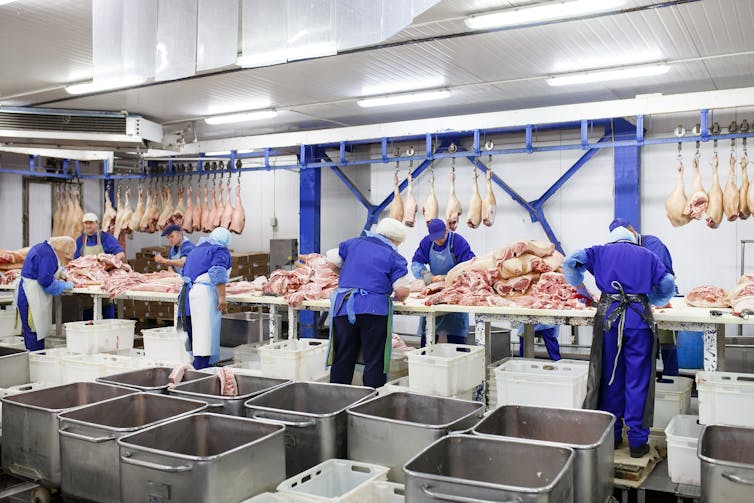 Slaughterhouse meat workers.
Shutterstock
Slaughterhouse meat workers.
Shutterstock
Synchronising the system
Quality and price are key purchasing decisions for most meat shoppers, and the meat industry has been geared to providing fresh produce at lowest cost.
Getting your favourite beef, lamb, chicken and pork cuts to your local supermarket or neighbourhood butcher is a complex game. Meat processing and distribution centres work out how much to produce, where to deliver and when to do it with great precision, planning up to 90 days ahead. They must synchronise supplies from farmers with demand from retailers.
Think of the system’s smooth operation as being like keeping a roomful of clocks synchronised.
If one clock fails, no problem. You can fix it. But what if a handful more clocks fail before you can fix it, and then dozens more fail? In a short time there will be so many faulty clocks that coordination is compromised. Eventually you won’t even know what the right time is.
Reducing capacity in one or two abattoirs for a few days could be worked around with minimal effects to consumers. But there’s no quick fix to reducing capacity in all of them for six weeks.
Supplies for some meat products will almost certainly be lower, and prices could increase. This is most likely to occur for the most common and popular meat cuts, like T-bone steaks or chicken drumsticks. If your preference is offal or giblets, though, you may not have a problem.
Read more: Disagreeability, neuroticism and stress: what drives panic buying during the COVID-19 pandemic[5]
What is the good news?
Yes, there is good news.
First, thanks to refrigerated transport, meat processors in other states can help meet lower production in Victoria. The industry has some flexibility to move from north to south, from west to east.
Second, supermarkets have been quick to bring restrictions back to prevent the panic buying and hoarding that make shortages even worse. Coles and Woolworths have already imposed two-pack limits[6] on meat packages (and other products).
Third, to hoard meat you need freezer capacity, and it’s quite possible those disposed to stockpiling still have frozen meat from the first COVID-19 wave.
Read more: Don't panic (again): here's why Melbourne's supermarket shortages will quickly pass[7]
Fourth, supermarkets and hundreds of smaller operators such as butchers will be affected in different ways at different times. Finding what you want may simply require looking in more than one shop.
Fourth, there are options. Not just between different fresh products such as beef, chicken, pork, lamb and fish, but between preserved, frozen and canned alternatives.
So it might be just a bit harder to have your preferred choice of meat for dinner in the coming days. But the situation won’t be as dire as some fear.
References
- ^ linked to about a dozen sites (www.stockandland.com.au)
- ^ Melbourne non-essential retailers closed, as Morrison unveils pandemic leave (theconversation.com)
- ^ 70-plus meat-processing facilities (www.aussiefarms.org.au)
- ^ premier Daniel Andrews (www.sheepcentral.com)
- ^ Disagreeability, neuroticism and stress: what drives panic buying during the COVID-19 pandemic (theconversation.com)
- ^ imposed two-pack limits (7news.com.au)
- ^ Don't panic (again): here's why Melbourne's supermarket shortages will quickly pass (theconversation.com)
Authors: Flavio Romero Macau, Senior Lecturer in Supply Chain Management and Global Logistics, Edith Cowan University