Weekend Times


Google Workspace

Business News

Borrowing from King Solomon, economists are getting closer to working out how good leaders can make good decisions

  • Written by Richard Holden, Professor of Economics, UNSW

Borrowing from King Solomon, economists are getting closer to working out how good leaders can make good decisions

Here’s a story from the Bible. As far as I know, it’s the first reported instance of the branch of economics known as “implementation theory”.

It’s from the First Book of Kings, Chapter 3, starting at Verse 16[1].

Two women came before King Solomon with two babies, one dead and one alive.

Each claimed the live boy was her son, and the dead boy belonged to the other.

Then the king said, “Bring me a sword.” So they brought a sword for the king. He then gave an order: “Cut the living child in two and give half to one and half to the other.”

The woman whose son was alive was deeply moved out of love for him and said to the king, “Please, my lord, give her the living baby, don’t kill him!”

The other said, “neither I nor you shall have him, cut him in two!”
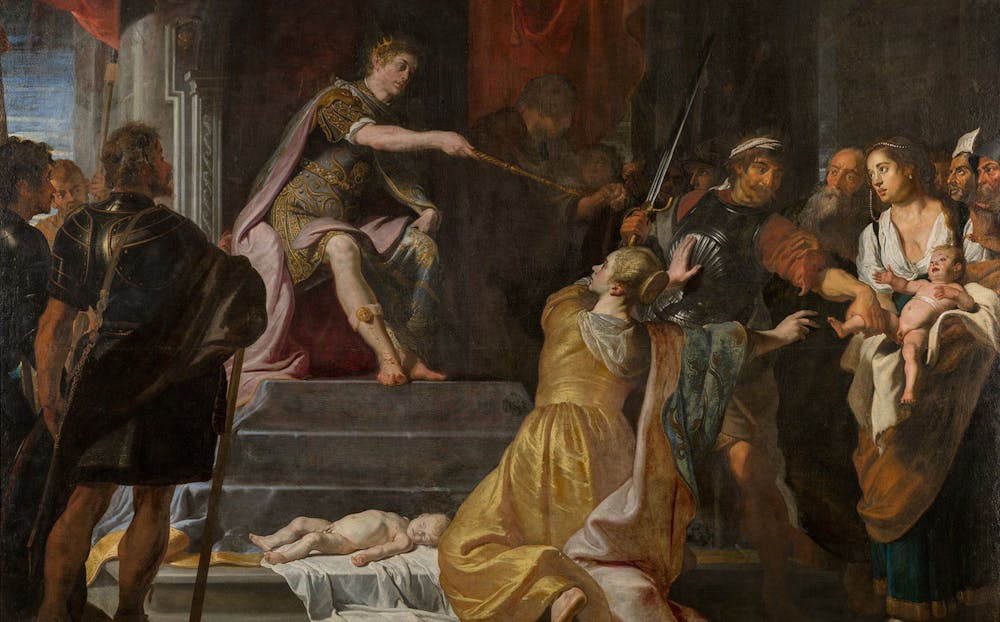
Gaspar de Crayer, Public Domain[2] Then Solomon gave his ruling: Give the living baby to the first woman. Do not kill him; she is his mother. Implementation theory asks the following question: given a social objective, can we design a game or “mechanism” whose predicted outcome is desirable? If you think that sounds broad, you are right. A social objective could be almost anything: what public goods to provide, whom to elect, what our environmental or defence policy should be, how to pay for things. Solomon pioneered “implementation theory” This suggests a tantalising possibility. Maybe some central authority, a “mechanism designer” like King Solomon could construct a series of questions for the parties involved that would lead us to the best outcome for society. Solomon might have begun the practice, but the formal study of it began with another wise person, Eric Maskin[3], in 1977. He went on, three decades later, to win the Nobel Prize for his work. Read more: Economic theories that have changed us: game theory[4] Maskin spoke about “social choice functions”. A social choice function is a sort-of formula that takes as an input all the relevant attributes of the people in a society and gives as an output the best social choice. You could envisage one where the output was the best environmental policy and the best way to pay for it and the input was all the views in society. But Maskin discovered that only certain types of problems can be solved this way. It’s less easy than Solomon made it look Among the problems that cannot be solved this way are those where decisions have distributional consequences, such as whether to build a road which will leave some people better off and and some people relatively worse off. Another problem is while a mechanism might implement a desirable outcome, it might not be the only desirable outcome. In the language of economics, it might be an equilibrium, but not the only equilibrium. Later economists have helped. John Moore and Raphael Repullo[5] showed that by allowing for sequential rather than simultaneous announcements by players, it is possible to resolve both of these limitations: We are able to implement any social choice function as a unique equilibrium. Wow! But there’s progress If that sounds too good to be true it kind of is. With co-authors[6], I have shown that sequential mechanisms might not properly work if there is even a tiny amount of incomplete information shared between the players. Ernst Fehr, Mike Powell and Tom Wilkening have shown that a lot depends[7] on what is observable. In an attempt to get social choice functions with sequential announcements to work, I and others[8] have proposed a new type of mechanism that is impervious to incomplete information and to some departures from rationality. Read more: The legacy of John Nash and his equilibrium theory[9] I am not saying we can construct mechanisms to solve all public policy questions. What I am saying is the work done so far provides important lessons. People need incentives to reveal their private information. If we expect people to provide information needed for making better public policy, we need to make it in their interests to reveal it. For policy to be robust it needs to be simple. Complicated policy (just like complicated implementation mechanisms) can be “gamed” to deliver the wrong result. We should be modest about what a central Solomon-like authority can do. Central rulers can be powerful, but they often have less information than what is dispersed in society, and have to respect the decision-making processes of others. Editor’s note: This has been Richard Holden’s 300th contribution to The Conversation. References^ Verse 16 (www.kingjamesbibleonline.org)^ Gaspar de Crayer, Public Domain (www.mskgent.be)^ Eric Maskin (www.nobelprize.org)^ Economic theories that have changed us: game theory (theconversation.com)^ John Moore and Raphael Repullo (www.jstor.org)^ co-authors (research.economics.unsw.edu.au)^ a lot depends (www.aeaweb.org)^ and others (drive.google.com)^ The legacy of John Nash and his equilibrium theory (theconversation.com)Authors: Richard Holden, Professor of Economics, UNSW

Read more https://theconversation.com/vital-signs-borrowing-from-king-solomon-economists-are-getting-closer-to-working-out-how-good-leaders-can-make-good-decisions-171106

The Weekend Times Magazine

Coasting through Australia: 5 things you need to know

No matter where you choose to explore, you can never go wrong with Australia. The best time to spend time on the water in Australia is during the autumn and...

The Importance of Quality Paint Protection for Brisbane Drivers

Shielding Your Vehicle with the Right Protection Every car owner appreciates that fresh showroom finish—the gleam of the paintwork, the smoothness of brand new panels. But once you drive out of...

What To Look For In a Robot Pool Cleaner

Robotic pool cleaners are a stunning feat of modern technology, allowing you to keep your pools clean with minimal effort on your part. Pool cleaning and maintenance has always remained...

The Most Popular Tattoo Placements (and Why)

Choosing where to place your tattoo is almost as important as choosing the artwork itself. Placement affects how a tattoo looks, how it heals, how visible it is in day-to-day...

Lifestyle Awnings – Bringing Style and Comfort to Melbourne Outdoor Living

Melbourne homeowners are always looking for ways to make better use of their outdoor areas. Whether it's entertaining, relaxing, or adding value to the property, installing Lifestyle Awnings is one of...

The 29-year-old Australian Revolutionising The Edible Collagen Market

Known as ‘Nature’s Botox’, scientific research shows collagen is not only anti-ageing and good for skin, but also optimises health, ligaments, muscle recovery, the gut, and helps heal the digestive...

The best Nike shoes you can buy right now

You certainly have a few pairs of Nike sneakers around the house, but you may not be aware that the brand famous for its Swoosh was not always known as...

Planting The Seed To Health Living Top tips on planting for wellbeing

With the family home full time and a need to keep everyone busy, it is the ideal time to plant a seed to a healthier lifestyle. Tuscan Path Product Manager...

Making these five clever moving mistakes will cost you both money and time

Moving to a new location can be a thrilling adventure, but it can also be costly and stressful. Because so much packing, planning, and logistics are involved, it is easy...