The pandemic exposes NZ’s supply chain vulnerability – be ready for more inflation in the year ahead
- Written by: Rahul Sen, Senior Lecturer, School of Economics, Auckland University of Technology
You don’t have to be an economist to know New Zealand faces its highest annual inflation rate[1] in 30 years – 5.9% as of December 2021. Visit a supermarket or petrol station and the evidence is right before your eyes.
The average price of petrol per litre is now up by 31% compared to last year. In some places, it has already hit NZ$3 a litre. To take just one grocery example, tomatoes doubled in price during the same period, contributing to the highest annual food price inflation since 2011.
These severe price hikes are a direct reflection of the impact of the global pandemic on tradable inflation – that is, goods and services we either import for our own consumption or as components in our own manufacturing and exporting processes.
Since mid-2021, annual tradable inflation has been outpacing non-tradable inflation (the rising price of goods and services we produce and consume domestically) – 6.9% versus 5.3% at December 2021.
While tradable inflation accounts for about 40% of New Zealand’s overall inflation, the pace at which it’s growing means external sources are increasingly fuelling inflationary pressure.
Pandemic pressures
Much of this can be sourced back to the effects of the pandemic on global supply lines. Three key factors are driving the pressures:
Costs of raw materials and other inputs are rising at each stage of the supply chain, with factories closing and reopening due to changing restrictions. The semiconductor industry, for example, has been facing a chip shortage since 2021.
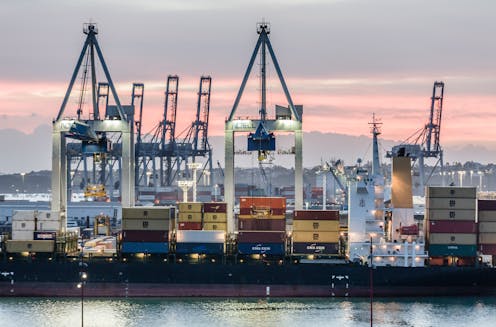
Logistics and transport costs are rising due to massive disruptions at the distribution end of the supply chain. Reduced airline capacity and rerouting of cargo, coupled with lockdowns and isolation requirements, have led to delays in unloading cargo at ports and slower turnaround times for ships. Freight company Mainfreight, for example, expects delays of 20-30 days[2] above normal shipping times for Auckland.
Energy costs are rising, partly due to recovery in global demand in 2021, combined with supply shortages and cartel-controlled production.
Read more: Energy prices: how COVID helped them to surge – and why they won't go down any time soon[3]
These combine to cause disruption at each stage of supply chain – production, transportation and distribution – forcing New Zealand to “import” more inflation on top of what is being generated from within its own economy. Vehicles, fuel, clothing, processed foods and manufacturing materials have all been affected.
Supply chain vulnerability
The rising cost of house construction provides an illustrative example. Prices go up when, say, imported iron girders cost more to produce in their country of origin, in turn caused by costlier imports of iron and steel.
On top of this there can be delays in shipping the materials due to port closures or workforces affected by the pandemic.
Similarly, the scarcity caused by a worldwide semiconductor shortage means higher costs of production for electronic products and new vehicles, pushing up retail prices for imports.
Read more: Inflation is raising prices and reducing real wages – what should be done to support NZ’s low-income households?[4]
Above all, rising energy costs are a financial body blow to the transport and logistics sector – the backbone of the local economy. The geopolitical tensions over Ukraine and Russia – both major oil and gas producers – simply add to the risk of spiking imported energy costs.
The pandemic has exposed New Zealand’s ever-present vulnerability to global supply chain disruptions. If the emergence of new COVID-19 variants affects New Zealand’s major trading partners (China, Australia, US, EU and Japan) imported inflation will remain a problem throughout 2022.
No quick fix
The unpredictable impacts of the pandemic on supply chain-led tradable inflation create a tough balancing act for policymakers because the causes are out of their direct control.
The Reserve Bank’s use of interest rates and monetary policy to maintain short-term price stability has worked well when domestic factors drove inflation. It’s a lot trickier when external supply shocks become the key drivers, and inflation predictions are clouded by global uncertainties.
Read more: How to prevent disruptions in food supply chains after COVID-19[5]
Some relief could be provided by the government reducing GST and fuel taxes, but this is not a quick fix. In the medium to longer term, New Zealand needs to diversify risk and bring some supply chains back within its own borders.
The government could take a cue from the trilateral supply chain resilience initiative (SCRI[6]) launched last year by two of New Zealand’s main trading partners, Australia and Japan, and the fastest-growing emerging global market, India. Its aim is to identify key sectors vulnerable to supply chain shocks and invest in their resilience to future uncertainties.
For now, however, New Zealand can count on an unpredictable road ahead, and should be ready for the possibility of even higher inflation than the year before.
References
- ^ highest annual inflation rate (www.stats.govt.nz)
- ^ 20-30 days (www.nzherald.co.nz)
- ^ Energy prices: how COVID helped them to surge – and why they won't go down any time soon (theconversation.com)
- ^ Inflation is raising prices and reducing real wages – what should be done to support NZ’s low-income households? (theconversation.com)
- ^ How to prevent disruptions in food supply chains after COVID-19 (theconversation.com)
- ^ SCRI (thediplomat.com)
Authors: Rahul Sen, Senior Lecturer, School of Economics, Auckland University of Technology