As the Commerce Commission found, there’s no magic way to make NZ supermarkets more competitive
- Written by: Alan Renwick, Professor of Agricultural Economics, Lincoln University, New Zealand
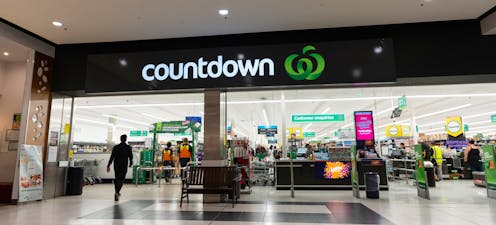
The Commerce Commission’s much-anticipated review of supermarket competition[1] has itself had mixed reviews. Many felt a major opportunity to reset New Zealand’s food system had been missed, others felt the commission’s final report got it about right – and supermarket owners probably breathed a little easier.
A review of the big players was certainly due. New Zealand has one of the most concentrated grocery retailing sectors in the world.
Foodstuffs and Woolworths control at least 80% of the market. There has been widespread concern they were using this dominance to the detriment of both suppliers[2] and consumers[3], especially low-income households.
Beyond the perception that New Zealand food prices were too high, there have also been claims of a lack of clarity in pricing, that suppliers were being unfairly treated, and that competitors were being prevented from entering the market – for example, through the use of restrictive land covenants by the dominant companies.
To varying extents all these concerns were validated during the investigation. The commission recommended mandatory unit pricing (to allow simpler price comparisons) and a statutory code of conduct governing how supermarkets deal with suppliers.
But those measures won’t tackle the issue of high prices and profits due to the lack of competition, and this is where the commission’s light-handed approach has drawn most criticism. The trouble is, even a heavier hand might not have achieved the desired outcomes.
Breakups don’t add up
That the commission shied away from the more radical interventions discussed during the investigation – and which might have gone further than remedies considered in other countries – is not so surprising.
A cursory examination of proposals to restructure the sector – by forcing supermarkets to sell stores or by separating out their wholesale and retail divisions – shows the costs could potentially outweigh the benefits.
Losses in scale and efficiency through breaking up the supermarkets, and the complexity of trying to ensure wholesale markets worked, risk increased costs in the supply chain and even higher prices – the exact opposite of what was intended.
Read more: The pandemic exposes NZ’s supply chain vulnerability – be ready for more inflation in the year ahead[4]
And it is certainly not clear that the much touted option of directly supporting the emergence of a third competitor in the market would remedy anything.
Moving from two to three players does not in itself constitute a magic leap from non-competitive to competitive markets. Three competitors can accommodate each other nearly as well as two!
Other countries – for example, Ireland and the UK – have faced similar competition issues, despite having five or more competing supermarket chains. It is not the number of competitors that matters, but the conditions under which they compete.
Insufficient remedies
To encourage competition without directly interfering in the structure of the industry, the commission recommended two main solutions: making it easier for competitors to access land, and that supermarkets offer wholesale supply to other grocery retailers on a voluntary basis (albeit with some regulation).
So the multi-million-dollar question – quite literally, given the financial stakes – is whether these changes are likely to increase competition and improve the situation for consumers and suppliers.
The answer is almost certainly no. Neither of the measures is sufficient to make emerging businesses viable. Given their size and power, the incumbent supermarkets could make it very difficult for new chains to establish a foothold and compete – by aggressive pricing in areas where new stores emerge, for example, or by upping their advertising spend.
Read more: Inflation is raising prices and reducing real wages – what should be done to support NZ’s low-income households?[5]
Overseas experience tends to suggest that, overall, there is little in the commission’s recommendations likely to have a major impact on the way New Zealand supermarkets operate.
Many of the commission’s proposals have been implemented in one form or another in the UK and, to a lesser extent, Ireland. The UK began in the 1990s by issuing a voluntary code of practice for supermarkets. Its failure meant it was later replaced by a statutory code of conduct supported by the appointment of an ombudsman.
Ireland also introduced a statutory code of conduct in 2014 but has yet to appoint[6] a regulator, while farmers have been protesting[7] over retailers failing to pass on price increases.
The UK has now had the statutory code for nearly a decade. While it appears to have had some success[8], the fundamental imbalance of power remains a problem[9]. Suppliers are unlikely to risk their businesses by complaining about their main or only customer.
Read more: The cost-of-living crisis will put more pressure on shoppers than COVID[10]
Expect little change
As we see upward pressures on food prices from supply-chain disruptions and the direct and indirect effects of the Russian invasion of Ukraine, it’s more important than ever that food markets work well.
Scale is an issue. In the UK and Ireland, the emergence of German discounters has done more to increase competition than any actions by regulators.
But the combination of New Zealand’s remoteness and relatively small population limits the viability of increasing competition through encouraging new large-scale entrants.
This points towards a realistic approach that effectively accepts the current structure but with more stringent regulation of the supermarket chains.
Overall, the Commerce Commission’s recommendations may be a step in this direction. But it’s unlikely the country’s supermarket owners will have suffered indigestion after reading the report. And it’s also unlikely the price of tomatoes will be falling anytime soon.
References
- ^ review of supermarket competition (comcom.govt.nz)
- ^ suppliers (www.stuff.co.nz)
- ^ consumers (www.1news.co.nz)
- ^ The pandemic exposes NZ’s supply chain vulnerability – be ready for more inflation in the year ahead (theconversation.com)
- ^ Inflation is raising prices and reducing real wages – what should be done to support NZ’s low-income households? (theconversation.com)
- ^ yet to appoint (www.foodnavigator.com)
- ^ protesting (www.irishexaminer.com)
- ^ some success (www.bbc.com)
- ^ remains a problem (www.independent.co.uk)
- ^ The cost-of-living crisis will put more pressure on shoppers than COVID (theconversation.com)
Authors: Alan Renwick, Professor of Agricultural Economics, Lincoln University, New Zealand