Weekend Times


Google Workspace

Business News

What would it take to get Australians to buy electric cars? Canberra provides a guide

  • Written by Yogi Vidyattama, Associate Professor, National Centre for Social and Economic Modelling, University of Canberra
What would it take to get Australians to buy electric cars? Canberra provides a guide

Only 5,532[1] of the 101,233 new cars sold in Australia last month were all-electric.

While that number is an improvement on previous months, it is tiny[2] compared to the 25% to 85% of new cars sold that are all-electric in European nations such as Germany, the Netherlands, Denmark and Norway.

A lot has been written about why that is[3], but less about what an individual state or territory can do to improve it, in the absence of help from the federal government.

Our team at the National Centre for Social and Economic Modelling, University of Canberra[4] has examined what the Australian Capital Territory[5] (ACT) is doing, and what effect this is having on electric vehicle take-up by price and type of household.

The ACT offers three incentives[6]

  • a full exemption from stamp duty on purchase

  • two years free registration

  • a zero-interest loan of up to A$15,000 for eligible households[7]

We used Australian Bureau of Statistics census and household expenditure data as well as microsimulations based on a survey of vehicle preferences to examine behaviour before and after the changes.

We simulated the decision to buy electric based on a total cost of ownership, which included the value of the vehicle as well as operational costs including petrol, service and repair.

Incentives matter

Our modelling found that with a stamp duty exemption, at an electric vehicle price of A$50,000, around 9%[8] of new vehicles sold would be electric in five years.

The proportion climbs to 11% with zero-interest loan and free registration added.

But even after five years, the proportion of total cars on ACT roads that were electric would be small: just 1.6% with just the stamp duty exemption, and 2.0% with the other measures as well.

This result is much higher than the latest-known proportion of electric vehicles in the ACT, which in 2019 was 0.1%. Nationally, only 23,000[9] (0.011%) of the 20.1 million vehicles registered are electric.

Prices matter

At a much-lower electric vehicle price of $25,000, an extraordinary 23%[10] of new vehicles sold after five years would be electric, provided they were stamp duty exempt.

If there was also a zero-interest loan of $15,000, the proportion would increase to 27%, and with two years free registration as well, to $30%.

As a proportion of the entire car fleet in the ACT, the figures would be 4.1%, 4.8% and 5.3% respectively, depending on those price, loan and registration factors. That would mean much larger demand than at present, but still small enough to mean the infrastructure for maintaining conventional vehicles would be needed for some time.

Income matters

We found that high income households are far more likely to replace their cars within five years and far more likely to switch electric even without incentives – and that for them, the incentives didn’t make much difference.
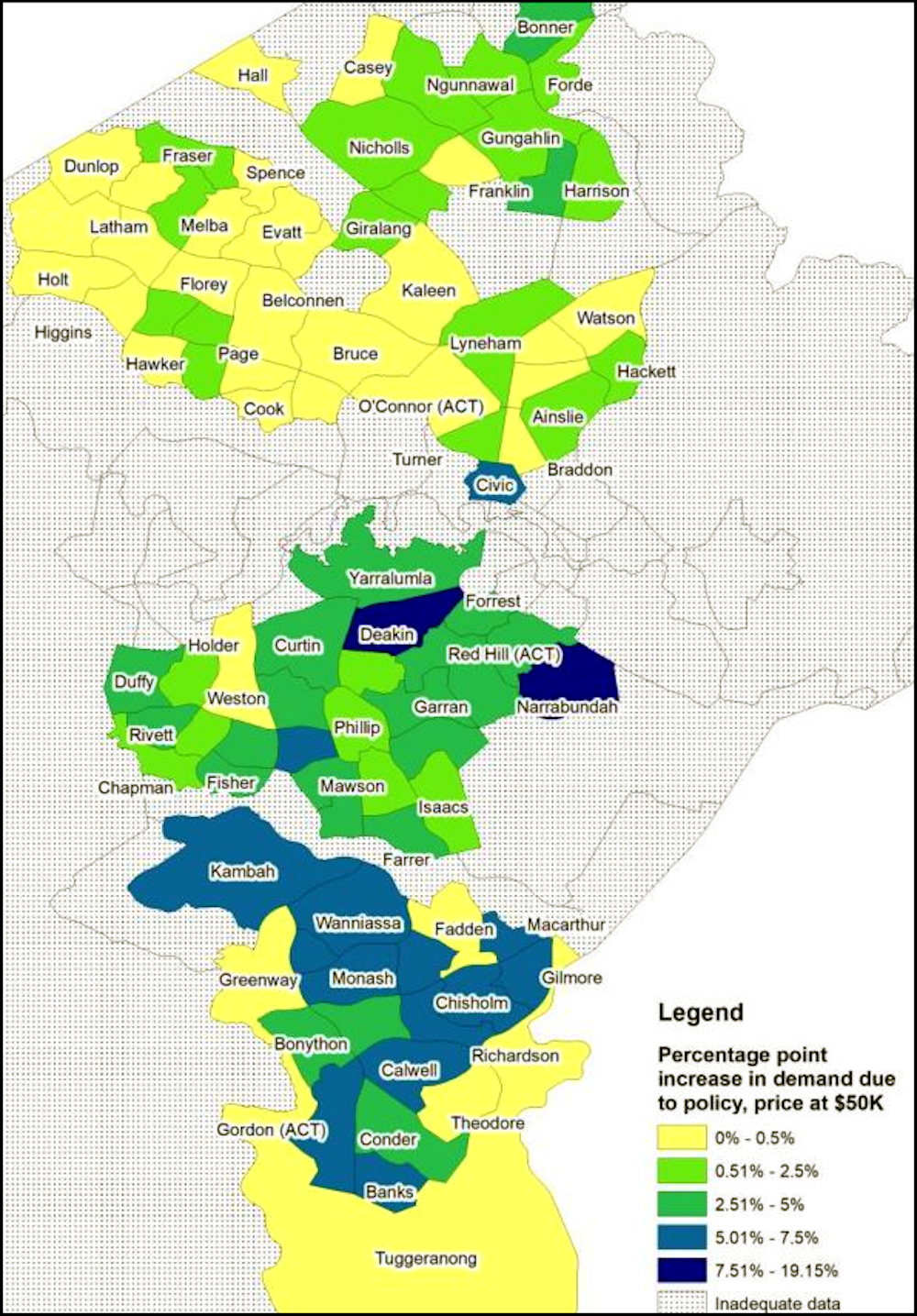
NATSEM, Impact simulation of ACT EV policy[11] The incentives had their biggest impact, not among the highest earning three-fifths of households, or among the bottom fifth, but in the second-bottom fifth. For that group, the interest-free loan was found to be more important than the free registration, whereas for higher income households it was the other way around. In terms of geography, the highest take up is set to be in Canberra’s inner north and south where incomes are high. Nevertheless, our modelling also suggests a high take up in the south of Canberra. Petrol matters And the take-up rate depends on the price of petrol. The price used in our modelling was the 2018-19 price of around $1.45 per litre for unleaded and diesel. Our modelling suggests that the recent increase in price to around $2 a litre would lift the purchase of electric vehicles by 0.5 percentage points, while an increase to $3 would increase take-up by around 2.5 percentage points. Different states are experimenting with different incentives. Victoria, NSW and Queensland are offering $3,000 rebates[12] on the purchase price, along with a registration discounts in Victoria offset by a road user charge. Read more: The embarrassingly easy, tax-free way for Australia to cut the cost of electric cars[13] What applies to the ACT might not apply elsewhere, especially as average incomes in Canberra are higher than in other cities. But our modelling provides a guide as to how incentive-based policies can work. Policies that increase the electric vehicle take-up in lower income households are likely to have the greatest effect, and also likely to benefit these households by freeing them from the need to pay for fuel. References^ 5,532 (www.carexpert.com.au)^ tiny (en.wikipedia.org)^ why that is (theconversation.com)^ National Centre for Social and Economic Modelling, University of Canberra (www.governanceinstitute.edu.au)^ Australian Capital Territory (www.environment.act.gov.au)^ three incentives (www.environment.act.gov.au)^ eligible households (www.climatechoices.act.gov.au)^ 9% (cdn.theconversation.com)^ 23,000 (www.abs.gov.au)^ 23% (cdn.theconversation.com)^ NATSEM, Impact simulation of ACT EV policy (cdn.theconversation.com)^ rebates (evcentral.com.au)^ The embarrassingly easy, tax-free way for Australia to cut the cost of electric cars (theconversation.com)Authors: Yogi Vidyattama, Associate Professor, National Centre for Social and Economic Modelling, University of Canberra

Read more https://theconversation.com/what-would-it-take-to-get-australians-to-buy-electric-cars-canberra-provides-a-guide-178778

The Weekend Times Magazine

What is Medicines Optimisation and Why is it Important?

Medicines optimisation is a patient-focused approach to safe and effective medication use that helps people get the best possible outcomes from their treatments. Rather than simply ensuring patients take their...

Who Can Install A Private Power Pole?

Private power poles provide property owners with the freedom to choose where electricity will enter the building. It also offers protection from hazards associated with being directly connected to the...

Diamonds & Why They Are The Popular Choice For Any Occasion Here In Australia

Diamonds have been an incredibly popular gem for many years now and they continue to be so even now in 2024. It seems like the perfect jewel to choose for...

Stylish and Sustainable Comfort with Ceiling Fans Adelaide

For Adelaide homeowners, finding the right balance between comfort, style, and energy efficiency is always a priority. With hot, dry summers and mild winters, it’s important to have cooling solutions...

The Best Camera Smartphones for 2021

Everyone is a photographer these days, and it is no surprise, given that the top camera phones on the market are capable of fighting head-on with luxury compact cameras and...

Aussie Rules Football History

One of the things that make Australia truly unique is its own version of football. Called Australia rules football, this sport precedes other contemporary football games in generating an official...

Ben & Jerry’s launches ‘next-level ice cream’ phenomenon

Get ready, ice cream fans – a new ice cream revolution is coming to Australian shores! Ben & Jerry’s is today officially launching its new range of flavours to the...

How to Pay Off Your Mortgage Faster

Paying off the mortgage on your property early can save you significant amounts of money on interest Freeing yourself of the burden of having to keep up with monthly mortgage...

Niacinamide: Skincare’s Ultimate Multitasker

One ingredient, multiple uses: why niacinamide is this year’s most relevant skincare ingredient Niacinamide—also known as vitamin B3—is celebrated as skincare’s brilliant all-rounder. A relative newcomer in commercial cosmetic formulations, this...