Why unemployment is set to stay below 5% for years to come
- Written by: Peter Martin, Visiting Fellow, Crawford School of Public Policy, Australian National University
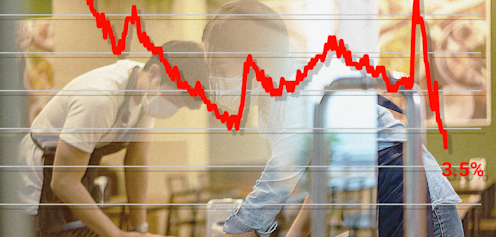
Unfathomably, Australia’s unemployment rate has sunk to 3.5%[1]. Even harder to believe is that it will soon sink lower – perhaps even this week, when the update is released on Thursday – and after that, if the ANZ’s forecasts are correct, dip below the next threshold to two-point-something[2] for the first time since 1974.
That this can be happening at a time when interest rates are soaring and households are tightening their belts[3] belies standard analysis.
So what’s driving this new ultra-low unemployment? It’s been harder for employers to get workers, because borders were closed, and because of unusually high rates of people off sick.
But digging further into the economic data reveals something we haven’t seen before – which has already changed the lives of almost 100,000 Australians.
Time lost to illness has almost doubled
Even now, an awful lot of workers on whom employers normally depend are sick, or on reduced hours, caring for someone who is sick.
In the years before COVID (and in the first two years of COVID itself), typically 3% of the workforce worked less than usual hours in any given week as a result of illness or injury. Calculations by the University of Melbourne’s Jeff Borland suggest so far this year it’s been 5.2%[4].
The effect isn’t quite as dramatic when you examine the number of hours lost. Pre-COVID (and in the first two years of COVID) 2% of working hours were lost to illness. So far this year, with so many of us ill, it’s been 3.8%.
As a sign at a doctor’s surgery I visited the other day read:
The whole world is short-staffed, be KIND to those who show up.
Borland illustrates what sickness is doing to employment by talking about a café with five staff. He says if one is away one day per week on average, the cafe might have to put on a sixth to cover – if it can. Unfilled vacancies are higher than ever[5].
It’s also true (at least until now) we’ve been spending big-time, spurred on by pent-up demand from when we were all in lockdown, as well as ultra-low interest rates and generous[6] government support.
We escaped the jobless ‘escalator’
But there’s something else explaining our new ultra-low unemployment, something that flows from the nature of the labour market – and how it’s different from the market for goods in shops.
You can see it most clearly when unemployment climbs.
In the half century we have been collecting modern employment statistics, unemployment has shot up dramatically three times:
in the mid 1970s, when it jumped from 2.1% to 5.4% in a matter of months and never came back down
in the early 1980s, when it jumped from 5.3% to 10.3%, and took six years to come back down
in the early 1990s, when it jumped from 5.8% to 11.2%, and took seven years to come back down.
Each time, unemployment went up by the escalator, and down by the stairs[7].
Remarkably, as the graph shows, that’s not what happened during the global financial crisis or COVID. Instead, both times the government and Reserve Bank went hard and early[8] with as much support as it took[9] to prevent unemployment climbing too far.
If unemployment had shot up as it had in earlier crises, it might have taken the best part of a decade to get down.
The long-lasting scars of unemployment
Economists use an ugly word to describe the reasons why unemployment stays high long after the reason for high unemployment has passed. It’s “scarring[10]”.
Each person who loses their job or who is unable to get a first job when unemployment shoots up can lose confidence and up-to-date work experience.
Then, as things improve and employers begin hiring again, people who have been out of work for longer get pushed back in the queue. Employers find it safer to take on new graduates or people with more recent experience.
Read more: Forget the election gaffes: Australia's unemployment rate is good news – and set to get even better by polling day[11]
The more those who were unlucky during a crisis get pushed to the back of the queue, the less employable they seem – and the less employable they become.
This puts a new higher “floor” under the unemployment rate, because it gets to the point where employers would rather not fill a vacancy than put on someone who’s been continually passed over.
It’s a phenomenon well known to the Treasury[12] and Reserve Bank[13]. What’s less well known, and is only now becoming apparent, is that it can work in reverse.
Almost 100,000 lives already transformed
If employers are forced to hire people they wouldn’t have in other circumstances, because they’ve run out of every other conceivable option, those people become employable. They either develop the right skills, or employers discover they are not so bad after all. The floor under the unemployment rate drops.
We haven’t seen this before – at least, not in the past half century – because employers have never before been given no other option but to employ people they would really rather not.
People are regarded as long-term unemployed (and harder to employ) if they’ve been out of work for one year or more. In the year to June 2022, the number of long-term unemployed fell from 218,200 to 130,100.
Read more: How we invented 'unemployment' – and why we're outgrowing it[14]
That fall is far more important than the fall in the total number of unemployed from 682,400 to 493,900.
It means those Australians are more likely to be employed than shunned for years to come. It means future employments rates are more likely to start with a “2”, a “3” or a “4” than a “5”.
It means we’ve bought ourselves long-lasting lower unemployment, whatever happens from here on.
It also means the best part of 100,000 lives have been transformed. It means the best part of 100,000 people no longer face years on JobSeeker.
Read more: Technically unemployment now begins with a '3'. How to keep it there?[15]
And it means we’ve discovered something really useful.
Just as a crisis that renders people near unemployable can lift the floor under unemployment for years to come, a crisis that forces employers to take on people rendered near unemployable can cut it, perhaps for a very long time.
References
- ^ 3.5% (www.abs.gov.au)
- ^ two-point-something (cdn.theconversation.com)
- ^ tightening their belts (www.westpac.com.au)
- ^ 5.2% (cdn.theconversation.com)
- ^ higher than ever (theconversation.com)
- ^ generous (theconversation.com)
- ^ down by the stairs (twitter.com)
- ^ hard and early (theconversation.com)
- ^ as much support as it took (theconversation.com)
- ^ scarring (drive.google.com)
- ^ Forget the election gaffes: Australia's unemployment rate is good news – and set to get even better by polling day (theconversation.com)
- ^ Treasury (treasury.gov.au)
- ^ Reserve Bank (www.rba.gov.au)
- ^ How we invented 'unemployment' – and why we're outgrowing it (theconversation.com)
- ^ Technically unemployment now begins with a '3'. How to keep it there? (theconversation.com)
Authors: Peter Martin, Visiting Fellow, Crawford School of Public Policy, Australian National University
Read more https://theconversation.com/why-unemployment-is-set-to-stay-below-5-for-years-to-come-188705