China's influence in Myanmar could tip the scales towards war in the South China Sea
- Written by: Htwe Htwe Thein, Associate professor, Curtin University
The fate of Myanmar has major implications for a free and open Indo-Pacific.
An undemocratic Myanmar serves no one’s interests except China, which is consolidating its economic and strategic influence in its smaller neighbour in pursuit of its two-ocean strategy[1].
Read more: Friday essay: if growing US-China rivalry leads to 'the worst war ever', what should Australia do?[2]
Since the coup China has been – by far – the main source of foreign investment[3] in Myanmar.
This includes US$2.5 billion[4] in a gas-fired power plant to be built west of Myanmar’s capital, Yangon, that will be 81% owned and operated by Chinese companies.
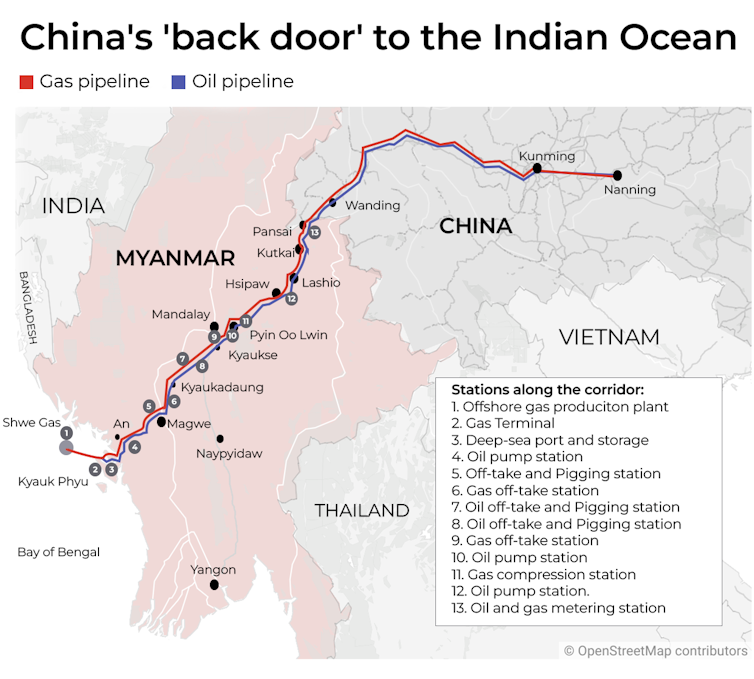
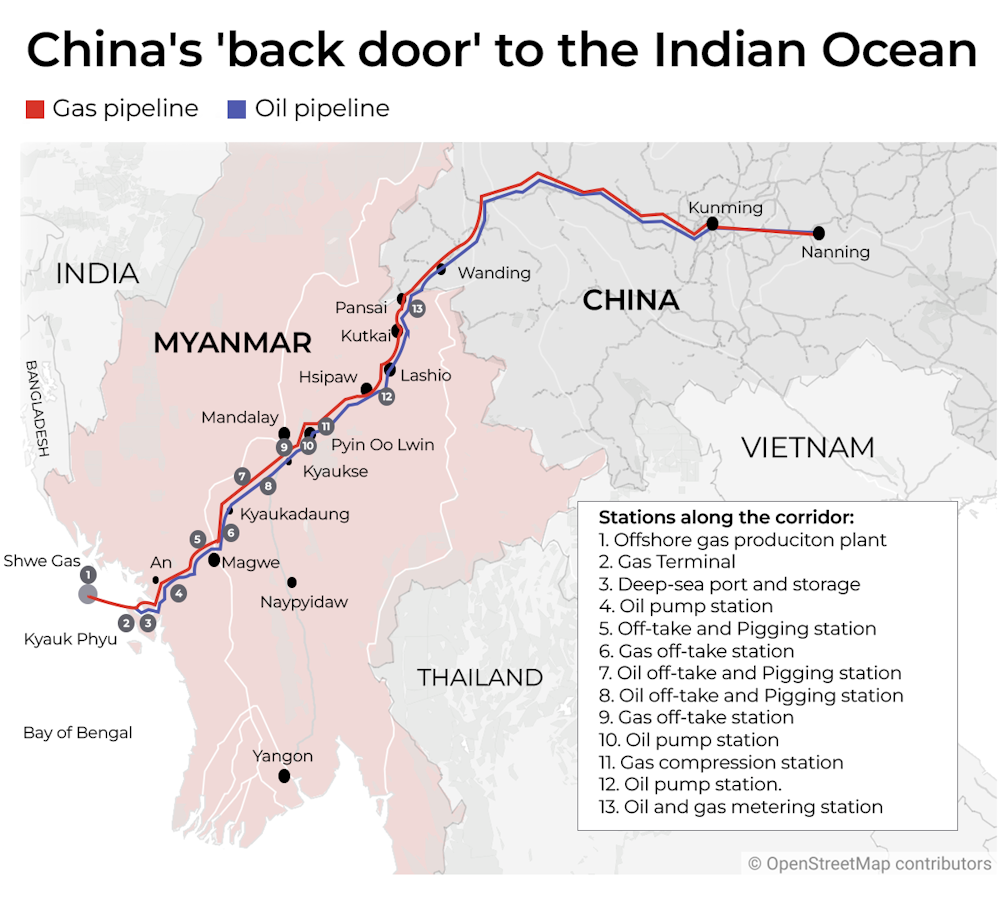
Among the dozens of infrastructure projects China is funding are high-speed rail links and dams. But its most strategically important investment is the China-Myanmar Economic Corridor[5], encompassing oil and gas pipelines, roads and rail links costing many tens of billions of dollars.
The corridor’s “jewel in the crown” is a deep-sea port to be built at Kyaukphyu, on Myanmar’s west coast, at an estimated cost of US$7 billion[6].
This will finally give China its long-desired “back door” to the Indian Ocean.
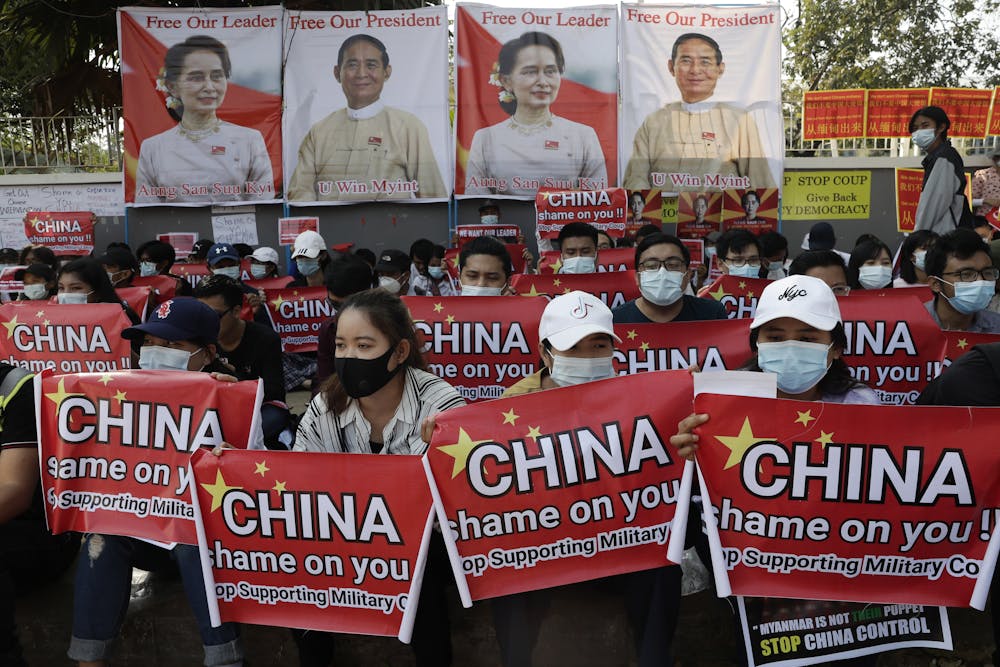 Pro-democracy demonstrators protest outside the Chinese embassy in Yangon, Myanmar, February 20 2021.
Lynn Bo Bo/EPA
Work continues on projects associated with the China-Myanmar Economic Corridor. New ventures (such as the aforementioned power station) have been approved.
More projects are on the cards. In June, for example, China’s embassy in Myanmar announced the completion of a feasibility study[13] to upgrade the Wan Pong port on the Lancang-Mekong River in Myanmar’s east.
Read more:
As Myanmar suffers, the military junta is desperate, isolated and running out of options[14]
Debt trap warnings
In 2020, before the coup, Myanmar’s auditor general Maw Than warned of growing indebtedness[15] to China, with Chinese lenders charging higher interest payments than those from the International Monetary Fund or World Bank.
At that time about 40%[16] of Myanmar’s foreign debt of US$10 billion was owed to China. It is likely to be greater now. It will only increase the longer a military dictatorship, with few other supporters or sources of foreign money, remains in power, dragging down Myanmar’s economy[17].
Efforts to restore democracy in Myanmar should therefore be seen as crucial to the long-term strategic interests of the region’s democracies, and to global peace and prosperity, given the increasing belligerence of China under Xi Jinping.
Xi, now president for life, this month told the People’s Liberation Army to prepare for war[18]. A compliant and indebted Myanmar with a deep-sea port controlled by Chinese interests tips the scales towards that happening.
A democratic and independent Myanmar is a counter-strategy to this potential.
Calls for sanctions
Myanmar’s democracy movement wants the international community to impose tough sanctions[19] on the junta. But few have responded.
The United States and United Kingdom have gone furthest, banning business dealings with Myanmar military officials and state-owned or private companies controlled by the military.
The European Union and Canada have imposed sanctions against a more limited range of individuals and economic entities.
South Korea has suspended financing new infrastructure projects. Japan has suspended aid and postponed the launch of Myanmar’s first satellite. New Zealand has suspended political and military contact.
Australia has suspended military cooperation (with some pre-existing restrictions[20] on dealing with military leaders imposed following the human rights atrocities committed against the Rohingya[21] in 2017.
But that’s about it.
Read more:
Sanctions against Myanmar's junta have been tried before. Can they work this time?[22]
Myanmar’s closest neighbours in the ten-member Association of South-East Asian Nations are still committed to a policy of dialogue and “non-interference[23]” – though Malaysia[24] and Indonesia[25] are increasingly arguing for a tougher approach as the atrocities mount.
The Armed Conflict Location and Event Data Project[26] says the only country now more violent than Myanmar is Ukraine.
Given its unique geo-strategic position, self-interest alone should be enough for the international community to take greater action.
References^ two-ocean strategy (cimsec.org)^ Friday essay: if growing US-China rivalry leads to 'the worst war ever', what should Australia do? (theconversation.com)^ foreign investment (www.reuters.com)^ US$2.5 billion (www.myanmar-now.org)^ China-Myanmar Economic Corridor (www.wilsoncenter.org)^ cost of US$7 billion (www.bnionline.net)^ to the Indian Ocean (www.diis.dk)^ 80% of China’s oil imports (chinapower.csis.org)^ Belt and Road initiative (theconversation.com)^ Conflict in the South China Sea threatens 90% of Australia's fuel imports: study (theconversation.com)^ China would support Myanmar (apnews.com)^ a statement expressing concern (news.yahoo.com)^ a feasibility study (www.thestar.com.my)^ As Myanmar suffers, the military junta is desperate, isolated and running out of options (theconversation.com)^ warned of growing indebtedness (www.rfa.org)^ about 40% (www.asianews.it)^ dragging down Myanmar’s economy (www.eastasiaforum.org)^ prepare for war (www.theguardian.com)^ tough sanctions (specialadvisorycouncil.org)^ pre-existing restrictions (www.dfat.gov.au)^ Rohingya (www.bbc.com)^ Sanctions against Myanmar's junta have been tried before. Can they work this time? (theconversation.com)^ non-interference (thediplomat.com)^ Malaysia (thediplomat.com)^ Indonesia (thediplomat.com)^ Armed Conflict Location and Event Data Project (myanmar.iiss.org)Authors: Htwe Htwe Thein, Associate professor, Curtin University
Pro-democracy demonstrators protest outside the Chinese embassy in Yangon, Myanmar, February 20 2021.
Lynn Bo Bo/EPA
Work continues on projects associated with the China-Myanmar Economic Corridor. New ventures (such as the aforementioned power station) have been approved.
More projects are on the cards. In June, for example, China’s embassy in Myanmar announced the completion of a feasibility study[13] to upgrade the Wan Pong port on the Lancang-Mekong River in Myanmar’s east.
Read more:
As Myanmar suffers, the military junta is desperate, isolated and running out of options[14]
Debt trap warnings
In 2020, before the coup, Myanmar’s auditor general Maw Than warned of growing indebtedness[15] to China, with Chinese lenders charging higher interest payments than those from the International Monetary Fund or World Bank.
At that time about 40%[16] of Myanmar’s foreign debt of US$10 billion was owed to China. It is likely to be greater now. It will only increase the longer a military dictatorship, with few other supporters or sources of foreign money, remains in power, dragging down Myanmar’s economy[17].
Efforts to restore democracy in Myanmar should therefore be seen as crucial to the long-term strategic interests of the region’s democracies, and to global peace and prosperity, given the increasing belligerence of China under Xi Jinping.
Xi, now president for life, this month told the People’s Liberation Army to prepare for war[18]. A compliant and indebted Myanmar with a deep-sea port controlled by Chinese interests tips the scales towards that happening.
A democratic and independent Myanmar is a counter-strategy to this potential.
Calls for sanctions
Myanmar’s democracy movement wants the international community to impose tough sanctions[19] on the junta. But few have responded.
The United States and United Kingdom have gone furthest, banning business dealings with Myanmar military officials and state-owned or private companies controlled by the military.
The European Union and Canada have imposed sanctions against a more limited range of individuals and economic entities.
South Korea has suspended financing new infrastructure projects. Japan has suspended aid and postponed the launch of Myanmar’s first satellite. New Zealand has suspended political and military contact.
Australia has suspended military cooperation (with some pre-existing restrictions[20] on dealing with military leaders imposed following the human rights atrocities committed against the Rohingya[21] in 2017.
But that’s about it.
Read more:
Sanctions against Myanmar's junta have been tried before. Can they work this time?[22]
Myanmar’s closest neighbours in the ten-member Association of South-East Asian Nations are still committed to a policy of dialogue and “non-interference[23]” – though Malaysia[24] and Indonesia[25] are increasingly arguing for a tougher approach as the atrocities mount.
The Armed Conflict Location and Event Data Project[26] says the only country now more violent than Myanmar is Ukraine.
Given its unique geo-strategic position, self-interest alone should be enough for the international community to take greater action.
References^ two-ocean strategy (cimsec.org)^ Friday essay: if growing US-China rivalry leads to 'the worst war ever', what should Australia do? (theconversation.com)^ foreign investment (www.reuters.com)^ US$2.5 billion (www.myanmar-now.org)^ China-Myanmar Economic Corridor (www.wilsoncenter.org)^ cost of US$7 billion (www.bnionline.net)^ to the Indian Ocean (www.diis.dk)^ 80% of China’s oil imports (chinapower.csis.org)^ Belt and Road initiative (theconversation.com)^ Conflict in the South China Sea threatens 90% of Australia's fuel imports: study (theconversation.com)^ China would support Myanmar (apnews.com)^ a statement expressing concern (news.yahoo.com)^ a feasibility study (www.thestar.com.my)^ As Myanmar suffers, the military junta is desperate, isolated and running out of options (theconversation.com)^ warned of growing indebtedness (www.rfa.org)^ about 40% (www.asianews.it)^ dragging down Myanmar’s economy (www.eastasiaforum.org)^ prepare for war (www.theguardian.com)^ tough sanctions (specialadvisorycouncil.org)^ pre-existing restrictions (www.dfat.gov.au)^ Rohingya (www.bbc.com)^ Sanctions against Myanmar's junta have been tried before. Can they work this time? (theconversation.com)^ non-interference (thediplomat.com)^ Malaysia (thediplomat.com)^ Indonesia (thediplomat.com)^ Armed Conflict Location and Event Data Project (myanmar.iiss.org)Authors: Htwe Htwe Thein, Associate professor, Curtin University