Google AI

Weekend Times


The Times

Business News

How can Australia pay $368 billion for new submarines? Some of the money will be created from thin air

  • Written by: Peter Martin, Visiting Fellow, Crawford School of Public Policy, Australian National University
How can Australia pay $368 billion for new submarines? Some of the money will be created from thin air

Australia’s decision to buy three nuclear-powered submarines and build another eight is so expensive that, for the A$268 billion to $368 billion price tag, we could give a million dollars to every resident of Geelong, or Hobart, or Wollongong.

Those are the sort of examples used by former NSW treasury secretary Percy Allan on the Pearls and Irritations[1] blog, “in case you can’t get your head around a billion dollars”.

Such multi-billion megaprojects[2] almost always go over budget.

For instance, when Prime Minister Malcolm Turnbull announced the Snowy Hydro 2.0 pumped hydroelectricity project in 2017, it was supposed to take four years and cost $2 billion[3]. The latest guess is it’ll actually take 10 years and cost $10 billion[4].

So to pay for those two megaprojects alone, there’s an awful lot of money we will need to find from somewhere. Or will we?

‘No simple budget constraint’

In the first year of the pandemic, Australians were given a glimpse of a truth so unnerving that economists and politicians normally keep to themselves.

It’s that, for a country like Australia, there is “no simple budget constraint” – meaning no hard limit on what we can spend.

“No simple budget constraint” is the phrase used by Financial Times’ chief economics commentator Martin Wolf[5], but he doesn’t want it said loudly.

The problem is, he says, “it will prove impossible to manage an economy sensibly once politicians believe there is no budget constraint”.

A quick look at history shows he is correct about there being no simple budget constraint, despite all the talk about the need to pay for spending.

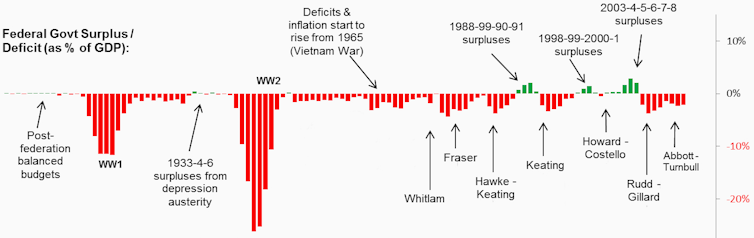
As you can see below, Australia’s Commonwealth government has been in deficit (spent more than it earned) in all but 17 of the past 50 years. The US government has been in deficit for all but four[6] of the past 50.

Commonwealth government surpluses and deficits since 1901
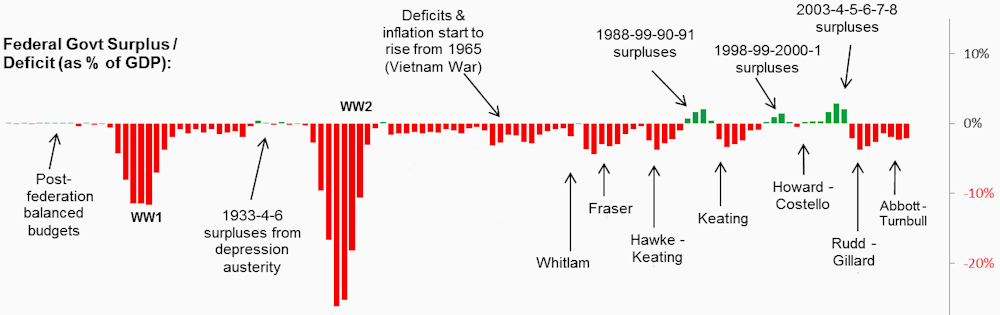
Ashley Owen, Stanford Brown[7] There is no hard limit on how the Commonwealth can spend over and above what it earns, just as there’s no hard limit on how much you and I can spend. But whereas you or I have to eventually pay back what we have borrowed, governments face no such constraint. Because the Commonwealth lives forever, it can keep borrowing forever, even borrowing to pay interest on borrowing. And unlike private corporations, it can borrow from itself – borrowing money it has itself created. Governments create money That’s what the Morrison government did in 2020 and 2021, in the early days of COVID. To raise the money it needed for programs such as JobKeeper, the government sold bonds (which are promises to repay and pay interest) to traders, which its wholly-owned Reserve Bank then bought, using money it had created. The government could have just as easily cut out the traders and borrowed directly from its wholly-owned Reserve Bank, using money the bank had created – effectively borrowing from itself. But the Reserve Bank preferred the appearance of arms-length transactions. And there’s no doubt the Reserve Bank created the money it spent, out of thin air. Asked in 2021 whether it was right to say he was printing money, Governor Philip Lowe[8] said it was, although the money was “created”, rather than printed. People think of it as printing money, because once upon a time if the central bank bought an asset, it might pay for that asset by giving you notes, you know, bank notes. I’d have to run my printing presses to do it. We don’t operate that way anymore. These days the Reserve Bank creates money electronically. It credits the accounts of the banks that bank with it. One way to think about it (the way so-called modern monetary theorists[9] think about it) is that none of the money the government spends comes from tax. The government creates money every time it gets the Reserve Bank to credit the account of a private bank (perhaps in order to pay a pension), and destroys money every time someone pays tax and the Reserve Bank debits the account. If it creates more money than it destroys, it’s called a budget deficit. If it destroys more than it creates, it’s called a budget surplus. Too much spending creates problems Can the government create more money than it destroys without limit? No, but where it should stop is a matter for judgement. If it spends too much money on things for which there is plenty of demand and a limited supply, it’ll push up prices, creating inflation. Where to stop will depend on how much others are spending. If there’s little demand (say for builders, as there was during the global financial crisis) the government can safely spend without much pushing up prices (as it did on builders during the global financial crisis). If it wants to spend really big (say on building submarines), it might have to restrain the spending of others, which it can do by raising taxes. What matters is what others are spending But it’s not a mechanical relationship. The main function of tax is not to pay for government spending, but to keep other spenders out of the way. If the economy is weak in the decades when the subs are being built, the burst of government spending will be welcome, and needed to create jobs. There will be no economic need to offset it by raising tax. Read more: Explainer: what is modern monetary theory?[10] But if the economy is strong, so strong the government would have to bid up prices to get the subs built, it might have to push up tax to wind other spending back. This truth means there’s no simple answer to the question “how they are going to pay for subs?” – just as there was no simple answer to questions about how to pay for a much-needed increase in the JobSeeker[11], or anything else. The deeply unsatisfying answer is that, from an economic perspective, it depends on who else is spending what at the time. References^ Pearls and Irritations (johnmenadue.com)^ megaprojects (deliverypdf.ssrn.com)^ $2 billion (cdn.theconversation.com)^ $10 billion (www.smh.com.au)^ Martin Wolf (www.ft.com)^ four (www.thoughtco.com)^ Ashley Owen, Stanford Brown (www.firstlinks.com.au)^ Philip Lowe (www.rba.gov.au)^ modern monetary theorists (era.org.au)^ Explainer: what is modern monetary theory? (theconversation.com)^ JobSeeker (theconversation.com)Authors: Peter Martin, Visiting Fellow, Crawford School of Public Policy, Australian National University

Read more https://theconversation.com/how-can-australia-pay-368-billion-for-new-submarines-some-of-the-money-will-be-created-from-thin-air-202150

The Weekend Times Magazine

Why Timely Air Conditioning Repair Is Important for Comfort, Efficiency, and System Longevity

A functioning air conditioning system is essential for maintaining a comfortable home, especially during warm weather. When the unit begins to show signs of trouble—such as weak airflow, unusual noises...

Essential Packaging Materials That Support Business Efficiency in Melbourne

Reliable access to packaging materials is a key factor in how smoothly businesses operate across storage, shipping, and distribution processes. Companies that depend on packaging supplies Melbourne understand that packaging is...

5 Things You Must Do in Australia

If you are setting sights on Australia as your next holiday destination this year, then you are about to embark on a life-changing adventure. The country offers an exciting and...

Tinseltown - Keeping up with the Kardashians no more: the complicated legacy of reality’s first family

Kim Kardashian West has announced to her 160m followers on Instagram that Keeping Up with the Kardashians will end after its next season. The Kardashians, particularly Kim, have been at the...

Microbes living on air a global phenomenon

UNSW researchers have found their previous discovery of bacteria living on air in Antarctica is likely a process that occurs globally, further supporting the potential existence of microbial life on...

Aussie Rules Football History

One of the things that make Australia truly unique is its own version of football. Called Australia rules football, this sport precedes other contemporary football games in generating an official...

Building Designer in Melbourne: Crafting Innovative, Functional, and Sustainable Spaces

In a city celebrated for its architectural excellence and diverse urban character, the role of a building designer Melbourne has never been more important. Melbourne’s built environment is a dynamic blend...

Does Sydney Australia Have a Good Nightlife Scene?

In the last several years, Sydney's nightlife has changed dramatically. The New South Wales state government adopted Draconian lockout regulations in 2014, forcing city center venues to close their doors...

5 Bars You Cannot Miss While Visiting Sydney

One of the best things about visiting Sydney is the nightlife. While there are a lot of touristic gems for visitors to see throughout the day, Sydney is also widely...