NZ’s housing market drives inequality – why not just tax houses like any other income?
- Written by: Susan St John, Honorary Associate Professor, Economic Policy Centre, Auckland Business School, University of Auckland
The Green Party made waves recently when it proposed to tax net wealth over NZ$2 million for individuals and $4 million for couples. As part of a broad range of actions, the policy aims[1] to “end poverty”.
Reactions ranged from endorsement to accusations it was fuelled by envy[2], but the debate signalled what could become a major election issue: the wealth gap and how to fix it.
The claim it amounts to an “envy tax” assumes all wealth has been fully earned and fully taxed in the first place. But we know that’s not the case. A good portion of the wealth accumulated at the top is attributable to fortunate circumstances generating significant tax-free gains.
Inland Revenue’s recent survey[3] of the wealthiest 311 New Zealand families revealed an average net worth of $276 million. At the same time, we know many households are struggling with the rising cost of living.
According to Stats NZ, around 155,000 households feel their incomes aren’t sufficient[4] to meet everyday basic needs. Foodbanks report ever-rising numbers of families unable to feed themselves[5].
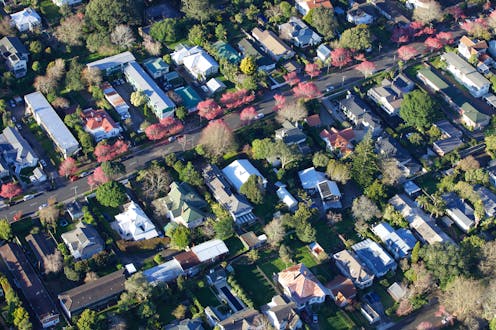
The major source of this lopsided wealth is the housing market. New Zealand has seen the biggest housing boom in the western world. Property owners have ridden the wave to make large tax-free capital gains, while others languish in substandard emergency housing or are forced to live in garages and cars.
Far too much of our scarce labour, building materials, imported fixtures and land have been diverted to unproductive high-end housing, leaving too little to meet the real housing need. Because it isn’t taxed properly[6], investing in housing has been encouraged as a way to accumulate wealth.
The trouble with a wealth tax
While the Greens’ wealth tax is a useful start to a wider discussion about inequality, it inevitably creates obstacles that in the end may be too difficult to overcome.
Probably the biggest hurdle is that this kind of tax can be incredibly complex and would provoke endless debate about what should be included.
The Greens’ proposal, for example, would capture business assets, shares, art above a certain value, and cars above $50,000. But what if you have two cars worth $49,000 each – why should they be excluded when one valued at $80,000 is included?
And how is debt factored into calculations of net wealth? House mortgages may be straightforward, but what about credit card debt, car finance or borrowing to finance overseas travel?
Read more: Proving the wealthiest New Zealanders pay low tax rates is a good start – now comes the hard part[7]
Not a capital gains tax
For all these reasons, it’s time to get away from debating notions of a confiscatory wealth tax and make the issue simply one of treating all income the same for tax purposes.
Instead of a complicated net wealth tax on everything, let’s start with the biggest culprit – housing. This would address the under-taxation of income from holding housing as an asset.
Read more: New Zealand's tax system is under the spotlight (again). What needs to change to make it fair?[8]
This is not the same as a capital gains tax – those days are over. Numerous tax working groups have failed over 30 years to make headway on this. Politically it is a dead duck.
Besides, the real problems – inequality and misallocation of resources – wouldn’t be touched by a capital gains tax. Such a tax can only apply to gains made on houses sold in the future, not the accumulated gains over many years, and it will always exempt the family home.
How a house tax works
Instead, let’s take the total value of all housing held by each individual, subtract registered first mortgages, and allow a $1 million exemption to reflect that everyone is entitled to a basic family home.
Then we treat this net equity as if it was in a term deposit generating a taxable interest return. When houses are held in trusts and companies, in most cases the income would be taxed at the trust or company rate with no exemption.
Calculated annually and pegged to the capital value of properties, this effective income would be taxed at the person’s marginal tax rate. It would affect those with second homes, multiple rentals, high-value properties – but without significantly affecting the great majority of homeowners who have much less than $1 million of net equity.
Thus a couple living in a $3 million house with a $1 million mortgage would fall under the threshold.
This approach would help put investment in housing, after a basic home, on the same footing as money in the bank or in shares. Better choices for the use of scarce housing resources should follow.
Landlords would no longer need expensive accountants to minimise taxable rental income. And it would reduce the blight of “ghost houses[9]” and residential land-banking.
Read more: Cutting GST on fresh produce won’t help those most in need – a targeted approach works better[10]
A circuit breaker
The simplicity of this income approach means the government can build on the existing tax system. It lives up to the mantra of a “broad base, low rate” tax system and affects only the very wealthy and those whose tax rates are highest.
Moreover, it is possible to implement quickly, using existing property valuations and registered mortgages, unlike a net wealth tax where the devil is in the contentious detail.
The effect should be positive for those struggling in the housing market, as more housing for sale or rent is opened up. Good landlords should welcome the greater simplicity.
In the longer term, the extra taxable income could produce revenue for redistribution and social investment. Critically, however, it would start to give the right price signals to reduce the over-investment in luxury housing and real estate held for capital gain.
The approach is essentially a circuit breaker that can simply and quickly address the accumulation of wealth by a small group of people.
Crucially, it has a sound economic rationale. By taking the first step and including luxury and investment housing returns that are currently under the radar, it reduces the advantages of holding housing rather than more productive investments.
References
- ^ policy aims (www.newshub.co.nz)
- ^ fuelled by envy (www.newshub.co.nz)
- ^ recent survey (www.ird.govt.nz)
- ^ aren’t sufficient (www.stuff.co.nz)
- ^ unable to feed themselves (www.rnz.co.nz)
- ^ isn’t taxed properly (cdn.auckland.ac.nz)
- ^ Proving the wealthiest New Zealanders pay low tax rates is a good start – now comes the hard part (theconversation.com)
- ^ New Zealand's tax system is under the spotlight (again). What needs to change to make it fair? (theconversation.com)
- ^ ghost houses (www.stuff.co.nz)
- ^ Cutting GST on fresh produce won’t help those most in need – a targeted approach works better (theconversation.com)
Authors: Susan St John, Honorary Associate Professor, Economic Policy Centre, Auckland Business School, University of Auckland