The Albanese government blew its shot at setting a historic new unemployment target
- Written by: Peter Martin, Visiting Fellow, Crawford School of Public Policy, Australian National University

Treasurer Jim Chalmers says the federal government’s employment white paper is “ambitious[1]”. I’m not convinced.
A clearly ambitious statement would have specified a target for unemployment, ideally one that was a bit of a stretch.
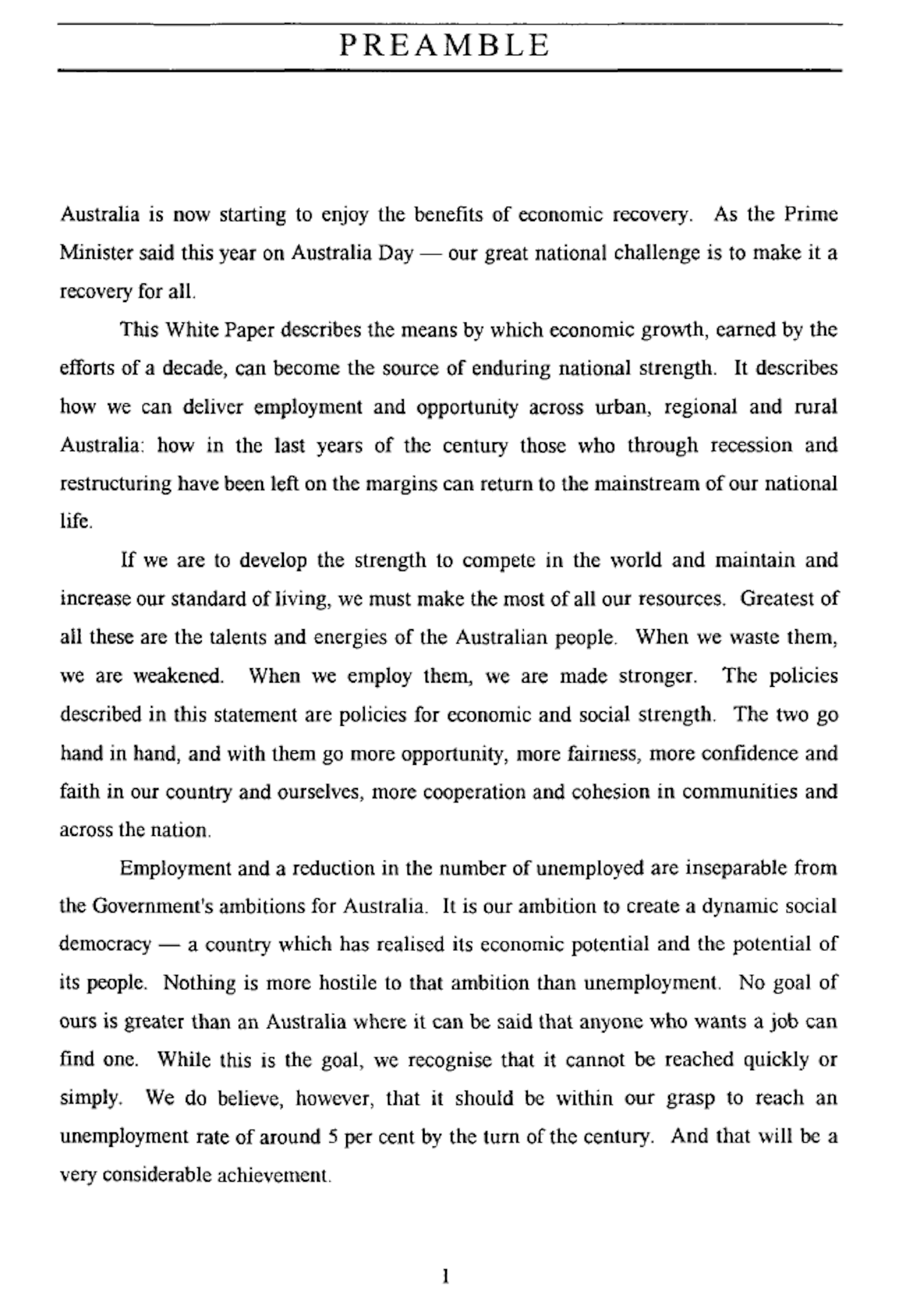
The Keating Labor government’s Working Nation[2] statement did that in 1994. Released at a time when unemployment was almost 10%, it specified a target unemployment rate of 5%[3] – an ambition that served as a beacon for decades.
That target certainly needs to be updated. Unemployment is now well below 5%, meaning “full employment” is now much less than 5%. Yet the Albanese government has passed up a historic opportunity to say how much less, which it could have done by setting its own target.
Setting our sights below 5%
The white paper[4] released on Monday[5] defines full employment as a state in which “everyone who wants a job should be able to find one without searching for too long”. That means our unemployment target ought to be somewhere between zero and 5%.
Of course, the unemployment rate can never be zero.
There will always be people out of work while they are moving between jobs, what the white paper calls “frictional” unemployment. That will also be true when Australia’s mix of employers changes – what the paper calls “structural” unemployment, as new industries requiring one sort of training replace old industries that required another.
The white paper says what matters in addition to unemployment (539,700 Australians) is “underemployment” in which people work fewer hours than they want (1 million) and “potential workers” who would like work but aren’t actively looking and so aren’t counted as unemployed (1.3 million).
I get that these things matter. I get that we need, in the words of the white paper, “a higher level of ambition than is implied by statistical measures”.
What gets measured gets done
But that higher level of ambition ought not replace targets.
If a target isn’t specific, it isn’t a target at all (or at best it’s a fuzzy target). That means it’s less likely to be aimed at and less likely to be hit.
That’s how it’s been with full employment itself. In 1996 Treasurer Peter Costello and the man he appointed Reserve Bank governor, Ian Macfarlane, signed what became the first Statement on the Conduct of Monetary Policy[6], an agreement that’s been updated six times[7].
As with all of the agreements since, that first statement set out an inflation target (“between 2% and 3%, on average, over the cycle”) but not an employment target – even though both are meant to be objectives under the Reserve Bank Act[8].
As a result, Governor Macfarlane was able to step down ten years later, secure in the knowledge that on average he had hit the middle of the target band: 2.5% inflation. His successor Glenn Stevens stepped down ten years further on, quietly boasting[9] the same thing.
But neither could make any boast about hitting the employment target – because there wasn’t one.
How failing to set a target costs jobs
The governor who has just retired, Philip Lowe, looks like he’ll hit an inflation average of 2.8%, which is pretty low given how high inflation has been lately.
But an estimate by former Reserve Bank staffer Isaac Gross, prepared using the Reserve Bank’s own economic model, suggests that in doing so he kept unemployment a good deal higher than it needed to be between 2016 and 2019 – the equivalent of 270,000[10] people being out of work for one year.
Read more: The RBA's failure to cut rates faster may have cost 270,000 jobs[11]
Lowe wasn’t held to account for the extra unemployed in the same way as he is being held to account[12] for his performance on inflation. Why? Because he was never actually given an unemployment target.
I am quite prepared to acknowledge that other measures of employment matter, underemployment among them. But here’s the thing: they move in line with unemployment.
When Australia’s unemployment rate falls, Australia’s underemployment rate falls, almost in tandem.
It’s easy to see why. As employers find it hard to hire new workers, they get existing workers to put in more hours. And retirees and others who haven’t been looking for work begin putting themselves out there.
Australia’s participation rate[13] measures the proportion of the population making itself available for work. As unemployment has fallen, it has climbed to an all-time high[14].
Our unemployment rate is a proxy for what matters
This makes the unemployment rate just about the perfect proxy for everything else about the labour market that matters, and just about the perfect number to target.
The Albanese government could have recognised that this week – setting a stretch target of 3% (or even 4%) as an aspiration. Even that would have been less “ambitious” than Keating choosing 5%, when the rate was twice as high.