Generational tensions flare as Japan faces the economic reality of its ageing baby boomers
- Written by: Simon Avenell, Professor in Modern Japanese History, Australian National University
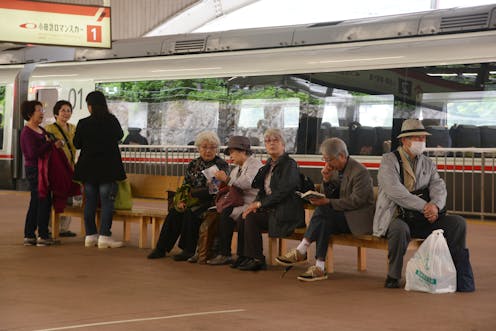
In 2024, the youngest of Japan’s baby boomers will turn 75. The boomers are called the “bunched” generation in Japan because they were born in a short spurt in the late 1940s, in the aftermath of the end of the second world war.
The sheer size of this cohort has made it a lightning rod for many of the thorny social and economic debates in Japan today. Japanese boomers are variously criticised for generational wealth disparity, national debt, and even the environmental crisis.
Historically, the boomers’ experience is very much the story of Japan’s postwar success. But were the boomers just lucky free-riders? And how have they shaped contemporary Japan?
The children of war defeat
Japan was under US-led occupation and struggling with a tattered economy when the boomers were born. Millions of soldiers and settlers had flooded back from the colonies and battlefields. As the Japanese began to rebuild their nation, they also enthusiastically procreated. From 1947 to 1949, Japan recorded around 2.7 million births annually, with a fertility rate exceeding 4.3.
Never again would Japan witness such stunning fertility. Apart from a short-lived uptick in the 1970s, annual births have been declining precipitously.
In 2020, Japan recorded its lowest number of annual births at 840,835 with a fertility rate of just 1.33. This is not the lowest in Asia, but it is well beneath the replacement rate of 2.1.
The protest generation
Japan’s boomers were both the engines and beneficiaries of the country’s economic miracle of the 1950s to 1970s, when GDP growth regularly hit the double digits.
In an age when most youth finished education in their teens, the boomers provided labor for Japan’s heavy, chemical, automotive, and electronics industries. Many migrated to cities like Tokyo, taking up jobs in small factories and retail stores.
The small percentage of boomers lucky enough to enter universities in the 1960s became the flagbearers of youth protest. They rallied against Japan’s subservience to America and its involvement in the Vietnam War. They demanded universities lower fees and give students a greater voice.
Beyond protest, they fashioned new cultures in music and art. Indeed, they were actors in the great theatre that was the “global 1960s”.
As student protest descended into violence in 1970s Japan, public opinion turned against the young boomers. A handful embraced murderous left-wing terrorism[1], but the majority chose the safety of corporate Japan.
Read more: Baby Boomers, be nice to your grandkids: they may save Australia[2]
Boomers fashion Japan’s economic miracle
In 1975, the youngest of Japan’s boomers were in their mid-20s. Japan was recovering from a massive hike in oil prices in 1973 and would face another petroleum shock in 1979.
It was the hardworking boomers who sustained Japan through these troubled economic times. In an age of rigidly defined gender roles, boomer men became Japan’s corporate and industrial warriors, while boomer women raised children and cared for elderly parents. Accordingly, they orchestrated Japan’s second – and last – postwar baby boom in the 1970s.
When Japan emerged as an economic superpower in the 1980s, it was the boomers who reaped the rewards. Although not all benefitted equally, Japanese baby boomers, now in their 30s, enjoyed relatively secure employment, a thriving economy, and superior standards of living.
At the same time, as the economy surged, the boomers faced financial pressures in housing and education. Some even worked themselves to death[3] inside Japan’s pressure-cooker corporations.
Nonetheless, things were good for the boomers during Japan’s “bubble” economy of the 1980s. By the end of the decade, the youngest were in their 40s. As mid-career workers, they could both save and spend – something later generations would only dream of.
Intergenerational tensions in recessionary Japan
Just as the boomers were moving into the middle echelons of society, Japan’s economic miracle ended abruptly. What followed from the 1990s onwards has been called Japan’s “lost decades”, an “ice age” of employment, and an era of youth uncertainty and despair.
The boomers, however, survived largely unscathed. Thanks to an employment system that protected senior workers, most (although not all) of the boomers retained their jobs while their children struggled to find even casual work. Many boomers also had savings to fall back on.
But in recessionary Japan, the now-ageing boomers raised thorny issues for the country. As a healthy, long-lived, and very large cohort, their approaching retirement in the 2000s threatened the viability of Japan’s already-strained pension and health schemes. Youth born in a post-bubble Japan are faced with carrying this burden.
Not surprisingly, intergenerational tensions have arisen. For the boomers, it is easy to label youth as lazy and lacking perseverance. For the young, boomers were simply lucky to be born in an era of growth. And, to make matters worse, now the young must support the boomers in retirement.
Ageing boomers in the oldest society
Given the electoral clout of the boomers, politicians are treading carefully around solutions involving redistribution from the old to the young. Ultimately, intergenerational blaming is not the solution.
Japan’s baby boomers were born into a nation rising, but they also helped to fashion that success. Youth can draw on the boomers’ journey from the ashes of defeat to stunning affluence. But the boomers must also recognise how their generation has contributed to the demographic and socioeconomic challenges facing Japan today.
As the world’s oldest society continues to age, intergenerational empathy from the boomers is now more important than ever.
References
- ^ murderous left-wing terrorism (www.npa.go.jp)
- ^ Baby Boomers, be nice to your grandkids: they may save Australia (theconversation.com)
- ^ worked themselves to death (doi.org)
Authors: Simon Avenell, Professor in Modern Japanese History, Australian National University