what we can learn from the inquest into 4 Aboriginal women's deaths in the NT
- Written by: Chay Brown, Research and Partnerships Manager, The Equality Institute, & Postdoctoral fellow, Australian National University
Aboriginal and Torres Strait Islander readers are advised this article contains names of deceased people. Some names have been changed to honour Sorry Business. This article also mentions violence against and killings of First Nations women.
Kumanjayi Haywood.
Ngeygo Ragurrk.
Miss Yunupingu.
Kumarn Rubuntja.
These are the names of the four Aboriginal women at the centre of Australia’s largest and longest-running coronial inquest[1] into women killed by their intimate male partners that adjourned on November 10. Over the past six months in the Northern Territory, Judge Elisabeth Armitage heard evidence[2] about the shocking circumstances surrounding each woman’s death.
Each of the women had experienced years of severe abuse from their male partners, some of whom had served lengthy jail terms, and some of whom had long histories of violence, sometimes against multiple partners.
Kumanjayi Haywood[3] died after her partner poured petrol under the door of the bathroom she was hiding in and set her alight. She sustained burns to 90% of her body. She was a loving mother.
Ngeygo Ragurrk[4] was killed by her partner on Darwin’s Mindil Beach after a brutal attack lasting several hours. She was a Warddeken ranger and is remembered as a loving aunty.
Miss Yunupingu[5] endured over a decade of abuse by her partner, who ultimately ended her life by stabbing her three times in the chest. She was much loved by her family.
Kumarn Rubuntja[6] was killed after her partner[7] deliberately hit her with his car, reversing over and hitting her several times. She was a well-known anti-violence advocate and beloved by her friends and family.
These women were failed repeatedly by the systems and institutions set up to protect them. They slipped through the gaping cracks in an overstretched and overburdened system. One of the women had called police 22 times. Another was herself arrested after calling police for help. The family of another was unaware of the exact nature and circumstances of her death and the sentence of her perpetrator because there were no interpreters[8] in court when he was sentenced.
The coroner dedicated time to hearing about the individual circumstances surrounding each women’s death, as well as two weeks for institutional responses.
I was called to give evidence in the inquest twice. The first time was to provide testimony in relation to Kumarn Rubuntja’s death, as she was my friend and colleague. I spoke about the rates and drivers[9] of violence in the territory.
The second time was part of the institutional responses, where I gave expert evidence due to my research into violence against women in the territory. I presented evidence about the development of different initiatives to improve the response to domestic, family and sexual violence in the territory, such as improved training[10] for police.
I believe the inquest was extraordinarily important, but it was also immeasurably difficult and painful. It was hard for all of us who loved, knew and worked with these women.
Inquest findings
Armitage, the judge, characterised extreme violence in the Northern Territory as an “epidemic[11]”, an “explosion[12]”, and a “horror[13]”.
The inquest heard domestic violence has increased by 117% in the past ten years, and is projected to increase a further 73%[14] in the next decade. As a result, police callout times to domestic violence incidents have more than doubled.
In the Northern Territory, domestic, family and sexual violence services are chronically under-funded and under-resourced. Women’s shelters from across the NT gave evidence that they had to turn women away because they did not have enough beds. Some were having to reduce staff pay due to lack of funding. Some had to rely on vacancies, while others were running their budgets in deficits.
However, the inquest also heard about several promising initiatives, including a co-response model for police and specialist services. But this initiative had only been given funding of $240,000 from the government. Queensland, by comparison, has funded its own co-response model with $22 million[15].
Another promising initiative is improved and specialist domestic, family and sexual violence (DFSV) training for police[16] and health care workers. But the Prevent.Assist.Respond.Training[17] program had only been funded to develop training, and there was no money for implementation or delivery.
Read more: Here's some context missing from the Mparntwe Alice Springs 'crime wave' reporting[18]
A national crisis
Through the inquest, the specialist domestic, family and sexual violence sector learned that the Northern Territory government had rejected its own working group’s recommendation for funding of $180 million over five years[19], instead committing to only $20 million over two years. Professor Marcia Langton, in her testimony, labelled this decision “gobsmacking[20]”.
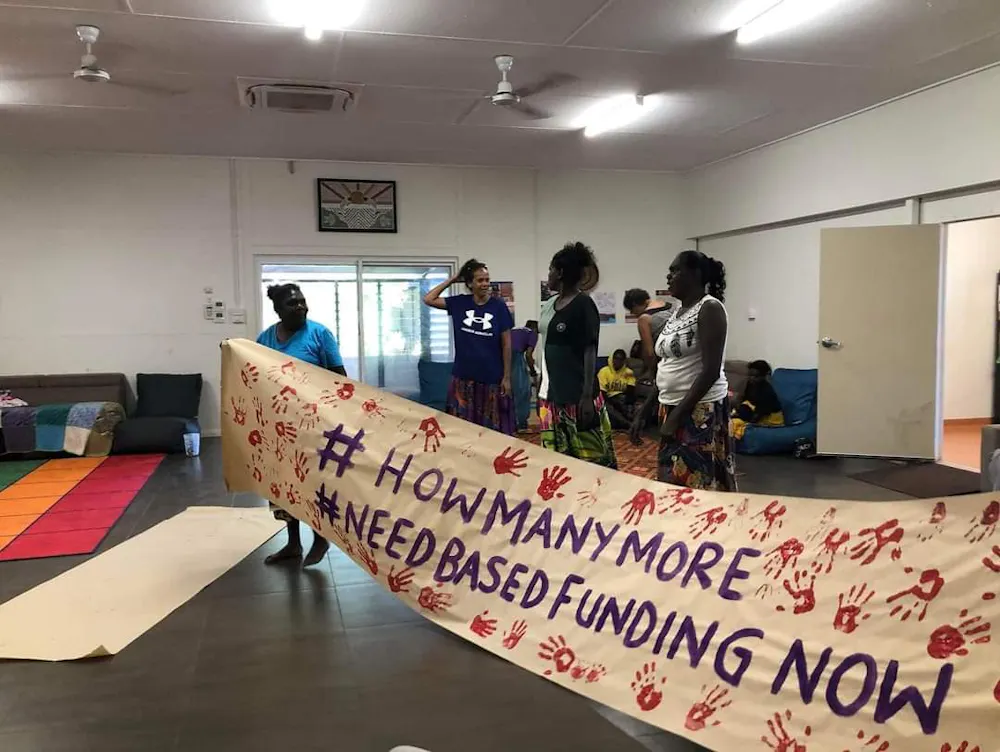
Upon learning of the inadequate funding for essential services, the DFSV sector organised a “day of action” on September 26. Hundreds of people[21] gathered across the territory, in regional centres and remote communities, to call on both the NT and federal government to commit to needs-based funding[22] for the territory.
The NT’s family violence sector called for:
- an immediate injection of a minimum additional $180 million over five years, per the government’s own recommendation
- the immediate establishment and ongoing funding of a NT-specific domestic, family and sexual violence peak organisation
- the allocation of 50% of new public housing to victim-survivors of domestic, family and sexual violence.
Read more: 49 women have been killed in Australia so far in 2023 as a result of violence. Are we actually making any progress?[23]
Action is needed before more women die
Prime Minister Anthony Albanese has not yet responded to multiple requests from the Northern Territory DFSV sector to visit the territory to meet with the family violence sector and see the level of need firsthand.
Minister for Social Services Amanda Rishworth said the Albanese government had already funded the NT government for family and domestic violence services with $147 million over four years[24].
But the breakdown[25] of this funding included many general services – several of which run no domestic violence programs and one that was not based in the NT. She also failed to include a single women’s shelter in the territory[26].
Recommendations will now be put to the coroner by counsel assisting and submissions will close in March. The coroner will then lay down her findings in November.
Kumanjayi Haywood, Ngeygo Ragurrk, Miss Yunupingu, Kumarn Rubuntja. These women rarely made the national news. The nation did not honour their lives or mourn them. Their lives did not spark marches or social media campaigns or speeches in parliament. Four more people have died[27] in what police believe are domestic violence incidents in the NT since the inquest began.
This inquest was an incredibly important opportunity to hear from the women’s friends and families, who recounted beautiful memories about them and told of their heartbreak. It’s important all of us hear the words of these grieving families – we need to do better.
As Ngeygo Ragurrk’s sister, Edna, said on the last day of the inquest: “It cannot be normal that men hurt us women. Everyone must do more from the start, not just after women get hurt or killed.”
References
- ^ coronial inquest (www.abc.net.au)
- ^ heard evidence (www.ourwatch.org.au)
- ^ Kumanjayi Haywood (www.abc.net.au)
- ^ Ngeygo Ragurrk (www.abc.net.au)
- ^ Miss Yunupingu (www.abc.net.au)
- ^ Kumarn Rubuntja (www.abc.net.au)
- ^ her partner (www.ntnews.com.au)
- ^ no interpreters (www.theguardian.com)
- ^ rates and drivers (www.ntnews.com.au)
- ^ improved training (www.abc.net.au)
- ^ epidemic (www.abc.net.au)
- ^ explosion (www.abc.net.au)
- ^ horror (www.theguardian.com)
- ^ further 73% (www.abc.net.au)
- ^ $22 million (www.theguardian.com)
- ^ training for police (www.abc.net.au)
- ^ Prevent.Assist.Respond.Training (doyourpart.com.au)
- ^ Here's some context missing from the Mparntwe Alice Springs 'crime wave' reporting (theconversation.com)
- ^ $180 million over five years (www.abc.net.au)
- ^ gobsmacking (www.theguardian.com)
- ^ Hundreds of people (www.ntnews.com.au)
- ^ needs-based funding (www.abc.net.au)
- ^ 49 women have been killed in Australia so far in 2023 as a result of violence. Are we actually making any progress? (theconversation.com)
- ^ $147 million over four years (www.abc.net.au)
- ^ breakdown (www.abc.net.au)
- ^ territory (www.ntnews.com.au)
- ^ have died (www.abc.net.au)
Authors: Chay Brown, Research and Partnerships Manager, The Equality Institute, & Postdoctoral fellow, Australian National University