Australian journalist John Pilger has died, age 84
- Written by: Matthew Ricketson, Professor of Communication, Deakin University
John Pilger, a giant of journalism born in Australia in 1939, has died at the age of 84, according to a statement released online by his family.
His numerous books and especially his documentaries opened the world’s eyes to the failings, and worse, of governments in many countries – including his birthplace.
He inspired many journalists, and journalism students, with his willingness to critique the damaging effects on ordinary people’s lives of capitalism and Western countries’ foreign policies, particularly the United States and the United Kingdom.
But his campaigning approach to journalism also regularly provoked controversy. That was partly because of his trenchant dissent from official stances, and partly because in aiming to reach the broadest possible audience, he tended to oversimplify issues and overstate his views.
Read more: More than one journalist per day is dying in the Israel-Gaza conflict. This has to stop[1]
‘I am, by inclination, anti-authoritarian’
The English journalist, Auberon Waugh, who clashed with Pilger on more than one occasion, invented the verb “to pilger” which he defined[2] as “to treat a subject emotionally with generous disregard for inconvenient detail, always in the left-wing cause and always with great indignation”.
Whatever the merits of Waugh’s criticism, they are, in my view, outweighed by the breadth and depth of Pilger’s disclosures in the public interest.
Pilger never hid behind the safety of the “he said, she said” approach to journalism, which New York University professor Jay Rosen has famously called[3] the “view from nowhere”.
Pilger, however, rejected the label of crusader, telling Anthony Hayward for his book, In the Name of Justice: The Television Reporting of John Pilger[4]:
I am, by inclination, anti-authoritarian and forever sceptical of anything the agents of power want to tell us. It is my duty, surely, to tell people when they’re being conned or told lies.
Telling the stories of ordinary people
Pilger was born in Bondi[5], Sydney. Like many of his generation, he moved to the UK in the early 1960s and worked for The Daily Mirror, Reuters and ITV’s investigative program World in Action.
He reported on conflicts in Bangladesh, Biafra, Cambodia and Vietnam and was named[6] newspaper journalist of the year in Britain in 1967 and 1979.
He made more than 50[7] documentaries. His best known is Year Zero: the Silent Death of Cambodia[8], which in 1979 revealed that as many as two million of the seven million population of the country had died as a result of genocide or starvation under Pol Pot’s brutal regime.
His documentaries garnered numerous prizes, including the prestigious Richard Dimbleby award for factual reporting, a Peabody award[9] for Cambodia: Year Ten[10] and a Best Documentary Emmy award[11] for Cambodia: The Betrayal[12].
He also made several documentaries about Australia, including one in 1985, The Secret Country[13], about historic and continuing mistreatment of First Nations people that thoroughly irritated the then Labor prime minister, Bob Hawke.
When the US government of George W. Bush reacted to al-Qaeda’s murderous 9/11 terrorist attacks by invading first Afghanistan, in late 2001, then Iraq in March 2003, Pilger made Truth and Lies: Breaking the Silence on the War on Terror[14].
It sharply criticised not only Bush’s actions but those of the most ardent members of the “coalition of the willing”: UK Labour prime minister, Tony Blair, and Australian coalition prime minister, John Howard.
No doubt, if Pilger was still alive he would condemn the absence of the National Security Committee’s papers from the 2003 cabinet papers released today[15] by the National Archives of Australia.
They show[16] Howard’s cabinet signed off on the controversial – in hindsight disastrous – decision to endorse the Bush administration’s plan to invade Iraq based on “oral reports” from the prime minister, rather than full cabinet submissions.
Pilger wrote or edited 11 books, including Tell Me No Lies[18], an anthology of outstanding investigative journalism, and perhaps his best regarded book, Heroes[19], which hewed to what one of his favourite journalists, Martha Gellhorn, called “the view from the ground”.
He did this by telling the stories of ordinary people he had encountered, whether miners in Durham, England, refugees from Vietnam, or American soldiers returning from the Vietnam War – not to parades, but to lives dislocated by the silence and shame surrounding the war’s end.
The world has lost a resolutely dissenting voice
Phillip Knightley, a contemporary of Pilger who was also born in Australia and went to Fleet Street to become a celebrated investigative journalist and author himself, summed up[20] his compatriot’s work in 2000:
He was certainly among the first to draw international attention to the shameful way in which Australia has treated the Aborigines [sic] […] John has a slightly less optimistic view than I have.
In Welcome to Australia[21] [Pilger’s 1999 film], he concentrated on the bad things that were happening but not the good. He would say that’s not part of his brief and it’s covered elsewhere. He’s a polemicist and, if you want to arouse people’s passions and anger, the stronger the polemic, the better.
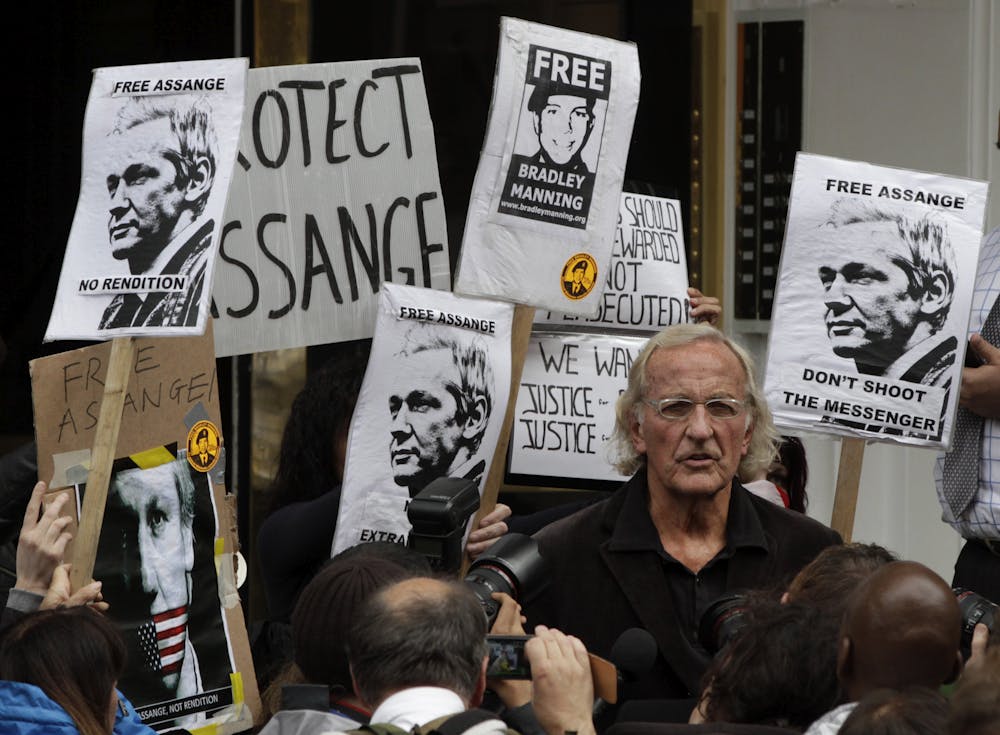
Pilger made fewer films in the 2000s, focusing much of his energy on supporting Julian Assange, founder of WikiLeaks. Assange continues to suffer in Belmarsh prison in England while appeals against his extradition to the US to answer charges under the 1917 Espionage Act grind interminably on.
Whatever flaws there are in Pilger’s journalism, it feels dispiriting that on the first day of a new year clouded by wars, inaction on climate change and a presidential election in the US where democracy itself is on the ballot, the world has lost another resolutely dissenting voice in the media.
Read more: 'A time of anxiety': The depressing new reality for local journalists in conflict zones[22]
References
- ^ More than one journalist per day is dying in the Israel-Gaza conflict. This has to stop (theconversation.com)
- ^ defined (www.goodreads.com)
- ^ called (pressthink.org)
- ^ In the Name of Justice: The Television Reporting of John Pilger (www.goodreads.com)
- ^ born in Bondi (johnpilger.com)
- ^ named (www.theguardian.com)
- ^ more than 50 (johnpilger.com)
- ^ Year Zero: the Silent Death of Cambodia (johnpilger.com)
- ^ Peabody award (johnpilger.com)
- ^ Cambodia: Year Ten (johnpilger.com)
- ^ award (www.brisbanetimes.com.au)
- ^ Cambodia: The Betrayal (johnpilger.com)
- ^ The Secret Country (www.imdb.com)
- ^ Truth and Lies: Breaking the Silence on the War on Terror (johnpilger.com)
- ^ released today (theconversation.com)
- ^ show (www.theguardian.com)
- ^ AP Photo/Lefteris Pitarakis (photos.aap.com.au)
- ^ Tell Me No Lies (www.penguin.com.au)
- ^ Heroes (johnpilger.com)
- ^ summed up (www.goodreads.com)
- ^ Welcome to Australia (johnpilger.com)
- ^ 'A time of anxiety': The depressing new reality for local journalists in conflict zones (theconversation.com)
Authors: Matthew Ricketson, Professor of Communication, Deakin University