Labor is in power - but the Coalition still attracts the most money
- Written by: Kate Griffiths, Deputy Program Director, Grattan Institute
Who funds Australia’s political parties? Besides the occasional scandal – think Aldi bags full of cash[1] – most Australians would not hear much about it.
But money matters: political donations can buy access to politicians[2] and create opportunities to sway public decisions in the donor’s favour.
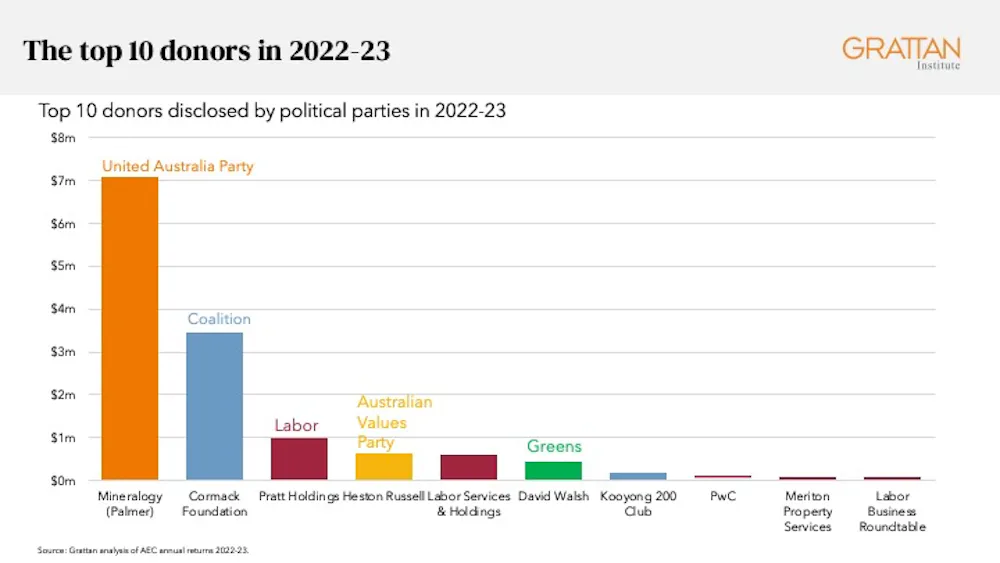
New data[3], released today by the Australian Electoral Commission, provide the best information available on political party funding and Australia’s major donors. So let’s follow the money.
Read more: Big money was spent on the 2022 election – but the party with the deepest pockets didn't win[4]
Even in a non-election year, fundraising continued apace
In the 2022-23 financial year, Australia’s political parties collectively raised $259 million, with most of the money (81%) flowing to the major parties.
It initially appeared that Labor had raised a whopping $220 million, but this has since been revised down to just $84 million after correcting for a typo in Labor’s ACT branch return.
This leaves the Coalition well ahead at $125 million – continuing their long history as the frontrunner in fundraising.
Federal politics is awash in dark money
These are the big donors on the record, but declared donations make up only 6% of political parties’ total income. There are other sources of income on the public record, including public funding, but about a quarter of the money remains hidden.
Labor’s funding is a little more murky: 27% of Labor party income in 2022-23 was hidden, compared with 22% for the Coalition.
In the main, this isn’t because pollies are walking away with briefcases full of cash from shadowy carpark rendezvous. Giant holes in disclosure laws create plenty of perfectly legal dark corners.
At the federal level, parties were not obliged to disclose donations below $15,200 in 2022-23. This means, hypothetically, a donor could have donated $15,000 every week, adding up to $780,000 over the year, and political parties would not be required to declare it. The donor themselves has an obligation to tally their own donations and declare themselves when they reach the threshold, but there is no effective way to police this.
Even among the declared funds, it can be difficult to distinguish investment income from political fundraising, because income from fundraising events is not classified as a “donation” – it is instead grouped in with everything else in an ambiguous category of “other receipts”.
Are donations swaying decisions?
Some groups only donate – or donate much more – when particular policy issues are “live”.
Gambling was one of the top issues in the 2023 NSW state election, with the Liberal Party proposing tighter regulation of pokies. Gambling groups have a history[5] of making big political donations when gambling restrictions are on the table.
Donations from gambling groups to NSW election campaigns are banned, but industry players still made their presence felt nationally. The ALP received $197,000 in income from pokies supporters (including Clubs NSW, Clubs Australia, and the federal and NSW branches of the Australian Hotels Association), while the Coalition received $123,000.
And accounting firm PwC – whose unethical behaviour[6] in managing conflicts of interest in work for the public service came to the fore last year – continued its regular pattern of political donations and other party support, giving $422,000.
Explicit quid pro quo is probably rare, but there is still substantial risk in more subtle influences – that donors get more access to policymakers and their views are given more weight. These risks are exacerbated by a lack of transparency[7] in dealings between policymakers and special interests.
The states show us a better way
Many of the states have stronger rules[8] on money in politics than the Commonwealth.
For example, NSW and Victoria require election donations to be reported within 21 days, and cap total donations. They have lower thresholds for when donations must be made public, and have banned donation-splitting, so it’s harder to flout the threshold. And NSW sets limits on election spending, taking away the drive for politicians to fundraise quite so frenetically.
The effect of these rules is clear. Donations in the lead-up to the last federal election were dominated by a handful of people and organisations: 5% of donors contributed 73% of declared donations. In contrast, in the most recent NSW and Victorian elections, the top 5% of donors contributed just a third of donations. Better rules help to reduce the potential influence of individual donors.
Read more: Federal parliament just weakened political donations laws while you weren't watching[9]
Federal donations reform is on the horizon
The federal donations disclosure regime has long lagged the states. But there are finally signs of change afoot.
A federal parliamentary committee inquiry into the 2022 election has recommended several changes to better regulate money in Australian politics, including:
lowering the donations disclosure threshold to $1,000 to reduce the amount of dark money in the system
introducing “real time” disclosure requirements so that Australians know who’s donating while policy issues – and elections – are still “live”
introducing expenditure caps for federal elections to reduce the fundraising arms race.
It is still to be seen if the government will implement these recommendations. It should, because better rules around donations would ensure Australians know who funds our political parties and enable us to keep our politicians in check.
This article was amended in several places after the AEC corrected a mistake in Labor’s ACT branch return. The original article stated that Labor raised substantially more ($220 million) than the Coalition ($125 million). This has since been revealed to be incorrect.
References
- ^ Aldi bags full of cash (theconversation.com)
- ^ buy access to politicians (grattan.edu.au)
- ^ New data (transparency.aec.gov.au)
- ^ Big money was spent on the 2022 election – but the party with the deepest pockets didn't win (theconversation.com)
- ^ have a history (theconversation.com)
- ^ unethical behaviour (theconversation.com)
- ^ lack of transparency (theconversation.com)
- ^ stronger rules (www.aph.gov.au)
- ^ Federal parliament just weakened political donations laws while you weren't watching (theconversation.com)
Authors: Kate Griffiths, Deputy Program Director, Grattan Institute
Read more https://theconversation.com/labor-is-in-power-but-the-coalition-still-attracts-the-most-money-221976