Google AI

Weekend Times


The Times

Business News

terrorist’s online history gives clues to preventing future atrocities

  • Written by: Chris Wilson, Co-founder and director of Hate & Extremism Insights Aotearoa (HEIA) and director, Master of Conflict and Terrorism Studies, University of Auckland, Waipapa Taumata Rau
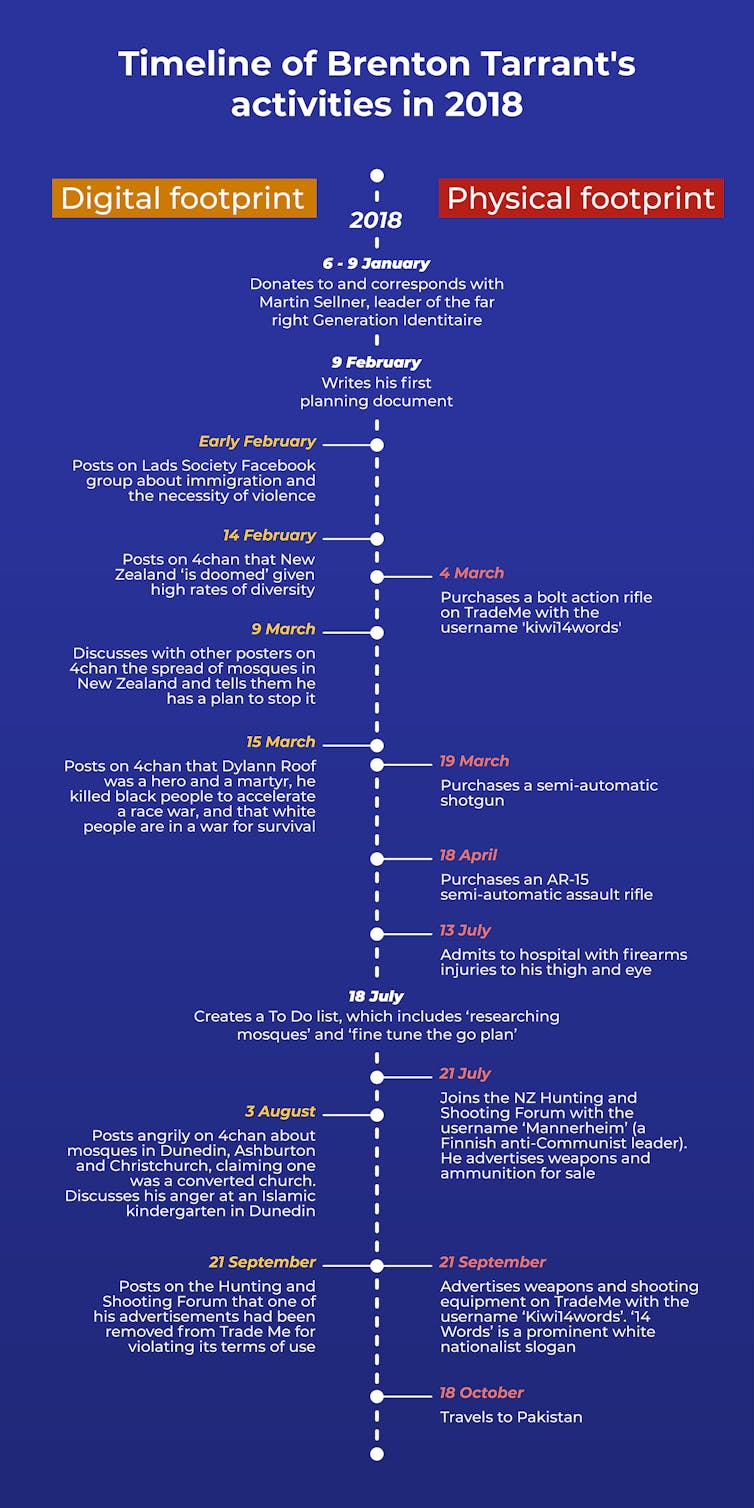
A timeline of Brenton Tarrant's activities in 2018

As our research has previously revealed[1], the man who attacked two mosques in Christchurch in 2019, killing 51 people, posted publicly online for five years before his terrorist atrocity.

Here we provide further information about Brenton Tarrant’s posting. This article has two main goals.

First, by placing his online posting against his other online and offline activities, we gain a far more complete picture of the path to his attack.

Second, we want to show how his online community played a role in his radicalisation. This is important, as the same can happen to others immersed in that community.

In combining his online and offline activity here we do not seek to attribute blame to those who might have been expected to detect this behaviour. It is exceptionally difficult to identify terrorists online.

And yet, history is full of difficult problems that have been overcome. We use the benefit of hindsight to provide greater understanding of Tarrant’s pathway than has previously been available.

The aim is to prevent similar attacks by better understanding how such people act and how they might be detected.

Read more: Christchurch terrorist discussed attacks online a year before carrying them out, new research reveals[2]

Words and deeds

In the timeline below, we focus on Tarrant’s activity in 2018, following his first visit to Dunedin’s Bruce Rifle Club on December 14 2017, until his final overseas trip in October. It is for this period that we have the most comprehensive online posting history.

A timeline of Brenton Tarrant's activities in 2018
The Conversation, CC BY-SA[3] In 2024, we have both the benefit of hindsight and the accumulation of information relating to the attack. However, this triangulation of online and offline activities illustrates the ways those contemplating terrorist violence might act. We can now see, for example, that Tarrant bought high-powered firearms on three occasions over a six-week period in March and April 2018. And he posted publicly twice on the online imageboard 4chan about his plans for racially motivated violence, and his veneration of a perpetrator of a similar attack. Tarrant therefore not only “leaked” his plans for violence, he did so at the very moment he was buying weapons for it. Read more: The road to March 15: 'networked white rage' and the Christchurch terror attacks[4] Over 20 days in July and August, Tarrant presented to hospital with gunshot wounds, and began selling weapons online under the username Mannerheim (the name of a Finnish nationalist leader revered for defeating the communists in the country’s civil war). He also posted publicly about his anger at the presence of mosques in South Island cities (claiming one had replaced a church). He wrote “soon” when another poster suggested setting fire to these places of worship. A month later he attempted to sell weapons on online marketplace TradeMe, using a prominent white nationalist slogan – “14 Words[5]” – in his username. (Strangely, this clear red flag was mentioned only once in the royal commission report[6] on the attacks.) TradeMe removed one of these advertisements for violating its terms of use. That caused Tarrant to move to another forum – NZ Hunting and Shooting Forums – to complain. Read more: Can ideology-detecting algorithms catch online extremism before it takes hold?[7] Extremist community Our study has also revealed how important the 4chan community is to the radicalisation of individuals like Tarrant. In contrast to the fleeting human interaction he had with others as he travelled the world, 4chan was Tarrant’s community. 4chan’s /pol/ (politically incorrect) board became his home. Here he interacted with others over long periods, imagining he was speaking to the same people over months and years, and assuming many of them had become his friends. We have found that, while creating a sense of belonging and community, /pol/ also works to create extremists in both direct and indirect ways. Its anonymous nature (users are assigned a unique ID number for each thread, rather than a username) has two effects. One is well known, the other identified in our study. First, anonymity encourages behaviour that would be absent if the poster’s identity was known. Second, anonymity is frustrating for those who wish to “be someone”, who crave respect and notoriety. We have documented the way Tarrant (and others) strive to gain status in a discussion, only to have to start again when they move to a new thread and are given a new ID. This lack of ongoing recognition is agonising for some individuals, who go to lengths to obtain respect. Read more: Violent extremists are not lone wolves – dispelling this myth could help reduce violence[8] Anonymity and peer respect And just like a real-world fascist movement, /pol/ venerates violent action as necessary for the vitality and regeneration of the community. When a terrorist attack, school shooting or other violent event occurs, users celebrate these events in so-called “happening” threads. These threads are longer, more emotional and excited than any other discussions. Participants often claim the individual at the centre of the event is “/ourguy/” (a reference to the /pol/ board). The threads are also highly anticipatory: many users believe this event will finally push society into violent chaos and race war. These dynamics are closely connected. For those who seek recognition and status on the bulletin board, such as Tarrant, the excited attention and adoration given to those who perpetrate high-profile violence is the clearest path to the peer respect that the anonymity of the board otherwise denies them. As harrowing as this finding is, we contend that gaining respect from their online community is in itself a crucial motivation for some perpetrators of far-right terrorism. The nature of this extreme but easily accessible corner of the internet means any hope Tarrant was a one-off – and that this won’t happen again – is misguided. The authors acknowledge the expert contribution of tactical and forensic linguist and independent researcher Julia Kupper[9]. More information about our study will be released at heiaglobal.com[10]. Our research was approved by the University of Auckland Human Participant Ethics Committee. A paper based on this study has been submitted for peer review and publication.

Authors: Chris Wilson, Co-founder and director of Hate & Extremism Insights Aotearoa (HEIA) and director, Master of Conflict and Terrorism Studies, University of Auckland, Waipapa Taumata Rau


Read more https://theconversation.com/christchurch-attacks-5-years-on-terrorists-online-history-gives-clues-to-preventing-future-atrocities-225273

The Weekend Times Magazine

Protecting Properties with Durable Security Fencing

From residential homes to large commercial facilities, strong and reliable fencing provides peace of mind by keeping intruders out and safeguarding what matters most. Among the many options available, security...

When AEC IT breaks, It Rarely Looks Like IT

AEC businesses rarely lose time to one dramatic outage. What hurts more are the small, repeat delays that show up right when pressure is highest. The drawing set stalls, the...

The Smartest Financial Moves to Make In 2021

You are going to need all the finance tips you can get after winning your best US online casino real money. Everything may be unforeseen, therefore you must make wise...

The Role of Headless CMS in Modern Digital Architecture

With a constantly evolving digital architecture landscape, firms are continuously searching for novel avenues that guarantee nimbleness, flexibility, and scalability. A headless CMS sits front and center as one of...

Sydney Residents: Options for a Weekend Away Short Break

Living in Sydney offers an enviable lifestyle, but even the most iconic city in Australia can feel hectic at times. Whether it’s the daily commute, a fast-paced work schedule, or...

Planting The Seed To Health Living Top tips on planting for wellbeing

With the family home full time and a need to keep everyone busy, it is the ideal time to plant a seed to a healthier lifestyle. Tuscan Path Product Manager...

Horse Float Maintenance: Keeping Your Investment in Top Shape

Horse floats are equipment that are required for the safe and efficient transportation of horses. Long life and performance are assured with proper maintenance. Safety risks and structural damage may...

Why Sydney Never Stops Welcoming the World

Every weekend, Australia's harbour city reminds us why international tourism matters. Walk through Circular Quay on a Saturday morning and you'll hear dozens of languages before you've finished your coffee. Families photograph...

Prime Minister interview with Karl Stefanovic and Alison Langdon, Today

KARL STEFANOVIC: Joining us now from Kirribilli House in Sydney. PM, good morning to you. Thank you for your time.    PRIME MINISTER: G’day Karl.   STEFANOVIC: The Premiers don't seem to be listening...