what exactly is an independent foreign policy?
- Written by: Nicholas Khoo, Associate Professor of International Politics and Principal Research Fellow, Institute for Indo-Paciifc Affairs (Christchurch), University of Otago
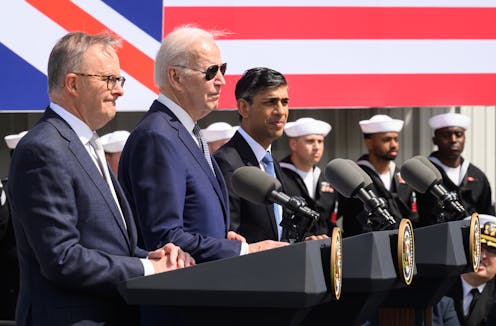
Last week’s visit of the Australian and British defence and foreign ministers[1] to Adelaide and Canberra is another step in the evolution of the trilateral AUKUS security and technology partnership.
Highlights of the visit included the signing of a new defence and security agreement, and the formal appointment of British firm BAE and Australian government-owned company ASC to build submarines under the “pillar one” component of AUKUS.
The visit was an important reminder that Australia’s 2021 decision to initiate AUKUS was one of the most important developments for New Zealand’s foreign policy since the breakdown of the ANZUS alliance in the mid-1980s.
Membership in AUKUS “pillar two[2]” would represent a valuable contribution to New Zealand’s security, the ANZAC alliance and regional security.
What is an independent foreign policy?
AUKUS’ growing strategic significance has two implications for New Zealand.
First, it highlights the imperative for greater clarity in our foreign policy discourse, beginning with the concept of New Zealand’s “independent foreign policy” and Australia’s role in it.
Former prime minister Helen Clark and former National Party leader Don Brash recently stated their opposition to New Zealand’s participation in AUKUS[3], citing the incompatibility between membership and maintaining our independent foreign policy.
Read more: New Zealand is reviving the ANZAC alliance – joining AUKUS is a logical next step[4]
This is curious logic. There are certainly questions that need to be answered before making a decision on AUKUS pillar two – not least if we can actually afford membership, and whether there is domestic support from the electorate.
But the danger posed by AUKUS to an independent foreign policy is not one of them.
Quite the opposite, in fact. If the concept of an independent foreign policy means anything, it surely must mean New Zealand retains the ability to make foreign policy decisions based on its national interests.
Time to define independence
Close alliances and partnerships with other states are clearly compatible with both foreign policy independence and New Zealand’s national interests. After all, few alliances in contemporary world politics have been as enduring or as close as the ANZAC alliance.
There is therefore no persuasive reason to preemptively rule out New Zealand’s AUKUS membership — as AUKUS critics appear to have done.
Moving forward, our independent foreign policy concept needs to be defined more rigorously – including a consideration of costs, benefits and responsibilities[6].
Equally significantly, the AUKUS critics’ commentary undervalues Australia’s role in New Zealand’s foreign policy. We need to correct this blind spot.
Like it or not, New Zealand’s decision on AUKUS pillar two will invariably be seen by Canberra as a signal of its commitment to the ANZAC alliance. How can it not be?
New Zealand’s limited response[7] to the unprecedented sanctions policy imposed on Australia by China since 2020 might be viewed in some quarters as necessary pragmatism, but it has come at the cost of alliance solidarity.
Do AUKUS critics view our reticence in that instance as an example of the effective functioning of an independent foreign policy? It would be instructive to know the answer.
Foreign policy needs to be strategic
Second, a fit-for-purpose foreign policy cannot be indifferent to strategic context. We are a long way from the historically benign era[8] that existed from the end of the Cold War to the onset of US-China strategic competition in 2017.
The onus is therefore on AUKUS critics to explain how exactly they propose to provide for New Zealand’s national security if it is not through AUKUS. If New Zealand does not invest in AUKUS, what exactly is the critics’ vision for the ANZAC alliance?
Read more: The defence dilemma facing NZ's next government: stay independent or join 'pillar 2' of AUKUS?[9]
Given the persistent budgetary challenges New Zealand faces, how does passing up on the pillar two technology aspect of AUKUS increase security?
The share of New Zealand’s total trade with the states that are either AUKUS members or have expressed an interest in joining – Canada, Japan and South Korea – surpasses our trade with China. How much does New Zealand value its credibility with these partners?
Are we expected to believe the AUKUS critics’ preference for taking policy actions that diverge substantially from those partners will serve New Zealand well in the new era of great power rivalry?
AUKUS gives New Zealand agency
AUKUS critics appear to share former defence minister Andrew Little’s sober and accurate 2023 assessment that “we do not live in a benign strategic environment”.
But their critique of AUKUS suggests that they have not rigorously thought through the implications of Little ‘s statement.
Don Brash recently asked[10] why New Zealand would join AUKUS in any form. The answer is clear.
New Zealand can either take a proactive approach to security and help shape the regional environment through AUKUS membership and a rebooted ANZAC alliance. Or it can adopt a reactive high-risk foreign policy that places New Zealand’s fortunes in the hands of fate.
References
- ^ visit of the Australian and British defence and foreign ministers (www.reuters.com)
- ^ pillar two (www.1news.co.nz)
- ^ opposition to New Zealand’s participation in AUKUS (www.odt.co.nz)
- ^ New Zealand is reviving the ANZAC alliance – joining AUKUS is a logical next step (theconversation.com)
- ^ Fiona Goodall/Getty Images (www.gettyimages.com.au)
- ^ a consideration of costs, benefits and responsibilities (www.tandfonline.com)
- ^ limited response (www.stuff.co.nz)
- ^ historically benign era (www.politico.com)
- ^ The defence dilemma facing NZ's next government: stay independent or join 'pillar 2' of AUKUS? (theconversation.com)
- ^ recently asked (www.nzherald.co.nz)
Authors: Nicholas Khoo, Associate Professor of International Politics and Principal Research Fellow, Institute for Indo-Paciifc Affairs (Christchurch), University of Otago