the lightning-quick WWI battle that marked the birth of the US-Australia military alliance
- Written by: Meighen McCrae, Associate Professor of Strategic & Defence Studies, Australian National University
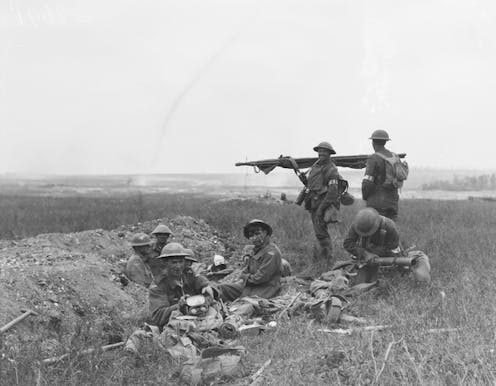
While the AUKUS alliance is new, the Australian-American partnership is not. As Australians reflect on the sacrifices of their soldiers on ANZAC Day, it’s worth remembering the first time Australian and American troops joined forces in battle – in northern France, in the final year of the first world war.
Australia fought as part of the British Empire in the early 20th century. This meant that when Britain declared war in 1914 against the Central Powers (Germany, Austria-Hungary and the Ottoman empire), Australia immediately went to war on the side of the Allies (the British, French, Russian and Japanese empires, with Italy and the United States joining later).
The US didn’t fully commit to the Allied cause until April 1917. Once it did, it focused on building up its industrial war machine and recruiting troops to be sent to Europe. By July 1918, there were around a million American soldiers in France, with more arriving every day.
As I describe in my book, Coalition Strategy and the End of the First World War[1], from the Allied perspective, the war still very much hung in the balance. They knew the Germans were a formidable enemy, as the launch of the German Spring Offensives[2] in March 1918 had shown.
The Allies had some battle successes beginning in June 1918 that slowly built their confidence. One of the important engagements would become known as the Battle of Hamel in northern France. This was when the Australian overall commander, Lieutenant General John Monash[3], spearheaded the first Australian-American attack in history. Monash organised the offensive for July 4, American Independence Day.
A quick victory, with limited casualties
Ahead of the battle, American forces moved into Australian lines. As Australian Lieutenant Edgar Rule described[4]:
Twelve were put in each platoon, and believe me they were some men. This was the first time that they had been in the line, and they were dead keen; and apart from that it bucked our lads up wonderfully. All the novelty of the war had long since vanished for our boys … everyone was smiling or laughing.
The Yanks were out for information and our boys were very willing teachers, and it speaks well for the future to see one set so eager to learn and the other so willing to teach.
Despite Monash’s best intentions, however, the American supreme commander, General John “Black Jack” Pershing[5], was not pleased. Americans supporting Australia in a defensive role was one thing. Attacking, however, would involve higher casualty rates and reduce the strength of the US forces at a time when Pershing wanted to have his own sector of the battlefield, rather than have his troops fed into other armies.
As a result, Pershing went so far as to withdraw six of his companies from the attack and then threatened to withdraw the remaining four. This treatment was not reserved for Monash. Many of the Allied commanders found Pershing difficult to work with – and Monash was no exception.
At 3:10am on July 4, 1918, Australian infantry, including four companies of the American 33rd Division, attacked the Germans in the town of Hamel. They moved forward under the protection of a “creeping barrage” (a slow-moving curtain of artillery fire that protects advancing troops and pins down enemy forces) and with the support of both aircraft and tanks.
Both the Australian Flying Corps and British Royal Air Force were used to prepare for and conduct the attack. This was the first major war in which armies used aircraft in large numbers. And the Battle of Hamel was the first time aircraft were used to parachute supplies to troops on the ground.
Within 93 minutes, the battle was over – and it was a success. The Australian-American forces had achieved their objective of gaining important ground – in this case, guarding the vital rail centre of Amiens – while limiting the loss of life. Casualties were comparatively low[6] for the war, with around 800 killed.
An excerpt from the citation of an Australian Victoria Cross recipient, Private Henry Dalziel[7], illustrates[8] how tough the battle was:
He twice went over open ground under heavy enemy artillery and machine-gun fire to secure ammunition, and though suffering from considerable loss of blood, he filled magazines and served his gun until severely wounded through the head.
His magnificent bravery and devotion to duty was an inspiring example to all his comrades, and his dash and unselfish courage at a most critical time undoubtedly saved many lives.
Dalziel survived the war and went on to be a songwriter.
Read more: Poetry, parties and 'strong Australian tea'. The surprising story of how Anzac Day has been marked in the US for over 100 years[9]
A rapid end of the war
Apart from demonstrating extraordinary courage, the Battle of Hamel is a case study of meticulous planning, excellent staff work and coordination of infantry, artillery, tanks and aircraft.
Indeed, the battle helped vindicate ideas about short, sharp attacks from mutually supporting Allied armies (which the Allied generalissimo, Ferdinand Foch[10] referred to as “punching and kicking” the German lines), as well as the combined use of infantry, creeping barrage, tanks and aircraft. It had taken several years of battle experience to reach this point.
These ideas culminated five weeks later with the unprecedented Allied success of the nearby Battle of Amiens[11], which saw all available[12] Australian spearhead the attack. It was Australia’s biggest victory of the war to that point.
The Australians also fought in the Battle of Mont Saint-Quentin[13] in late August before again joining forces with the Americans and other Allied forces to smash through the Hindenburg Line[14] in September.
By this point, it finally looked as though the tide had turned. The Allies began to envision an end to the conflict in late 1918 rather than in 1919, as they were planning for[15], Indeed, in less than two months, the fighting was over and the Allies were victorious.
For Australia, the end of the war could not come soon enough. The Hindenburg Line was the last offensive for them, as hard fighting over the previous two years had savagely reduced their troop numbers.
However, this was just the beginning of a long military partnership between the US and Australia, forged in shared battle experience and a growing trust, which has now lasted for more than a hundred years.
References
- ^ Coalition Strategy and the End of the First World War (www.cambridge.org)
- ^ German Spring Offensives (encyclopedia.1914-1918-online.net)
- ^ Lieutenant General John Monash (www.awm.gov.au)
- ^ described (www.penguin.com.au)
- ^ General John “Black Jack” Pershing (www.britannica.com)
- ^ comparatively low (www.awm.gov.au)
- ^ Private Henry Dalziel (www.awm.gov.au)
- ^ illustrates (www.gov.uk)
- ^ Poetry, parties and 'strong Australian tea'. The surprising story of how Anzac Day has been marked in the US for over 100 years (theconversation.com)
- ^ Ferdinand Foch (encyclopedia.1914-1918-online.net)
- ^ Battle of Amiens (www.iwm.org.uk)
- ^ all available (anzacportal.dva.gov.au)
- ^ Mont Saint-Quentin (sjmc.gov.au)
- ^ Hindenburg Line (www.awm.gov.au)
- ^ as they were planning for (doi.org)
Authors: Meighen McCrae, Associate Professor of Strategic & Defence Studies, Australian National University