Labor’s new National Urban Policy is welcome. But will it be transformative?
- Written by: Robert Freestone, Professor of Planning, School of Built Environment, UNSW Sydney
In March 2021, then-Opposition Leader Anthony Albanese declared[1] “cities policy has been one of the abiding passions of my time in public life”. He promised a new national urban policy framework if Labor was elected.
That moment has (almost) arrived with the release of a draft National Urban Policy[2].
The policy aims to inject an “urban lens across policymaking” in support of the United Nations Sustainable Development Goals[3].
The policy revolves around five main goals: liveability, equity, productivity, sustainability and resilience. Six key objectives expand on these goals by also stressing belongingness, safety, health and wellbeing. Six principles “to guide decision-making” complement the goals and objectives.
The government is seeking public feedback[4] on the policy before July 4. Two recent and substantive research documents may help in thinking about that feedback. They consider complementary aspects of what issues need to be addressed and policies explored in a national urban policy.
The draft policy’s goals and objectives largely align with those of the two documents. However, some areas of concern are surprisingly omitted. The most troubling gap relates to specifics on how the desired urban transformation will be achieved in practice.
How does the research relate to the policy?
The first research document is an edited collection, Australian Urban Policy[5]. This new book emerged from a 2021 workshop[6] enabled by the Academy of the Social Sciences in Australia. It offers a compendium of policy analyses, reviews and prescriptions.

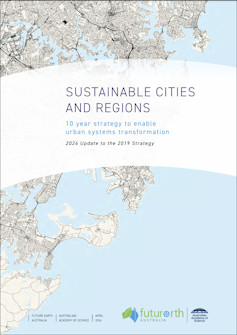
Second, Future Earth Australia (hosted at the Australian Academy of Sciences) published the strategy Sustainable Cities and Regions[8]. This is an update to its 2019 strategy to transform urban systems. It’s based on broad consultation with urban stakeholders and communities around Australia.
The strategy focuses on what is needed to transform a range of critical national to local urban capabilities. Among these are cohesive leadership and governance, inclusive engagement, urban systems understanding, knowledge sharing, and innovation and learning.
Then, on May 23, Infrastructure, Transport, Regional Development and Local Government Minister Catherine King released the National Urban Policy[9] at the Planning Institute of Australia’s annual congress.
So how does the policy stack up?
The draft policy’s five goals align identically with the five urban outcomes of the Sustainable Cities and Regions strategy. Most of the challenges identified in the strategy also resonate through the policy’s six objectives.
However, the policy lacks a strong focus on building capabilities as an essential component. It makes some supportive statements on coordinated governance, stakeholder and community engagement, and evidence-based decisions. But there are no specifics in the national objectives, challenges and possible responses on these and related areas.
Shared policy-level commitment to enhancing transformative capabilities is essential.
The National Urban Policy tackles the wide-ranging interdependent issues (aka “interconnected challenges”) canvassed in the book Australian Urban Policy. It even goes further into arts and culture, tourism, freight transport and, disarmingly, very specific targets like koala crossings[10] and cool paints[11].
But the draft reads as an extensive if not repetitive statement of aspirations. For the most part, these are hard to disagree with.
The policy’s decision-making “principles” add some groundedness, but the conceptual matrix needed to summarily tie all of these together with the goals and objectives is missing.
The draft injects a powerful and overdue First Nations theme. But there are some surprise omissions:
- “smart cities” are not mentioned at all
- towns are squeezed out by cities and suburbs
- knowledge industries seem forgotten
- high-speed rail doesn’t feature
And despite a concern with “urban development patterns”, this is mainly sprawl. A national plan of settlement recommended[12] by a 2018 parliamentary inquiry is not resurrected.
How to go beyond ‘business as usual’
A categorisation of an array of current federal programs, schemes and agreements reassures that the NUP is already “under way”. But business-as-usual won’t achieve truly transformative change. Both research-based documents stress the need for detailed mapping of how specific policy transitions will be achieved.
Most importantly, the governance to make the National Urban Policy happen – including a hopeful suggestion of “cross-portfolio engagement” – is still undeveloped beyond current ministerial and cross-jurisdictional forums, meetings and working groups. The all-important shared vision and partnerships with the states and territories remain a “placeholder” in the draft policy as negotiations continue.
The two research-based initiatives are complementary. One was based on broad consultation focused on developing the urban capabilities needed across policy areas and spatial scales. The other assembled the insights of leading researchers on more specific policy topics. Together they identify new ideas that need to be debated in formulating the National Urban Policy.
This is a critical moment in the decade to deliver on a coherent vision for Australia’s cities and regions. The government is to be commended for initiating a process to identify policy improvements. Whatever your views, we encourage all to share their feedback before the policy is finalised.
References
- ^ declared (anthonyalbanese.com.au)
- ^ National Urban Policy (www.infrastructure.gov.au)
- ^ Sustainable Development Goals (sdgs.un.org)
- ^ seeking public feedback (www.infrastructure.gov.au)
- ^ Australian Urban Policy (press.anu.edu.au)
- ^ 2021 workshop (socialsciences.org.au)
- ^ Future Earth Australia (www.futureearth.org.au)
- ^ Sustainable Cities and Regions (www.futureearth.org.au)
- ^ released the National Urban Policy (minister.infrastructure.gov.au)
- ^ koala crossings (www.koala.nsw.gov.au)
- ^ cool paints (theconversation.com)
- ^ recommended (www.aph.gov.au)
Authors: Robert Freestone, Professor of Planning, School of Built Environment, UNSW Sydney