what the UK election landslide would look like under NZ’s MMP system
- Written by: Richard Shaw, Professor of Politics, Massey University
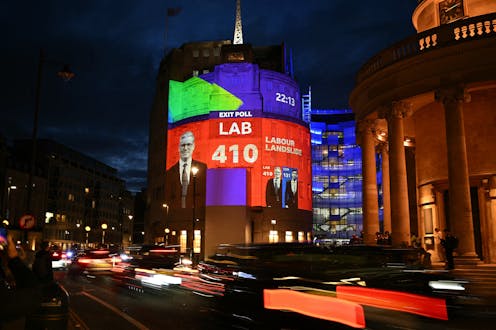
At first glance, Keir Starmer’s Labour Party[1] has just put in a performance for the ages in the British general election.
The incoming prime minister controls a comfortable parliamentary majority, Tory bastions have fallen to the left and the right, and any number of curtains have been brought down[2] on the careers of Tory MPs and ministers.
Whisper it quietly, but the curtain might also have fallen on the electoral system that delivered Starmer his moment of triumph.
On closer inspection, in fact, there are several striking similarities between what has been going on at Westminster and the circumstances that led to the adoption of the Mixed Member Proportional[3] (MMP) system in Aotearoa New Zealand in 1993.
A single-party state
Manufactured parliamentary majorities? Check. With the exception of 1951, every postwar election held in New Zealand under the old first-past-the-post (FPP) electoral system – the one they still use in the UK – produced a government comprising a single party voted for by a minority of voters but which controlled a majority of parliamentary seats.
Starmer’s Labour has won 63% of the 650 seats in the House of Commons on the basis of just 33.7% of the vote[4]
Declining voter support for major parties? Check. In New Zealand, the proportion of all votes won jointly by the two parties that have dominated politics for the better part of a century, National and Labour, began falling in the 1970s. In 2023, they won just 65% of the vote between them.
On election day the UK Labour and Conservative parties picked up a miserable 57.5% of the vote between them. They may have been rewarded with 82% of all Commons seats, but their tides are going out.
Smaller parties rising in popularity but being punished by FPP? Check. Support for what we used to call minor parties here in New Zealand grew steadily from the 1970s and ‘80s, but under FPP was never rewarded with proportionate numbers of parliamentary seats.
Most famously, in 1981, Social Credit won 20% of the vote[5] but just two seats. In the UK, the Liberal Democrats and Reform UK won more than 25% of the vote between them – and just 11% of parliamentary seats.
Disaffection and low turnout
Disaffected voters? Check. In New Zealand, much of the impetus behind electoral reform came from voters who had tired of an electoral system that stacked the odds in favour of the two large parties.
That system routinely delivered single-party majority governments (supported by a minority of voters) who were inclined to throw their executive weight around.
The disgruntlement was also reflected in declining rates of voting. Turnout in the UK was just 60% of eligible voters, the lowest since 2001. One estimate[6] put turnout below 50% in 59 constituencies.
Governments out of touch? Check. The referendum that led to a new electoral system in New Zealand came after decades of executive obfuscation, arrogance and overreach from both Labour and National governments.
The UK’s Conservative government, which unleashed austerity on poor people[7], took its country out of Europe on dubious grounds[8], behaved disgracefully[9] during a global pandemic, and tried to create a new form of macroeconomics[10] in which neither the markets nor governing institutions had any faith, has just been put out of its misery.
Careful what you wish for
There is one final historical parallel. In New Zealand, the Electoral Reform Coalition – a loose alliance which lobbied for a new electoral system – provided a focus for citizens with differing and disparate reasons for feeling grumpy with the FPP electoral system.
There is an equivalent group in the UK, the Electoral Reform Society[11] – coincidentally, led by former New Zealand Labour MP and minister Darren Hughes. The manifest disproportionality of the UK’s electoral rules has just given it some very good reasons to push harder for reform.
Consider what this UK election might have produced had it been held under New Zealand’s MMP system. Leaving aside the messy details of thresholds, coat-tailing rules and overhangs[12], Starmer would be leading a caucus of 219 MPs, not the 412 he actually has.
The Conservatives would have 154 seats (33 more than they won); the Lib Dems would have 79 spots. And Reform UK’s MPs would be sitting in 93 seats, not five, making Nigel Farage the leader of the third-largest party in the Commons.
In this world there is no Labour landslide. In fact, there is no parliamentary majority for Starmer at all – and perhaps no Labour government, which could not get to a parliamentary majority of 326 even with the support of the Lib Dems.
Neither, for that matter, could a Tory–Reform coalition. Instead, there would be a hung parliament and the prospect of a protracted process of government formation.
For many reasons, of course, things would have been quite different had the 2024 UK election actually been held under an MMP electoral system. But it bears saying, nonetheless, that with electoral law reform, as with most things, you need to be careful what you wish for.
References
- ^ Keir Starmer’s Labour Party (www.theguardian.com)
- ^ curtains have been brought down (www.reuters.com)
- ^ adoption of the Mixed Member Proportional (www.rnz.co.nz)
- ^ 33.7% of the vote (www.theguardian.com)
- ^ Social Credit won 20% of the vote (thespinoff.co.nz)
- ^ estimate (www.theguardian.com)
- ^ unleashed austerity on poor people (blogs.lse.ac.uk)
- ^ dubious grounds (www.lbc.co.uk)
- ^ behaved disgracefully (www.bbc.com)
- ^ new form of macroeconomics (theconversation.com)
- ^ Electoral Reform Society (election2024.electoral-reform.org.uk)
- ^ thresholds, coat-tailing rules and overhangs (ndhadeliver.natlib.govt.nz)
Authors: Richard Shaw, Professor of Politics, Massey University