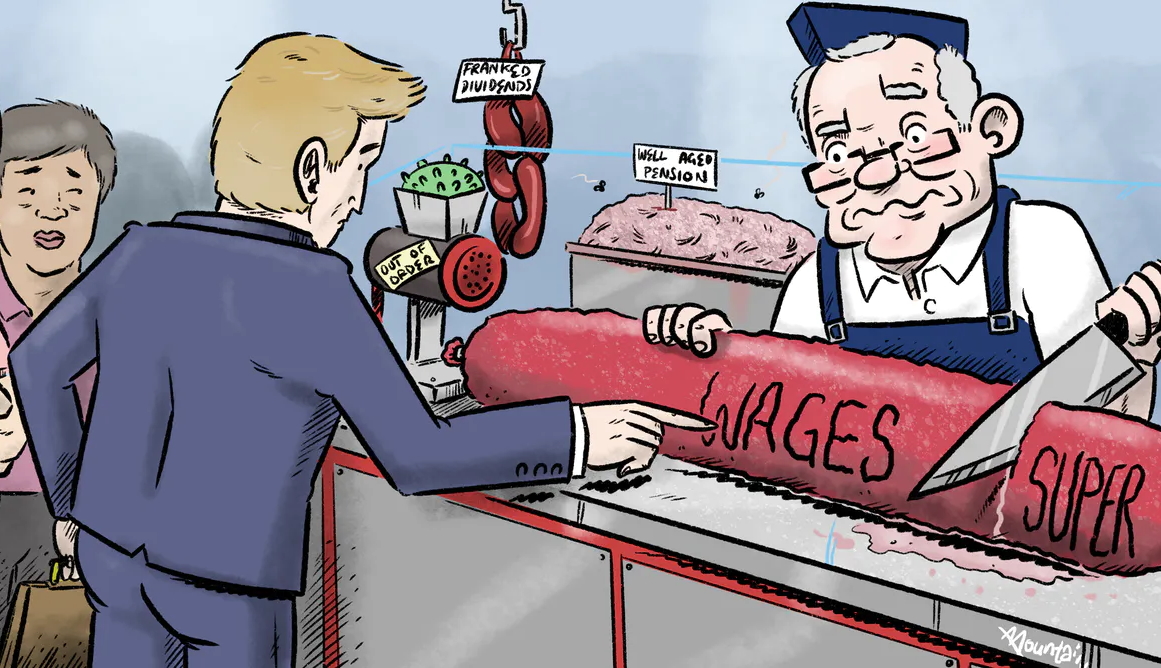
Would a tech tax be a fair way to make Google and Meta pay for the news they distribute and profit from?
- Written by: Anya Schiffrin, Senior Lecturer in Discipline of International and Public Affairs, Columbia University

As the News Media Bargaining Code agreements[1] in Australia start to wind down, there is discussion about what will come next. Media academic Andrea Carson calls the codes, passed in 2021, “world-first” legislation because Australia was the first country to use competition law to get Google and Meta to pay news publishers for the news they distribute and profit from.
According to former chair of the Australian Competition and Consumer Commission (ACCC) Rod Sims, about A$250 million[2] flowed to news publishers each year. It’s just a fraction of what would have been a fair price.
Globally, the code has had an enormous impact. Countries that have discussed[3] putting in their own versions have immediately seen Google strike deals with local publishers in an effort to forestall legislation.
The amounts paid out are far less than what is owed. If there were equal bargaining power and Google had to pay for the intellectual property produced by others which it made use of, it would be much more. But something is better than nothing. Thanks to the Australian law, Google has paid out tens of millions of dollars to publishers around the world. We will never know the exact amount, as Google requires publishers to sign non-disclosure agreements.
Google is, of course, dependent on news to make its search more attractive to audiences and advertisers. Research[4] in several countries has also shown just how important quality news is for Google.
Not surprisingly, Google has mounted full-on campaigns against code-type legislation in Brazil[5], South Africa, California, Indonesia and other countries where it has been proposed.
Meta, which owns Facebook, has been, if anything, even worse. It has been adamant about resisting paying for the news that passes over its platforms. It has threatened to drop all news from countries that adopt and enforce legislation like the bargaining code, spooking regulators.
These tactics have been effective. The two firms have done a good job killing off proposed regulation in many markets.
Now with Meta saying it will pull out of news distribution in Australia, as it did in Canada, and Google reportedly saying it will only sign one-year deals[6] with publishers, the question is: what will come next? Media reports suggest the government is considering a levy[7] on tech companies.
Would a tech levy work?
The OECD has tried and failed to get a global agreement to raise corporate taxes – an agreement that would have prohibited digital taxes. In the meantime, the US government, influenced by its tech giants, is strongly opposed to such taxes. US Treasury Secretary Janet Yellen has spent a good deal of time calling up her counterparts and telling them not to impose[8] them.
However, since the US has essentially blocked a global agreement on corporate taxes, many countries have decided to keep or adopt digital services taxes. Indeed, more than 18 countries[9] have such taxes and some 20 others have proposed[10] them. According to PWC[11], these may be levied on online sales, digital advertising, data usage, e-commerce, or streaming services.
While levies on streaming services to fund local content have been put in place in France, Switzerland, Canada, Portugal and are coming into force in Spain, and they’re being discussed in Australia, no government has used the funds raised from digital service taxes to directly support journalism.
In theory, taxes on tech have advantages over bargaining codes. The Australian version of the bargaining code doesn’t fully resolve the problem of power imbalances between the large social media firms and the publishers, and there were no requirements to spend the money on journalism. In theory, a tax on tech could address these shortcomings.
However, before publishers start pushing for taxes on tech to support journalism, there are a few things to consider. Is there public support for giving the revenue raised to journalism rather than putting it into the general kitty to be spent by the government? If there is support for a tax to support journalism, who decides on the allocation? How could there be safeguards to ensure governments don’t use the funds to support their media allies?
It’s also important to remember that, of course, tech firms oppose taxes. They’ve offshored their revenues for years and resisted paying taxes. In the US, Maryland in 2021 passed a tax on digital advertising[12] and the state has spent years fighting off multiple lawsuits. We should expect even more resistance to a tax than to the bargaining code.
Making tech firms pay for what they use to make money
The bargaining code addressed a simple issue: how to force the platforms to pay fairly for the intellectual property they were effectively stealing and which enhanced their profits, given the imbalance of powers in this market. In doing so, it helped address another major societal issue: how do we pay for quality journalism, a public good from which all benefit? It never pretended to adequately resolve that question, but at least it was a start.
Every country needs to address the theft of intellectual property that diminishes both the incentives and ability to produce the news on which we all — including the platforms — depend. The bargaining codes were a start.
But democratic governments should also publicly fund quality news media. With the platforms having appropriated for themselves so much of the advertising revenues on which the media used to depend, it is natural to turn to digital taxation. It is not a matter of either/or; it should be a matter of both/and. Pragmatism should prevail. As the economist Dean Baker says, “the best policy is the policy you can pass”.
This article was written with research assistance from Philip Crane, Emma Goldhaber, Reena Mensingh and Lei Zhu.
References
- ^ News Media Bargaining Code agreements (en.wikipedia.org)
- ^ A$250 million (www.smh.com.au)
- ^ have discussed (www.poynter.org)
- ^ Research (fehradvice.com)
- ^ Brazil (www.poynter.org)
- ^ one-year deals (www.bandt.com.au)
- ^ considering a levy (www.theguardian.com)
- ^ telling them not to impose (www.nytimes.com)
- ^ 18 countries (taxfoundation.org)
- ^ proposed (bipartisanpolicy.org)
- ^ PWC (www.pwc.com)
- ^ tax on digital advertising (www.nytimes.com)
Authors: Anya Schiffrin, Senior Lecturer in Discipline of International and Public Affairs, Columbia University