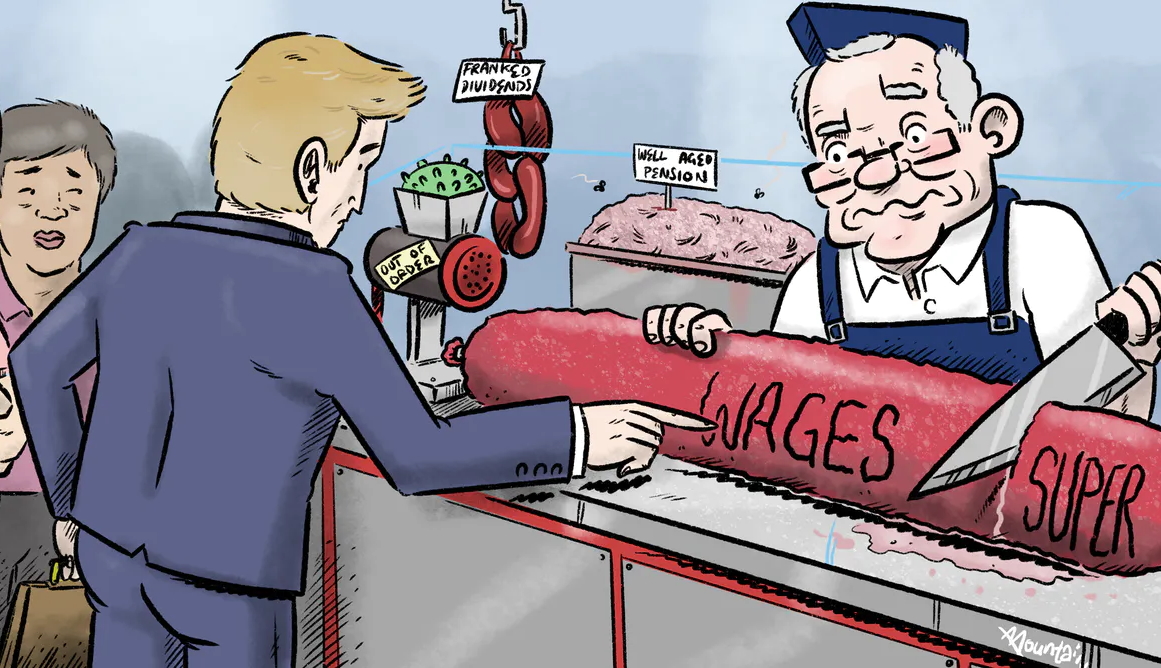
frustrated government can only bite its tongue as it waits on Michele Bullock
- Written by Michelle Grattan, Professorial Fellow, University of Canberra
As she reads the economic commentators, Reserve Bank Governor Michele Bullock might, in moments of doubt, wonder whether she’s making a similar misjudgement to her predecessor Philip Lowe.
Lowe ended up discredited because of some poor calls. He had signalled the bank would hold rates down for longer than turned out to be the case.
Presently, a big debate is underway about whether Bullock and the bank have got it wrong in their stand that rates shouldn’t be cut “in the near term”.
But that’s a debate Treasurer Jim Chalmers, for all his talk this week about Australia’s weak economy in the wake of Wednesday’s national accounts, won’t be drawn into.
It’s no secret the government is impatient for a rate cut, and frustrated we’re not seeing one. But it can’t say so, because that would invite attacks it was pressuring the independent bank.
A few months ago, Chalmers declared high interest rates were “smashing” the economy. Despite the fact he’d previously made the point, it turned into a big headline, feeding a feral news cycle. Chalmers learned a sharp lesson: even saying the obvious can be politically dangerous.
Others are forthright. Pradeep Philip, head of Deloitte Access Economics, says: “The private economy has been clobbered and we’d be in a recession if it wasn’t for government spending. Australia has been in an income per capita recession for some time now. The imperative for fiscal sustainability is stronger than ever and the case for a rate cut is palpable.”
ACTU secretary Sally McManus was blunt this week. “Central banks in almost all advanced economies have already started cutting their official cash rates – and it is time for Australia’s Reserve Bank to do the same.”
There’s no expectation the bank will be sympathetic to calls for a cut when it meets next week. It still argues inflation must fall further before a reduction can safely and sustainably be made. But the bank’s language will be carefully monitored for any sign of softening.
Its critics assert, variously, that the bank’s thinking is flawed – in particular, the belief unemployment needs to climb further to bring inflation to the acceptable level needed for a rate cut – or that it has backed itself into a corner because Bullock earlier flagged there’d be no cut this year.
Weeks ago, expectations about a rate cut were being pushed well into 2025. A government with its back to the wall hopes (but doesn’t necessarily expect) Wednesday’s figures might bring that forward to early next year.
Labor hardheads accept one cut wouldn’t significantly shift the government’s low popularity. But they do think it would show voters there’s light at the end of the tunnel.
Meanwhile, Chalmers was this week forced back onto the argument that, yes, people are hurting, but “Australians would be much worse off and growth in our economy would be even weaker without our responsible and balanced approach to the budget and without our cost-of-living support”.
Prime Minister Anthony Albanese is talking up his second-term agenda but, as it crafts campaign lines, Labor will need to rely heavily on the alleged dangers posed by a Dutton government. Its focus groups are said to show people do think they’d be worse off under Dutton. Voters are disillusioned with the government but don’t assume change is risk-free.
Expect to hear a lot about how Dutton as health minister (way back when) went after Medicare. How he never backs wage rises. How he didn’t support cost-of-living help.
With a sour electorate, the best thing going for Labor may be its negative campaign, however unedifying that might be.
Dutton has so far been successful in his attack lines against Labor, delivered sharply and cleanly, while he’s kept the opposition a relatively small target with just a few popular policy offerings (such as on social media, and gambling reform).
But as he produces more policies, his vulnerability will increase. And as Labor unveils election giveaways, Dutton will be forced into awkward choices.
He’s promised the costing of his nuclear policy before Christmas and this will open him to more criticism over what many experts see as an unrealistic option. Nuclear power, however, is likely to be only a second-order issue, because it’s blue-sky stuff when it comes to Australia’s immediate energy needs. Voters think about their power bills in the next year or two, not decades hence.
Albanese has flagged he has a couple of big policy announcements to make over the summer, starting this month. One is expected to be an expanded child-care policy, with the final shape still being settled. The other remains firmly under wraps.
The Australian Financial Review reported this week the government was “mulling” another round of power bill discounts to take to the election. It would seem an obvious promise, and the Coalition would have to decide how to respond.
The Coalition’s soft underbelly will be its alternative economic policy, given there’s no easy way out of Australia’s malaise.
It argues government spending is too high, and is crowding out the private sector. But when it finally says (and it can’t get away with not saying) what it would cut, that will bring a backlash. Just declaring it would slash the public service won’t wash.
The Coalition says we must boost productivity. But how’s that to be done? If it involves winding back industrial relations changes, that’s risky territory in an election campaign.
On Thursday the Productivity Commission called on “everyday Australians” to come up with ideas on how to boost productivity. “We are looking for practical policy ideas from people in all walks of life on how Australia can work smarter, more efficiently, and more productively,” commission chair Danielle Wood said.
Perhaps people can copy Dutton in on their emails to the commission.
In the bowels of the bureaucracy and the offices of the treasurer and finance minister, they’re already at work on a March 25 budget that, depending on Albanese’s election timing, may never be delivered.
Within Labor, people differ on the pros and cons of launching the campaign off the back of a budget. It enables the government to frame its forward pitch and dominate the start of the campaign. But the debate can bog down in detail, and put the grim numbers up in lights.
Back at the Reserve Bank, Chalmers saw his legislation to set up a new monetary board pass last week, in a deal with the Greens. He intends to transfer all the current board onto the monetary board, except those who opt to be on the bank’s governance board. That will mean he’ll have a couple of vacancies to fill on the monetary board.
The first meeting of the monetary board is scheduled for March 31-April 1. If there’s no rate fall ahead of that, is it possible the new board could, on April Fool’s Day, make its first big decision a rate cut?
Authors: Michelle Grattan, Professorial Fellow, University of Canberra