David Seymour says Kiwis are too squeamish about privatisation – history shows why they lost the appetite
- Written by: Richard Shaw, Professor of Politics, Te Kunenga ki Pūrehuroa – Massey University
State asset sales have been a political dividing line in New Zealand for decades now, and it seems voters are again being asked to decide which side they’re on.
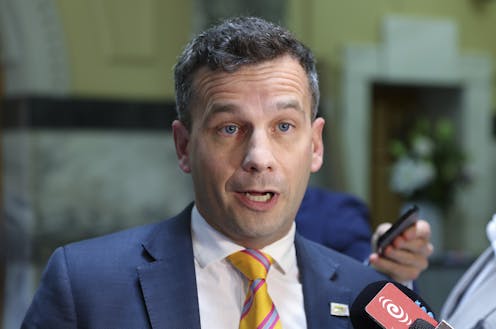
In his state-of-the-nation speech[1] last week, ACT Party leader David Seymour advised New Zealanders to “get past their squeamishness about privatisation” and ask themselves:
If we want to be a first world country, then are we making the best use of the government’s half-a-trillion-dollars–plus worth of assets? If something isn’t getting a return, the government should sell it so we can afford to buy something that does.
No doubt this appealed to ACT’s core constituency. But the available evidence suggests many New Zealanders view the privatisation of state assets with scepticism, not squeamishness.
The most rigorous available data are from the New Zealand Election Study[2]: just under 50% of those surveyed in 2020 either “somewhat” or “strongly” agreed with the proposition that “privatisation has gone too far”.
Just over 9% either somewhat or strongly disagreed with that statement. In other words, those who oppose state asset sales comfortably outnumber those who support them.
It seems reasonable to suggest this reflects the sizeable proportion of New Zealanders who remember the asset sales experience of the 1980s and 1990s[3] under both Labour and National governments.
Writing in 2000, during the heights of this bipartisan privatisation boom, economic analyst Brian Gaynor argued[4]:
By selling 100 per cent shareholdings in state assets, the New Zealand Government has allowed a small group of investors, mainly offshore, to make enormous profits. With just a little foresight these profits could have been kept for the benefit of domestic investors and taxpayers.
At the same time, voters have watched levels of wealth inequality rise[5], and the transfer of public wealth[6] into private hands. And while asset sales can improve efficiency, they can also reduce access to services for those on limited incomes or experiencing higher unemployment.
Market failure
Research has shown a clear majority of New Zealanders would prefer the government provides social services[7], especially in health and education.
Just over 80% of New Zealanders trust the public service[8] based on their own experiences. And levels of trust in the public service outstrip those in the private sector[9]. All this suggests there is little appetite for a return to the days of peak privatisation.
More broadly, some New Zealanders will also question Seymour’s assertion that state assets should provide a return on investment.
Aside from it not being possible to turn a profit on many of the assets a government needs to serve the needs of its citizens, there are costs associated with putting a market value on certain social goods and services.
As Harvard political philosopher Michael Sandel has argued[10]:
[W]hen money comes increasingly to govern access to the essentials of the good life – decent health care, access to the best education, political voice and influence in campaigns – when money comes to govern all of those things, inequality matters a great deal.
Furthermore, there is ample evidence of the ethical and operational shortcomings of applying the profit motive to public institutions such as prisons[11], hospitals[12] and schools[13].
Nor are markets themselves value-free, self-correcting mechanisms. In the material economy, they have a propensity to fail. When they do, the people who suffer most tend to be those least well positioned to defend themselves.
That is why the state performs certain functions: to make sure those unable to pay for privately provided goods and services are not denied them.
The nature and extent of what the state should provide is quite properly a matter for debate. But those decisions affect everyone and should be decided in the public domain, not left to the managers and owners of private companies.
Public versus private debt
Seymour also suggested a return to asset sales was justified by the country’s current levels of public debt. He referred to “the other tribe” who are
building a majority for mediocrity – who would love nothing more than to go into lockdown again, make some more sourdough, and worry about the billions in debt another day.
But as the right-leaning Maxim Institute[15] points out,
the real risk in New Zealand is our very high levels of private debt, which includes household debt like mortgages, student loans, credit card, hire purchases, to buying a car in instalments […] Compared to our relatively low levels of public debt our current household debt stands at 95% of GDP.
According to the Treasury[16], current public debt levels are “prudent”, although “an ageing population, climate change and historical trends mean governments have important choices to make”.
The risk of renewed asset sales and privatisation is that public debt might be reduced but at the expense of private debt increasing.
Prime Minister Christopher Luxon has responded by saying he was open to a conversation[17] about selling state assets. While it was “not something on our agenda right now”, he said, he hinted National may campaign on it[18] ahead of next year’s election.
His other coalition partner, NZ First, has a long-held antipathy to selling local assets to offshore owners[19]. And Luxon may also remember the result of the non-binding citizens-initiated referendum[20] in 2013, when 67.3% opposed the potential sale of the state’s energy companies.
A niche party[21] such as ACT can safely take policy positions that have little appeal beyond its core supporters. But that’s not a luxury available to its major coalition partner, which started the year behind in the polls[22].
On the other hand, National does not want to be outflanked any further by ACT. Asset sales, it seems, are destined to remain a perennial political fault line.
References
- ^ state-of-the-nation speech (www.act.org.nz)
- ^ New Zealand Election Study (dataverse.ada.edu.au)
- ^ 1980s and 1990s (www.nzherald.co.nz)
- ^ Brian Gaynor argued (www.nzherald.co.nz)
- ^ levels of wealth inequality rise (www.stats.govt.nz)
- ^ transfer of public wealth (www.psa.org.nz)
- ^ prefer the government provides social services (briefingpapers.co.nz)
- ^ 80% of New Zealanders trust the public service (www.publicservice.govt.nz)
- ^ outstrip those in the private sector (www.publicservice.govt.nz)
- ^ Michael Sandel has argued (blog.ted.com)
- ^ prisons (time.com)
- ^ hospitals (hbr.org)
- ^ schools (www.nzherald.co.nz)
- ^ Getty Images (www.gettyimages.co.nz)
- ^ right-leaning Maxim Institute (www.maxim.org.nz)
- ^ According to the Treasury (www.treasury.govt.nz)
- ^ open to a conversation (www.rnz.co.nz)
- ^ National may campaign on it (www.rnz.co.nz)
- ^ antipathy to selling local assets to offshore owners (www.nzherald.co.nz)
- ^ citizens-initiated referendum (electionresults.govt.nz)
- ^ niche party (www.electionresults.govt.nz)
- ^ behind in the polls (www.rnz.co.nz)
Authors: Richard Shaw, Professor of Politics, Te Kunenga ki Pūrehuroa – Massey University