NZ governments enjoy an ‘executive paradise’ – a longer parliamentary term won’t change that
- Written by: Richard Shaw, Professor of Politics, Te Kunenga ki Pūrehuroa – Massey University
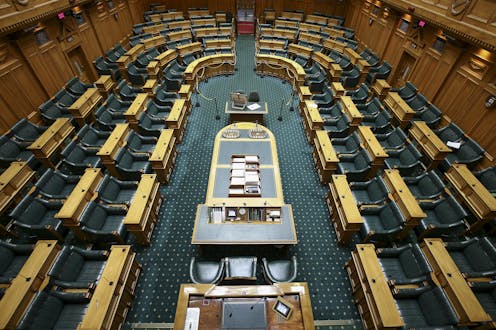
Extending the length of the parliamentary term is one of those recurring issues in New Zealand politics, emerging from the constitutional shadows[1] every 30 years or so and quickly retreating from the bright light of scrutiny.
The pending introduction of the Term of Parliament (Enabling 4-year Term) Legislation Amendment Bill[2] – a coalition initiative of the ACT Party but which enjoys qualified cross-party support – sees the question once again enjoying a moment in the sun[3].
Because of the constitutional protection of the parliamentary term[4], and if the bill becomes law, an extension would require a public referendum with the 2026 general election (or the support of 75% of all MPs, a route the government will not take).
The standard maximum term of parliament would remain three years. But a prime minister would have the option at the start of a new parliamentary term of advising the governor-general it would be extended to four years.
This could only happen if the allocation of places on select committees reflected the distribution of non-executive MPs across all parliamentary parties. Theoretically, this would be a check on executive power.
But while the coming debate will be framed as one about parliament, the real issue is whether voters wish to extend the length of time governments spend in office. This is a crucial distinction.
Lack of checks and balances
New Zealand voters do not directly elect the executive branch. Rather, the government is formed by the party or parties able to command a majority of MPs following each election.
In short, we elect parliaments, which then provide governments. The length of one is connected to that of the other – meaning elections are one of the few ways New Zealanders can hold their governments to account.
Perhaps for this reason, voters have consistently supported a three-year term, despite historical attempts by earlier governments to extend it. Two previous referendums, in 1967 and 1990, maintained the status quo.
This does make New Zealand something of an outlier internationally[5]. Of 190 lower houses and unicameral national legislatures around the world, only nine have terms of three years or less. The vast majority have terms of four or five years.
But New Zealand also lacks the checks and balances found in many of those other countries: a codified constitution, a Supreme Court responsible for policing it, and an upper legislative chamber.
Consequently, the frequency with which governments are held accountable to the people really does matter.
An ‘executive paradise’
This absence of the sorts of constitutional guardrails common elsewhere is what led former prime minister and constitutional lawyer Geoffrey Palmer to call New Zealand an “executive paradise[6]”.
The introduction of a four-year parliamentary term would do little to alter that, despite the argument it would improve the quality of parliamentary law and the standard of public policy-making.
A three-year cycle, it is often claimed, forces governments to spend their first year in office removing as many traces of the previous administration as possible, the second consolidating its own policy agenda, and the third campaigning for the next election.
A four-year term, the logic goes, would give ministers more time to learn the intricacies of their portfolios and develop policy expertise. It would allow for longer parliamentary deliberation on complex legislation, and ensure parliament properly scrutinises government policies, budgets and performance.
All things being equal, a longer parliamentary term could improve governance and create a more stable, durable policy mix. But, of course, all things are rarely equal.
Missing provisions
In and of itself, a longer parliamentary term is unlikely to produce the benefits[8] its proponents promise. Improved policy-making requires resources as well as more time, including policy and procedural expertise, judgement and institutional wisdom.
These things reside in the professional bureaucracy. Without also addressing the systemic crisis in the public service[9], an extra year won’t improve matters.
It would be especially important to ensure a longer term went hand in hand with more effective parliamentary scrutiny of government activity, both its forecasts and actual results.
As a 2019 report from the Institute for Governance and Policy Studies[10] suggested, investment in MPs’ policy expertise, systematic work plans for select committees and changes to parliament’s Standing Orders are also needed to improve the legislative process.
But these do not feature in the draft legislation. And without them, an extended parliamentary term would simply tip the balance even further towards the executive branch and away from the legislature.
Democratic accountability
There are other important issues the draft legislation doesn’t address, including the implications of making a four-year term discretionary, and what might prevent a government from ignoring irksome select committee recommendations[11] (as can and does presently occur).
Worryingly, too, advice from the Ministry of Justice to the justice minister[12] points out that parts of the proposed legislation are “constitutionally and practically problematic”.
The inevitable uncertainty at the start of every new parliament would “undermine democratic accountability” and “risks undermining the legitimacy of parliament and its exercise of public decision-making powers”.
The advice also says the legislation is “out of step with other long-standing legal and constitutional principles, including that it appears to encroach on the House of Representatives’ right to control its own operations”. In our constitutional tradition it is not for the executive to determine how parliament functions. A king’s head once rolled over this issue[13].
The proposed legislation starkly illustrates the tensions that can emerge when constitutional arrangements blur the boundaries between the executive and legislative branches, enabling the former to dictate terms to the latter.
Without other changes – an increase in the size of the House relative to the executive[14], say, or restrictions on the power of the prime minister to call early elections – the variable parliamentary term promised by the bill will inject more uncertainty into public life, not less.
And it will not improve the quality of our laws. It will simply extend the length of time government ministers get to spend in paradise.
References
- ^ emerging from the constitutional shadows (www.parliament.nz)
- ^ Term of Parliament (Enabling 4-year Term) Legislation Amendment Bill (www.legislation.govt.nz)
- ^ enjoying a moment in the sun (www.rnz.co.nz)
- ^ constitutional protection of the parliamentary term (www.legislation.govt.nz)
- ^ an outlier internationally (www.parliament.nz)
- ^ executive paradise (newsroom.co.nz)
- ^ Getty Images (www.gettyimages.co.nz)
- ^ unlikely to produce the benefits (ndhadeliver.natlib.govt.nz)
- ^ the systemic crisis in the public service (www.rnz.co.nz)
- ^ report from the Institute for Governance and Policy Studies (www.victoria.ac.nz)
- ^ select committee recommendations (thespinoff.co.nz)
- ^ Ministry of Justice to the justice minister (www.justice.govt.nz)
- ^ A king’s head once rolled over this issue (worldhistoryedu.com)
- ^ an increase in the size of the House relative to the executive (newsroom.co.nz)
Authors: Richard Shaw, Professor of Politics, Te Kunenga ki Pūrehuroa – Massey University