Peter Dutton wants to deport criminal dual citizens. We already have laws for that
- Written by: Luke Beck, Professor of Constitutional Law, Monash University
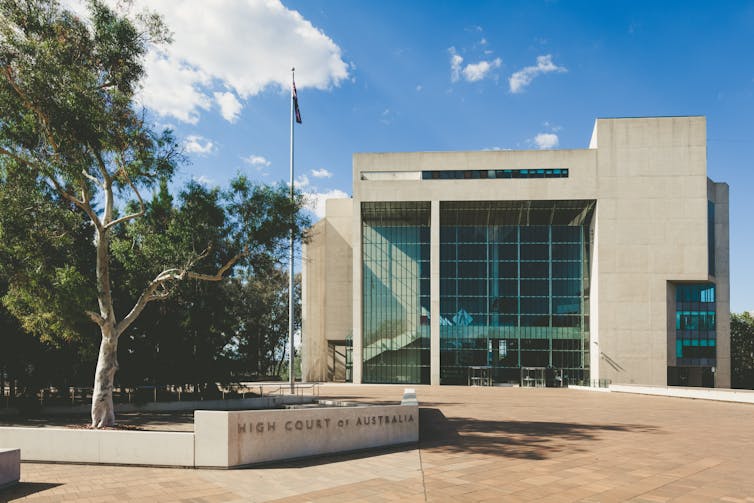
Opposition Leader Peter Dutton has floated the idea of amending the Australian Constitution to allow government ministers to strip dual citizens of their Australian citizenship if they commit serious crimes related to terrorism.
Almost immediately, Dutton’s coalition colleague and Shadow Attorney-General Michaelia Cash walked back the idea, saying the Coalition had “no plan[1]” for a referendum.
Dual citizens can already lose their Australian citizenship if they commit terrorism offences.
So what does the Constitution say about the issue?
Citizenship cessation
Under the Australian Citizenship Act[2], there are three main ways an Australian citizen can cease their Australian citizenship.
First, a dual citizen can voluntarily renounce their Australian citizenship. Some people choose to do this if they move overseas and don’t intend to return to Australia.
Second, the government can revoke a dual citizen’s Australian citizenship if they obtained it by fraud. The logic here is that the person was never really eligible for Australian citizenship in the first place.
Read more: View from The Hill: Dutton's talk about a citizenship referendum is personal over-reach and political folly[3]
Third, and most seriously, a court can – if the government asks it to – strip a dual citizen of their Australian citizenship as part of the sentencing process for serious crimes such as terrorism and foreign incursions.
In deciding whether to impose this punishment, the court must be satisfied the person’s crime was “so serious and significant that it demonstrates that the person has repudiated their allegiance to Australia”.
In other words, dual citizen terrorists can already lose their Australian citizenship.
What does the Constitution say?
Federal parliament can make laws only on certain subject matters, as listed in the Constitution. One of those subject matters is “naturalisation and aliens”.
In a 2022 case called Alexander[4], the High Court confirmed the naturalisation and aliens power allows the federal parliament to pass laws taking away a person’s citizenship if the person has done something that shows they had repudiated their allegiance to Australia.
That case concerned an Australian-Turkish dual citizen who travelled to Syria to fight with the Islamic State militant group. That kind of voluntary conduct clearly repudiates allegiance to Australia.

But to be valid, a federal law must not only fall under one of the listed subject matters such as “naturalisation and aliens”, it also must not breach any limitation on the federal parliament’s power.
An important limitation on the federal parliament’s lawmaking power is keeping federal judicial power separate from the power of the parliament and the executive. This is called the “separation of powers[6]”.
The separation of federal judicial power is an important constitutional concept. The idea is that it prevents the parliament or government ministers interfering in the role of the courts or usurping the role of the courts.
Attempts at legislation
Only courts can exercise federal judicial power. Judicial power includes things like imposing punishments on people for criminal conduct. This is where past citizenship stripping laws have run into trouble.
The problem with the law in the Alexander case was that it allowed a government minister to take away the terrorist’s Australian citizenship, rather than a court, and even if the person had not been first convicted by a court.
So while the High Court ruled the parliament could legislate under the aliens power, it found ministers cannot decide guilt or punishment.
The government thought the problem with the law was simply the lack of criminal conviction. So the parliament passed a new law allowing a government minister to strip dual citizen terrorists of their Australian citizenship, but only if they had first been convicted by a court.
But the High Court struck down that law in a 2023 case called Benbrika[7].
Read more: Is a terrorist’s win in the High Court bad for national security? Not necessarily[8]
Benbrika had been convicted of terrorism offences in the courts, then a government minister made an order taking away his citizenship.
The problem with the law, the High Court said, was that a government minister was imposing a punishment. Only courts can impose punishment under the separation of powers.
So in response to that decision, the federal parliament passed another law. This time the new law allowed the courts to strip a dual citizen of their Australian citizenship as a punishment as part of the sentencing process for serious crimes like terrorism.
This is the law that’s currently in place. It avoids the separation of powers issue. There is no constitutional problem with courts imposing punishment for crimes.
So what does Peter Dutton want to do?
Peter Dutton’s comments suggest he wants government ministers – rather than courts – to impose the punishment of removing citizenship. He hasn’t said why or what purpose this would serve, apart from “keeping our country safe[9]”.
The only way to allow federal ministers to impose punishments is to change the Constitution through a referendum that inserts a new provision overriding separation of powers rules.
Given Australia’s long history[10] of defeated referendums, such a vote is unlikely to succeed.
That’s if it makes it out of the gate. Reported tensions[11] within the Liberal party suggest it may not get off the ground to become official Coalition policy.
References
- ^ no plan (www.theguardian.com)
- ^ Australian Citizenship Act (www.austlii.edu.au)
- ^ View from The Hill: Dutton's talk about a citizenship referendum is personal over-reach and political folly (theconversation.com)
- ^ Alexander (www.hcourt.gov.au)
- ^ Shutterstock (www.shutterstock.com)
- ^ separation of powers (peo.gov.au)
- ^ Benbrika (www.hcourt.gov.au)
- ^ Is a terrorist’s win in the High Court bad for national security? Not necessarily (theconversation.com)
- ^ keeping our country safe (www.abc.net.au)
- ^ long history (theconversation.com)
- ^ Reported tensions (www.abc.net.au)
Authors: Luke Beck, Professor of Constitutional Law, Monash University