Australian para sport has issues everywhere – here’s what must be fixed ahead of the Brisbane Paralympics
- Written by: Katherine Raw, Lecturer, Sport Management, Swinburne University of Technology
Australia’s underwhelming performance at the 2024 Paris Paralympics has raised serious questions about how well our adaptive sport system is working. The Paris games returned our lowest medal tally since 1988[1], from our smallest team since 2004.
This result hasn’t gone unnoticed.
Ahead of the 2032 Brisbane games, now is the time to rebuild and strengthen grassroots disability sport across the country.
To do this, we must focus on inclusive, sustainable and community-driven approaches that truly support people with disabilities from the very start.
Issues at grassroots level
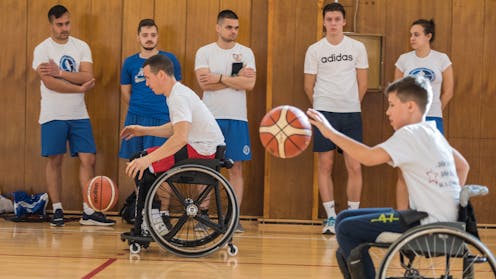
Grassroots disability clubs are vital to the health of para sports in Australia.
These local clubs give people with disabilities the chance to be active, which supports both physical and mental wellbeing.
Just as importantly, they provide places[2] where people can build friendships, feel included and develop a sense of belonging.
Many paralympians start their journey in these environments; they’re not just places to play sport, they’re key to developing future talent.
Current and former athletes have called[3] for more and better participation opportunities in adaptive sport.
Paralympian Leanne Del Toso called for more support[4] for women’s wheelchair basketball after Australia missed qualification for the Rio and Paris Olympics.
It shouldn’t be about funding, it shouldn’t be about access, it should be about equality.
The message is clear: we need to rebuild from the ground up, starting with a stronger and more supportive grassroots system.
Read more: If we truly want our Paralympic athletes to shine, their coaches need more support[5]
What are the main problems?
Australia’s para sports system is often fragmented and inconsistent, especially compared to mainstream sports such as swimming or athletics, which usually have national pathways, structured support and a clear line from beginner to elite.
But adaptive sports are often run in disconnected ways[6] across different states, clubs or organisations.
This system is often difficult to navigate[7] for aspiring athletes.
Another big part of the problem is the “mainstreaming” of adaptive sport: instead of creating separate systems designed specifically for people with disabilities, many sports fold disability sport into their existing structures.
While this can sound inclusive, it often creates problems.
Research shows[8] this approach can actually narrow who gets to participate.
Many organisations and leagues tend to follow a standard competitive model that doesn’t work for everyone, especially those with more complex needs[9].
Even well-meaning attempts at inclusion can backfire if they don’t involve people with disability.
That’s why researchers now believe adaptive sport only works when paired[10] with real disability-specific knowledge, community consultation and strong systems of accountability.
Without that, we risk reinforcing the very inequalities we’re trying to fix.
Another problem is the lack of participation data.
One of the main sources of sports participation data in Australia is the AusPlay survey[11].
This gives some insight into who is playing sport and being active, but it doesn’t give enough detail when it comes to disability sport.
For instance, while the AusPlay survey indicates 51% of adults with a disability engage in physical activity once per week, it lacks specificity regarding the activities these people participate in.
This makes it hard for policymakers, funders and sport organisations to make smart decisions, as they don’t have enough information about who is participating, where the gaps are or how things are changing over time.
With better data, we could target resources where they’re needed most, especially in communities that currently miss out.
Some possible solutions
If we want to fix these problems, we need a different approach.
That starts with co-design: involving people with disabilities in designing the systems, programs and policies that affect them.
It’s not just about asking for feedback, it’s about giving real decision-making power.
A great example of this is Wheelchair Sports NSW/ACT[12], which has embraced co-design[13] and made it a core part of its programs.
This has led to a 380% increase in membership over five years, and a record number of affiliated clubs[14] across their network.
This success shows what’s possible when sport organisations stop designing systems for people with disabilities and start designing with them.
When people feel valued and heard, they are more likely to get involved and stay involved.
Recent initiatives, such as the new para unit[15] launched by the Western Australian Institute of Sport (the original home of Australia’s Paralympic movement), demonstrate promising steps towards a more cohesive para sport system.
But grassroots sport isn’t about medals. While we all love to celebrate paralympic success, local sport has a much bigger role to play.
It helps people with disabilities stay healthy, feel included and connect with their communities[16]. It can change lives on and off the field.
As we look to Brisbane 2032, it’s clear paralympic success doesn’t start at the top. It starts in the community and on local fields.
If we invest now in grassroots sport and centre people with disabilities in the design and delivery of programs, we can create a stronger and more inclusive future for para sport in Australia.
The author would like to acknowledge the contributions of Mick Garnett to discussions on the future of adaptive sport in Australia[17].
References
- ^ lowest medal tally since 1988 (www.espn.com.au)
- ^ they provide places (www.tandfonline.com)
- ^ have called (www.abc.net.au)
- ^ called for more support (www.abc.net.au)
- ^ If we truly want our Paralympic athletes to shine, their coaches need more support (theconversation.com)
- ^ run in disconnected ways (www.tandfonline.com)
- ^ difficult to navigate (www.tandfonline.com)
- ^ Research shows (www.tandfonline.com)
- ^ especially those with more complex needs (www.tandfonline.com)
- ^ only works when paired (www.tandfonline.com)
- ^ the AusPlay survey (www.clearinghouseforsport.gov.au)
- ^ Wheelchair Sports NSW/ACT (www.wsnsw.org.au)
- ^ embraced co-design (www.linkedin.com)
- ^ record number of affiliated clubs (www.linkedin.com)
- ^ the new para unit (www.paralympic.org.au)
- ^ connect with their communities (pubmed.ncbi.nlm.nih.gov)
- ^ the future of adaptive sport in Australia (www.linkedin.com)
Authors: Katherine Raw, Lecturer, Sport Management, Swinburne University of Technology